Tag: Compliance & Regulations

  • Why Having a Lease Agreement with Your Landlord Is Essential for Tenants and Landlords

    Why Having a Lease Agreement with Your Landlord Is Essential for Tenants and Landlords

    In the rental world, a written lease agreement is far more than just paperwork. For tenants and landlords alike it becomes the foundation of a stable, transparent relationship. When drafted through a legal-tech tool like Wansom AI, the lease helps both sides understand rights, obligations, risks and rewards up front.

    In this article we explore why a proper lease agreement matters, what it must cover, how it benefits each party, and how you can use the free, printable template from Wansom to get started on the right footing.


    Understanding the Lease Agreement

    A lease agreement is a legally binding contract between a landlord and tenant. It sets the terms under which the tenant occupies the property and the landlord provides it. It defines rent amount, payment schedule, duration of tenancy, maintenance responsibilities, deposit rules, usage restrictions and many other critical details.

    Without such clarity, both parties are vulnerable: the tenant may face sudden rent hikes, unclear maintenance obligations, eviction risks; the landlord may face unpaid rent, property damage, ambiguous responsibilities.


    Why Lease Agreements Matter for Tenants

    Predictability and Financial Planning

    For a tenant, having a written lease means you know exactly how much rent you owe, when it’s due, and what your term is. You can budget. You can plan. You avoid surprises. As one article puts it: “tenants can benefit from the security of knowing they have a fixed place to live for a specific period of time.”

    Legal Protection

    A lease provides your rights in writing. If the landlord fails to keep the property in a habitable condition, or enters your dwelling without notice, you have a document that states agreed terms.

    Stability and Peace of Mind

    You don’t want to wake up one morning to find you’re being asked to vacate without cause. A lease gives you security for the term. Especially for families, professionals or anyone wanting some continuity, that matters.

    Clear Maintenance and Deposit Rules

    Many tenant-landlord disputes revolve around deposits and repairs. A lease addresses these up front: how much is the security deposit, under what conditions is it refunded, who handles repairs. This clarity saves headaches later.


    Why Lease Agreements Matter for Landlords

    Predictable Income

    As a landlord, you want to know your rental income is coming in, and that the tenant is obliged to pay. A signed lease establishes this. As one legal blog observes: “A lease can provide landlords with legal protection in the event of a dispute with a tenant.”

    Property Protection and Usage Control

    You own or manage a property. You need rules about how it’s used, whether pets are allowed, whether sub-letting is permitted, what repairs will or won’t be done. A lease gives you the power to set those. kirksimas.com+1

    Legal Backup in Disputes

    When something goes wrong—non-payment, damage, breach of terms—the lease is your evidence. It defines responsibilities and sets the path for enforcement. Without it you may be in an uncertain position.

    Reduced Turnover Costs & Administrative Burden

    A well negotiated lease often means fewer vacancies, fewer tenant changes, less advertising and fewer turnovers. That saves money and time. As noted in research around longer leases: “Reduced vacancy costs” and “lower administrative burden.”


    Key Clauses Your Lease Agreement Must Include

    To be effective, a lease must cover more than a handful of items. Here are the critical components every lease ought to include:

    • Names of parties – landlord (or agent) and tenant(s) with legal contact information.

    • Description of property – full address, unit number or portion, included amenities.

    • Term – start date and end date (or month-to-month if applicable).

    • Rent terms – amount, due date, accepted payment methods, late fees.

    • Security deposit – amount, condition, timeline for refund.

    • Maintenance & repairs – who handles what, which utilities are the tenant’s responsibility.

    • Rules of use – occupancy limits, pets, sub-letting, noise, alterations.

    • Entry and access terms – when landlord can enter, notice required.

    • Termination and renewal – notice periods, rights to renew, early termination consequences.

    • Dispute resolution & governing law – which jurisdiction applies, what happens in case of litigation.

    • Signatures – both parties sign and date the document.

    These clauses turn a lease from vague promise into enforceable contract. Many resources emphasise the need for written clarity around rent obligations, disclosure requirements and termination rights.


    Common Misconceptions and Pitfalls

    1. “We’ll just do a handshake deal”

    Informal tenancy arrangements may feel simpler, but they carry risk. Without a lease you may have no notice period, unclear rights and obligations, and little legal recourse.

    2. “Lease means the rent can’t change”

    While a lease locks in terms for the specified period, it doesn’t necessarily prevent legal or contractually-agreed increases (if you allow for escalation clauses). Also local laws may restrict changes even with a lease.

    4. “Landlord will always handle every repair”

    Not necessarily. Some leases assign major repairs to the tenant; some local jurisdictions allow landlords to off-load certain duties. Clarity upfront avoids fights.

    5. “Tenant can’t be evicted”

    Even with a written lease, failing to comply with terms (rent payment, damage, violating use) can result in termination or eviction under law. A lease gives you rights—but also obligations.


    How a Free Printable Lease Agreement Template Helps

    Using a well-designed lease template provides advantages:

    • You start from a structured, comprehensive document rather than blank page.

    • It reduces the chance you’ll leave out important clauses.

    • It gives both parties a professional, clear foundation—continuing the trust-building.

    • When integrated with a legal-tech tool like Wansom AI, you can customise the template for jurisdiction, property type, term length, and unique rules, then download in PDF or Word format for signature.

    In short: the template transforms the legal complexity of leases into something workable and user-friendly for both landlord and tenant.


    How to Use the Lease Template from Wansom AI

    1. Visit Wansom AI and choose the Residential Lease Agreement Template.

    2. Enter property details: address, unit, type (house, apartment, room).

    3. Enter term: fixed (e.g., 12 months) or month-to-month.

    4. Set rent: amount, due date, payment method, late fee.

    5. Security deposit: amount, condition, refund process.

    6. Maintenance and utilities: landlord vs. tenant responsibilities.

    7. Use rules: pets, smoking, guests, sub-letting.

    8. Review the draft document; tailor any clause unique to your situation.

    9. Download the document (PDF or Word). Get both parties to sign and retain copies.

    10. Keep a record—and refer to it in any future disagreements or clarifications.

    This workflow reduces legal ambiguity, promotes professional relationships and protects both parties.


    What Can Go Wrong Without a Lease

    Case 1: The Unwritten Agreement That Became a Dispute

    A tenant moves into a house based on a verbal promise of “rent at Ksh 40,000 a month until I tell you otherwise”. Three months in the landlord raises the rent, tenant objects, eviction follows. Without a written lease, the tenant has little legal recourse; the landlord’s position is weak but enforcing still becomes messy.

    Case 2: The Landlord Who Forgot the Use Clause

    An apartment owner rented the unit for residential use only. The tenant sub-leased it briefly to a small event company. Neighbours complained, landlord faced fines and eviction from the building manager. A lease including a clear “permitted use” clause would have helped guard against this risk.

    Case 3: The Deposit Dispute

    Tenant paid a deposit on a 6-month stay. At the end, landlord withheld the full amount citing “damage” though tenant claimed no damage beyond normal wear and tear. No clause spelled out deposit return timeline, condition expectations or inspection process—leading to mediation and legal cost for both sides.

    When you compare these scenarios to having a complete lease in place, the value of clarity becomes obvious.


    Long-Term Benefits for Both Parties

    For Tenants

    • Peace of mind about term and payment.

    • Clear standard of condition and maintenance responsibilities.

    • Formal protection if landlord fails to comply with terms.

    For Landlords

    • Predictable revenue, fewer surprises.

    • Clear rule-book for property usage and maintenance.

    • Legal evidence supporting enforcement when needed.

    Together, these benefits lead to more sustainable landlord-tenant relationships, fewer turnovers, fewer disputes, and more professional rental operations.


    Best Practices Before Signing the Lease

    • Read every clause. Don’t sign just because you’re told “it’s standard”.

    • Ask questions about anything unclear: payment terms, maintenance obligations, use restrictions.

    • Ensure legibility and completeness—names, dates, addresses, amounts must all be correct.

    • Document property condition (photos/video) at move-in; tie it to the lease or an addendum.

    • Keep a signed copy. Both parties should retain the document.

    • Plan for termination or renewal. The lease should say how either party can exit or extend.

    • Consider local law. In Nairobi or Kenya generally, check whether there are specific requirements for leases or disclosures.

    • Stay professional. A well-crafted lease signals respect on both sides and helps maintain trust.


    TL;DR

    In sum: a written lease agreement is a foundational tool in the rental relationship. It gives tenants clarity, protection and stability. It gives landlords predictability, legal support and property control. Without it, both sides risk confusion, disputes and lost time/money.

    Using a free, printable legal template from Wansom AI gives you a ready structure, ensures core clauses are included and allows you to customise for local law, property type and unique requirements. It is an investment of effort upfront, but pays dividends in fewer headaches, stronger relationships and better rental outcomes.

    Blog image

    Whether you are renting out your first property or moving into a new flat, spending time on a proper lease agreement is time well spent.


  • AI Bill of Rights: Everything You Need to Know

    AI Bill of Rights: Everything You Need to Know

    Artificial intelligence is no longer an abstract concept from science fiction—it’s embedded in nearly every sector of modern life. From accelerating medical breakthroughs to optimizing legal research and automating document review, AI has transformed how professionals work and make decisions.

    Yet as with any powerful technology, the same systems that unlock efficiency and insight can also create risk. Concerns over bias, privacy, surveillance, and accountability have driven the need for ethical frameworks that balance innovation with human rights.

    To address this, the White House Office of Science and Technology Policy (OSTP) introduced the Blueprint for an AI Bill of Rights in October 2022. This framework outlines how AI systems should be designed, deployed, and governed to protect people from harm while ensuring fair and responsible use.

    For legal professionals and organizations working with sensitive data, understanding this framework is essential. At Wansom, we see it as a guidepost for building AI tools that enhance human capability—without compromising privacy, fairness, or transparency.


    Key Takeaways:

    1. The AI Bill of Rights establishes five core principles to guide the ethical, transparent, and safe use of artificial intelligence.

    2. It emphasizes human oversight, data privacy, fairness, and accountability in automated decision-making systems.

    3. Though not legally binding, the framework shapes emerging AI regulations in the U.S. and globally.

    4. For legal teams, these principles ensure AI supports justice while protecting confidentiality and client rights.

    5. Wansom aligns with the AI Bill of Rights by building secure, responsible AI tools that empower—not replace—legal professionals.


    What Is the AI Bill of Rights?

    The AI Bill of Rights provides five key principles to guide the development and use of automated systems. These principles aim to protect civil and human rights as AI becomes more integrated into public and private life.

    The document isn’t legislation—it’s a policy framework that lays the groundwork for future regulation. But it has already begun shaping how organizations, including law firms and legal tech companies, approach AI ethics and governance.

    According to the OSTP, these guidelines should apply to any system that meaningfully impacts people’s rights, opportunities, or access to essential resources or services. In practice, that includes AI tools used in employment, healthcare, housing, education, and—crucially—law.


    The Five Core Principles of the AI Bill of Rights

    1. Safe and Effective Systems

    People deserve protection from unsafe or ineffective AI systems. Developers are encouraged to test models before deployment, engage diverse experts, and continuously monitor performance.
    For legal teams, this means relying on AI tools that have been rigorously validated for accuracy and compliance. Wansom’s platform, for instance, integrates human oversight throughout its workflows to ensure both performance and ethical integrity.

    2. Algorithmic Discrimination Protections

    AI should never amplify bias or discrimination. Systems must be designed to identify and mitigate unfair treatment arising from biased data or flawed logic.
    Equity testing, representative datasets, and accessibility features are vital. At Wansom, we align with this principle by ensuring our AI respects fairness across client interactions, case assessments, and research insights—helping legal teams uphold justice both in data and in practice.

    3. Data Privacy

    Individuals should have control over how their data is collected and used. AI systems should limit data collection to what’s necessary, protect sensitive information, and make privacy safeguards the default.
    This is central to Wansom’s mission. Our platform embeds privacy-by-design, maintaining strict confidentiality and compliance with data protection standards—so legal professionals can work confidently with privileged material.

    4. Notice and Explanation

    Users have the right to know when an automated system is in use and understand how it influences decisions. Transparency builds trust, especially in sectors like law where outcomes affect rights and livelihoods.
    AI explanations should be plain, accurate, and accessible. Wansom’s AI solutions are designed to be interpretable—providing clear insight into how recommendations or document drafts are generated.

    5. Human Alternatives and Accountability

    Even in an AI-driven world, humans must remain in control. The AI Bill of Rights emphasizes that users should be able to opt for human review or oversight when automation impacts critical decisions.
    Wansom mirrors this principle by combining machine precision with human judgment—ensuring lawyers and legal teams retain ultimate authority over their work.


    From Principles to Practice: The Path Toward AI Regulation

    While the AI Bill of Rights is not legally binding, it signals a growing movement toward responsible AI regulation. Subsequent actions, such as the Executive Order on the Safe, Secure, and Trustworthy Development and Use of Artificial Intelligence (2023), have built on its foundation.

    Under this order, AI developers must share risk-related safety test results with the U.S. government and follow new standards from the National Institute of Standards and Technology (NIST) to ensure trust and security.

    Several states have also enacted AI-specific laws—such as Colorado’s regulations on insurers using predictive models and Illinois’s rules on AI in hiring. These efforts collectively point to a new era of accountability and transparency in AI governance.

    Globally, similar frameworks are emerging:

    • European Union’s AI Act (2024): Introduces a risk-based classification of AI systems, banning those deemed “unacceptable.”

    • China’s AI Regulations (2023): Establish controls for generative AI and content management through the Cybersecurity Administration of China.


    Why Ethical AI Matters for Legal Teams

    In the legal profession, the stakes of AI misuse are especially high. Lawyers handle privileged data, interpret precedent, and influence real-world outcomes. The risks of bias, data misuse, or opaque decision-making aren’t just theoretical—they affect justice and trust.

    That’s why frameworks like the AI Bill of Rights are vital. They provide a moral and operational compass, ensuring that AI augments human expertise rather than undermines it.

    At Wansom, we believe AI should empower lawyers to work smarter—automating administrative burdens while safeguarding ethics and confidentiality. Our secure AI workspace helps teams draft, review, and research documents faster while maintaining full visibility and control over their data.


    Conclusion: Building Trustworthy AI for the Future

    The AI Bill of Rights isn’t merely an American policy initiative—it’s a signal of where the world is heading. It calls for a future where technology serves humanity, not the other way around.

    As governments refine regulations and organizations adopt ethical standards, one thing remains constant: AI must be built with transparency, fairness, and accountability at its core.

    At Wansom, these principles aren’t just theoretical—they define how we design, train, and deploy every AI feature we build. Our mission is to help legal teams harness the full power of AI responsibly, ensuring innovation never comes at the expense of trust.

  • Legal Aid Funding Application for Non-Profits  with Template

    Legal Aid Funding Application for Non-Profits with Template

    The bedrock of a just society rests on the principle of equal access to legal representation. Yet, the reality is a widening "justice gap," where millions of individuals and families lack the resources to secure the legal aid they desperately need. For non-profit legal services organizations, bridging this gap requires more than dedication; it demands sustained, predictable funding.

    Securing multi-year grants from governmental bodies, private foundations, and key funding agencies (such as the Legal Services Corporation, or LSC, in the US context) is not merely a matter of good intentions—it is a highly competitive, meticulously procedural, and complex exercise in legal compliance and strategic communication. A single error in a Legal Aid Funding Application can mean the difference between providing vital services and shutting down operations.

    This definitive guide is engineered for non-profit Executive Directors, Grant Writers, Legal Aid Attorneys, and Board Members. We will dissect the essential components of a successful Legal Aid Funding Application, reveal the strategic imperatives that distinguish winning proposals, and demonstrate how Wansom’s AI-powered collaborative workspace provides the industry-leading Legal Aid Funding Application for Non-Profits Template to streamline compliance, maximize scoring, and secure the resources your clients deserve.


    Key Takeaways:

    1. A winning legal aid application must simultaneously demonstrate impeccable organizational capacity, statistically proven community need, and quantifiable legal impact.

    2. Funders, especially governmental bodies, prioritize measurable outcomes (like client housing retention) over simple service volume outputs.

    3. Strategic grant drafting requires using the funder’s exact programmatic keywords to ensure compliance and maximize scoring against internal rubrics.

    4. The application's Budget and Financial Sustainability section must show detailed line-item costs and evidence of revenue diversification for long-term stability.

    5. The most common reason for rejection is misalignment between the documented community need and the program methodology proposed to solve it.


    What is a Legal Aid Funding Application?

    A Legal Aid Funding Application is a formal, highly detailed grant proposal submitted by a non-profit organization to secure financial resources—typically multi-year funding—for the purpose of providing free or low-cost civil legal services to indigent or underserved populations. Unlike general non-profit grants, these applications are distinguished by their focus on legal compliance, ethical case handling, and stringent reporting on legal outcomes. The application must prove three core tenets: (1) Organizational Capacity (the ability to manage legal funds compliantly), (2) Documented Need (statistical evidence of the justice gap in the service area), and (3) Measurable Legal Impact (the specific, quantifiable relief achieved for clients, such as secured housing or resolved benefits cases). It is the foundational document that establishes a non-profit's right to receive and responsibly manage public and private funds dedicated to the cause of justice.


    Understanding the Legal Aid Funding Ecosystem and the "Justice Gap"

    Before tackling the application itself, an applicant must demonstrate a profound understanding of the financial ecosystem and the documented need it aims to address. Grant funding bodies are not simply looking to donate; they are looking to invest in measurable, high-impact solutions to a systemic problem.

    The Critical Need: Quantifying the Justice Gap

    The "justice gap" refers to the massive difference between the civil legal needs of low-income individuals and the resources available to meet those needs. This gap underpins the entire funding rationale.

    • Civil Legal Needs: These include critical issues like housing instability (eviction defense), domestic violence protection, ensuring veterans' benefits, and fighting employment discrimination.

    • The Funding Challenge: Federal, state, and foundational funding sources are perpetually insufficient to meet the demand. This creates intense competition among legal aid providers, making the quality of the funding application the single most important factor for success.

    Primary Funding Sources for Legal Aid

    A successful non-profit typically relies on a diversified funding portfolio. The template must be adaptable to multiple primary sources, as their reporting and compliance standards often cross-pollinate.

    Funding Source

    Focus & Compliance Priority

    Wansom Template Application

    Federal/Governmental

    Strict compliance with administrative and financial rules (e.g., LSC restrictions, specific program mandates). Emphasis on data and outcomes.

    Templates include required government forms (SF-424, etc.) and pre-drafted assurances.

    State & Local Government

    Alignment with state-specific priorities (e.g., foreclosure prevention, specific immigration issues). Strong emphasis on local community impact.

    Sections dedicated to defining the Geographic Service Area (GSA) and local partnerships.

    Private Foundations

    Clear, compelling narrative and mission alignment. Focus on innovation, pilot programs, and long-term sustainability.

    Template structure enforces powerful storytelling and logical flow from "Need" to "Impact."

    To succeed, your application must simultaneously demonstrate impeccable financial compliance (for governmental sources) and a compelling, mission-driven narrative (for private foundations).

    Related Blog: Maintaining Your Non-Profit Status: Essential Annual Legal Compliance Checklists


    Dissecting the Five Core Components of a Winning Application

    Every robust Legal Aid Funding Application for Non-Profits is built around five non-negotiable sections. Wansom’s template simplifies the process by providing structured fields and compliant language for each.

    Organizational Capacity and Governance

    Funders want confidence that the money will be managed ethically and effectively. This section is not just a formality; it is an assessment of fiduciary risk.

    • Legal Standing: Proof of current 501(c)(3) (or equivalent) status, articles of incorporation, and IRS determination letter.

    • Board & Leadership: A clear outline of the Board of Directors, ensuring demographic representation of the target community and professional expertise (legal, financial, community).

    • Staffing Plan: Detailed organizational chart, demonstrating sufficient qualified legal and administrative staff to execute the proposed program. Funders will heavily scrutinize the lawyer-to-client ratio.

    Wansom Template Advantage: The template includes a section for Governance Assurances, providing pre-vetted language affirming conflict of interest policies, non-discrimination clauses, and financial oversight protocols—standard requirements for major legal aid grants.

    Need Assessment and Target Population Analysis

    This section establishes the gravity of the problem and the specific population being served. It requires data, not anecdotes.

    • Defining Need: Statistical evidence (e.g., US Census data, poverty rates, eviction filing rates) justifying the program's existence in the proposed service area.

    • Eligibility Criteria: Clear definition of who qualifies for aid (e.g., 125% of the Federal Poverty Guidelines) and verification methods.

    • Underserved Communities: Identification of specific groups facing disproportionate barriers (e.g., rural populations, non-English speakers, elderly).

    Program Design, Methodology, and Service Delivery

    This is the "how" of your proposal. It must be logical, repeatable, and align directly with the stated need.

    • Service Model: Detailed description of the legal services provided (e.g., full representation, brief advice, pro se clinics).

    • Case Selection Process: How cases are prioritized to maximize impact and align with funding mandates (e.g., preference for high-impact systemic cases over low-impact individual cases).

    • Collaboration: Proof of partnerships with other community organizations (social services, shelters, food banks) to provide holistic support, a key metric for many foundations.

    Budget and Financial Sustainability

    The budget is where most applications fail. It must be detailed, reasonable, and fully align with the narrative.

    • Line-Item Detail: A multi-year budget showing personnel costs (salaries, benefits), operating expenses, and specific program costs. Personnel costs must be justifiable and tied to the approved staffing plan.

    • Revenue Diversification: Evidence that the non-profit is not solely reliant on this single grant. This demonstrates long-term stability and a commitment to fundraising.

    • Budget Narrative: A written justification explaining every major expense, translating numerical data into clear, persuasive prose.

    Wansom Template Advantage: Wansom integrates an auto-calculating, customizable budget appendix compatible with standard federal grant formats. It flags potential issues like excessive administrative overhead (a common red flag for LSC-type grants) before submission.

    Evaluation Metrics and Impact Reporting

    Funders demand quantifiable proof of success and accountability. The application must define success upfront.

    • Outputs vs. Outcomes: A clear distinction must be made:

      • Outputs: The volume of service (e.g., 500 clients served, 3 systemic lawsuits filed).

      • Outcomes: The measurable impact (e.g., 85% of clients maintained housing, 90% of domestic violence victims secured protection orders).

    • Data Collection Plan: Description of the system (e.g., case management software) used to track outputs and outcomes, assuring the funder that reporting will be accurate and timely.

    Related Blog: The Role of the Legal Non-Profit Board: Governance and Fiduciary Duty


    Strategic Drafting: Leveraging SEO Principles for Grant Proposals

    As a legal content strategist, we understand that grant writing, at its heart, is persuasive technical writing. Applying the precision and keyword alignment of SEO content ensures your proposal is not only compliant but also highly scorable.

    Precision in Programmatic Keywords

    Funders often use internal scoring rubrics and may even use software to scan applications for specific programmatic language.

    • Aligning Language: Do not merely describe your work; use the funder's exact terminology. If a grant seeks to fund “Eviction Diversion Programs,” use that phrase, not just “housing help.”

    • The Problem/Solution Loop: Ensure every program component directly addresses a data point mentioned in the Need Assessment and Target Population Analysis. This creates a tight, defensible logic: "Because 40% of our population faces unrepresented eviction (Need), our Eviction Diversion Program (Solution) will achieve a 75% housing retention rate (Outcome)."

    Narrative Flow and Scannability

    Reviewers often handle hundreds of applications. Clutter and complexity lead to fatigue and lower scores.

    • Active Voice: Use direct, active language (e.g., "The team will achieve this objective" rather than "This objective will be achieved by the team").

    • Logical Headings: Use Wansom’s template structure, which utilizes clear, mandated headings to ensure easy navigation for the reviewer, allowing them to quickly find required information.

    • Brevity and Conciseness: Every word must earn its place. Wansom’s template encourages concise drafting by providing pre-written transitional and compliance language, saving space for your unique program details.

    Compliance Cross-Check: The Wansom AI Edge

    The most significant risk in legal aid applications is the failure to cross-reference multiple mandatory assurances and budget constraints.

    • Automated Rubric Alignment: Wansom’s template includes an optional feature that allows the user to input the funder's specific scoring rubric (e.g., 20 points for "Sustainability," 30 points for "Demonstrated Need"). The system then checks the drafted text against these criteria, flagging areas where the narrative is weak or missing the key programmatic keywords.

    • Assurance Validation: Legal aid grants often require dozens of assurances (e.g., a promise not to engage in political lobbying, a commitment to civil legal services only). The Wansom template pre-populates these complex sections and uses AI to ensure your program description doesn't inadvertently violate a core assurance, a common cause for administrative rejection.

    Related Blog: Persuasive Legal Writing: How to Build an Irrefutable Case Narrative


    Wansom’s Legal Aid Funding Application Template: Features and Advantages

    Wansom’s template is specifically engineered to address the administrative burden and compliance complexities inherent in legal aid grant applications, transforming a weeks-long drafting process into a streamlined, high-confidence submission.

    Modular and Adaptable Structure

    Grant applications are rarely a single, continuous document. They are a collection of modules (Narrative, Budget, Assurances, Attachments) that must interlock perfectly.

    • Modular Design: The Wansom template is broken down into these distinct, editable modules, ensuring that changes in one area (e.g., the staffing plan) automatically update relevant sections in the budget and the organizational capacity narrative.

    • Funder-Specific Variants: The template includes variants optimized for different primary funders (e.g., LSC-Style Compliance Focus, Private Foundation Narrative Focus), allowing the non-profit to quickly switch templates to match the grant opportunity.

    Integrated Budget and Financial Form Generation

    Handling the financial forms (like the SF-424, Budget Summary, and Budget Detail) is often the most time-consuming and error-prone step.

    • Dynamic Data Fields: Users input financial data into a central sheet within the Wansom workspace. This data then automatically populates all required financial forms and dynamically generates the written Budget Narrative, eliminating transposition errors.

    • Compliance Flagging: The system is programmed with common legal aid administrative overhead limits. If the administrative expenses exceed a percentage (e.g., 15-20% of the total budget), the template flags it as a high-risk area, prompting the user to either reduce the cost or provide a strong, defensible written justification.

    Collaborative Review and Version Control

    Given the number of stakeholders involved (Executive Director, Finance Officer, Board Chair, Program Manager), collaboration is essential, but it introduces the risk of conflicting edits.

    • Secure Legal Workspace: Wansom provides a dedicated, secure collaborative workspace. All team members can review and comment in real-time without the risk of version mismatch or accidental deletion of critical legal clauses.

    • Immutable Audit Trail: Every edit, every change in a programmatic assurance, and every approval is logged with an Immutable Audit Trail. This is crucial for demonstrating organizational diligence and compliance if the funding body requires an audit of the application process itself.

    Related Blog: Secure AI in Legal: Automating Document Review for Legal Teams


    Common Pitfalls and Rejection Avoidance in Legal Aid Grant Writing

    Even with the right template, vigilance is necessary. The most competitive applications are often rejected for preventable errors related to precision and alignment.

    Misalignment Between Need and Program

    The most fundamental flaw is proposing a solution that does not logically address the documented need.

    • Pitfall Example: The Needs Assessment shows a critical need for landlord-tenant dispute resolution, but the Program Design focuses heavily on consumer debt litigation.

    • Wansom Solution: The template forces a tight narrative loop, requiring the user to explicitly draw a line from the data in the Need Assessment to the methodology in the Program Design, highlighting any gaps in logic.

    Weak or Undefined Outcomes

    Funders are moving away from simply counting "inputs" (money spent) or "outputs" (clients seen). They demand measurable outcomes.

    • Pitfall Example: Stating the goal is "to provide access to justice."

    • Wansom Solution: The template forces the use of SMART goals (Specific, Measurable, Achievable, Relevant, Time-bound). Example: "By the end of the funding period, the Housing Stability Program will increase the rate of client housing retention from the baseline of 60% to 80%."

    Incomplete Assurances and Attachments

    Federal and large foundation applications require numerous, often redundant, forms and legal assurances. Missing even one form or checkbox is grounds for automatic administrative rejection.

    • Pitfall Example: Failing to include the required Lobbying Certification form or neglecting to update the list of current grant awards (a critical part of the revenue diversification proof).

    • Wansom Solution: The template includes a Mandatory Attachment Checklist that dynamically updates based on the application type selected, ensuring 100% submission completeness.

    Related Blog: Grant Audit Readiness: Best Practices for Non-Profit Financial Compliance


    Post-Award Compliance and Long-Term Sustainability

    A successful grant award is not the end of the legal compliance journey; it is the beginning of the reporting and grant management cycle, which directly impacts the ability to secure future funding.

    Rigorous Financial Tracking

    Grant funds must be segregated and tracked meticulously according to the approved budget. This is particularly true for governmental grants, which often prohibit commingling of funds with non-grant activities.

    • Template to Tracker Integration: The budget generated by the Wansom template serves as the foundation for the organization's internal grant tracking system, ensuring the categorization of expenses remains consistent from application to audit.

    The Performance Reporting Cycle

    Accurate, timely performance reports (quarterly or semi-annually) are non-negotiable.

    • Reporting Consistency: The metrics defined in the Evaluation Metrics and Impact Reporting section must be the exact metrics used in all subsequent reports. The template ensures this consistency by providing the language and the framework for future reporting documents.

    Cultivating the Funder Relationship

    The quality of compliance and reporting determines the likelihood of securing renewal funding. A non-profit that is easy to audit and consistently meets or exceeds its projected outcomes is far more likely to receive a favorable review in the next cycle. By using a robust, legally sound template, you establish yourself as a low-risk, high-impact investment partner.

    Related Blog: The Definitive Guide to Legal Aid Performance Reporting and Metrics

    Related Content

    To further strengthen your application strategy and ensure the long-term governance of your non-profit legal organization, we recommend reviewing our complementary guide:


    Conclusion:

    The challenge of obtaining legal aid funding is a complex fusion of advocacy, data analysis, and regulatory compliance. Non-profit organizations are fighting for social justice with one hand and battling administrative paperwork with the other. The key to securing stable, life-saving funding is to eliminate the administrative and compliance risk that leads to grant rejection.

    Wansom’s Legal Aid Funding Application for Non-Profits Template offers the strategic advantage your organization needs. By automating the integration of financial data, enforcing compliance with programmatic assurances, and providing an auditable, collaborative workspace, Wansom ensures your program narrative is clear, your budget is sound, and your application is submission-ready. Stop wasting precious lawyer time on administrative formatting and start focusing on the core mission.

    Ready to secure your non-profit’s financial future with a flawlessly compliant application?

    Blog image

    Customize and download Wansom's AI-validated Legal Aid Funding Application Template now and transform your proposal strategy.

  • Sectional Properties Plan Template with Examples

    The evolution of land tenure in modern development—moving from traditional freehold deeds to the complex segmentation required by high-density projects—has created a critical need for precision in legal drafting. For developers, legal firms, surveyors, and financiers, the success of any multi-unit project hinges on one document: the Sectional Properties Plan (SPP).

    The SPP is the definitive legal blueprint that transforms a single parcel of land into a collection of individual, legally distinct unit titles and shared Common Property. Errors in its drafting, particularly in the complex calculation of Unit Factors or the delineation of boundaries, lead to immediate rejection by the Land Registry, generating costly delays, litigation, and financial instability for the entire development.

    This comprehensive guide is an authoritative resource for legal counsel, conveyancers, and property developers. We will detail the mandatory legal requirements of a compliant SPP under modern Sectional Properties Act frameworks, explore critical compliance pitfalls, and demonstrate how Wansom’s AI-powered collaborative workspace provides the definitive Sectional Properties Plan Template to guarantee accuracy, accelerate registration, and safeguard your client’s investments.


    Key Takeaways:

    1. The Sectional Properties Plan (SPP) is the mandatory legal blueprint that converts a single parcel of land into individual Unit Titles and defines Common Property.

    2. The Unit Factor (UF) is the most critical element of the SPP, governing maintenance levies, voting rights, and proportional ownership interest in the scheme.

    3. SPP registration often fails due to simple errors in the UF calculation, inconsistency between legal documents, or missing statutory declarations like Lender/Chargee Consent.

    4. Wansom’s template automates compliance by performing AI-driven reconciliation of the Unit Factor and integrating the By-Laws and Owners’ Management Company documents.

    5. A fully compliant and registered SPP forms the foundation for secure conveyancing and serves as the primary evidence in future disputes over Common Property boundaries or maintenance allocations.


    What is a Sectional Property Plan?

    The Sectional Properties Plan (SPP) is the core statutory document required under the Sectional Properties Act (SPA) to legally subdivide a single parcel of land or a building into multiple, distinct ownership units. It is essentially the legal blueprint that governs a multi-unit development, such as an apartment block, townhouse scheme, or mixed-use complex. The SPP has two primary functions: first, it defines the precise physical and legal boundaries of each Unit Title, granting the owner secure tenure over a specific space. Second, it officially designates and allocates ownership rights over all shared amenities and structures known as Common Property, utilizing the crucial Unit Factor to determine each owner's interest and contribution. Lodging a compliant SPP with the Land Registry is the prerequisite for issuing individual Unit Titles.

    Defining the Sectional Properties Landscape

    To understand the critical role of the Sectional Properties Plan, one must first understand the legislation it enforces. The Sectional Properties Act (SPA) represents a necessary legal shift away from archaic systems that struggled to accommodate contemporary vertical and horizontal subdivision, such as apartments, townhouses, and business parks.

    Historically, multi-unit properties were often managed through systems of long-term leases (e.g., 99-year or 50-year leases) granted over a share certificate or management company structure. This convoluted arrangement created financial friction, complicated resale, and offered limited true ownership security to the unit holder.

    The Sectional Properties Act provides a clear, robust legal framework for the creation of Unit Titles. A Unit Title is a clean, statutory form of ownership over a specific, defined physical space within a larger structure. The SPP is the instrument that legally creates these units.

    The Shift from Leases to Titles

    The transition to unit titles is driven by three key benefits:

    • Security of Tenure: A unit owner receives a title deed, granting the same security as traditional land ownership, rather than a mere leasehold interest.

    • Simplified Conveyancing: The process of transferring ownership (conveyancing) becomes simpler, faster, and more efficient, reducing transaction costs and risk.

    • Clarity on Common Property: The SPP mandates clear demarcation and allocation of ownership rights over shared assets, eliminating ambiguity that often led to disputes in older leasehold schemes.

    If you are involved in a new development or assisting with the conversion of an existing scheme, understanding the absolute necessity of a legally compliant Sectional Properties Plan Template is the first step toward successful registration.


    Mandatory Components of the Sectional Properties Plan (SPP)

    The Sectional Properties Plan is a specific technical document prepared by a Licensed Surveyor. While technical in nature, its contents are legally prescribed and must be accurate down to the millimeter. Any discrepancy between the physical structure and the plan is grounds for rejection by the Registrar.

    A compliant SPP is required to contain, at a minimum, the following mandatory elements. These elements form the structure of any authoritative Sectional Properties Plan Template.

    1. Defining the Boundaries and Extent

    The plan must start with a detailed mapping of the land itself and its relationship to the proposed units.

    • Location and Site Boundaries: A clear, precise drawing of the external boundaries of the entire parcel of land based on the official survey records.

    • Building Location: The plan must accurately position the structure(s) on the land parcel, showing setback compliance and integration with the overall site plan.

    • Easements and Encumbrances: Any pre-existing legal restrictions, rights-of-way, or easements affecting the land must be clearly noted on the plan to ensure transparency for future unit holders.

    2. Delineation of Units

    This is the core purpose of the SPP. It must provide a crystal-clear, three-dimensional definition of each unit.

    • Floor Plans and Elevations: Detailed drawings of every floor, showing the perimeters of each unit. The plan must use metes and bounds or equivalent survey markers to legally define the unit's boundaries.

    • Horizontal and Vertical Boundaries: The plan must explicitly state that the boundaries of a unit are the mid-point of the walls, floors, and ceilings bounding the unit. This is critical for determining who is responsible for structural maintenance and repairs.

    • Unit Numbering: A systematic, unique numbering system must be applied to every single unit on the plan, correlating directly to the Unit Title Register.

    3. The Declaration of Common Property

    The SPP must clearly differentiate between the privately owned units and the Common Property, which is collectively owned by all unit holders.

    • Definition: Common property includes structural components (foundations, load-bearing walls, roof, external facades), shared amenities (swimming pools, gyms, lifts, stairwells, lobbies), and the remainder of the land outside the unit perimeters.

    • Exclusive Use Areas: The plan must also delineate any Limited Common Property—areas designated for the exclusive use of one or more units but legally defined as Common Property (e.g., balconies, private gardens on the ground floor, or assigned parking spaces).

    4. The Critical Unit Factor (UF)

    The Unit Factor is arguably the most complex and litigated aspect of the SPP. It is the percentage or fraction that determines the unit owner's collective interest in the Common Property.

    • What the UF Governs:

      1. Maintenance Levies: The amount of service charge or maintenance fees payable by the unit owner.

      2. Voting Rights: The weight of the unit owner's vote in the Owners' Management Company or Corporation.

      3. Share in Proceeds: The unit owner’s proportional share if the entire property is eventually sold, destroyed, or acquired.

    • Calculation Basis: The Unit Factor must be determined according to the floor area of the unit, or another method explicitly sanctioned by the Act and justified on the plan (e.g., value, size, or utility). The total of all Unit Factors must mathematically equal 100% or 1/1. Any mathematical error, even slight, will result in rejection.


    Legal and Regulatory Hurdles in SPP Registration

    Drafting the Sectional Properties Plan is a multi-disciplinary challenge requiring seamless collaboration between the surveyor and the legal counsel. Failure to coordinate these two streams is the leading cause of rejection by the Registrar.

    1. Required Statutory Declarations

    The SPP cannot be registered without specific legal certifications attached, which serve as proof of compliance and accuracy.

    • Surveyor’s Certificate: A formal statement by the Licensed Surveyor or Architect, affirming that the SPP is a true and accurate depiction of the physical building and land, and that it complies with all planning approvals and zoning requirements.

    • Developer’s Declaration: A statutory declaration by the developer (or their authorized representative) confirming that all legal requirements of the SPA have been met, including the sale of units and adherence to the building’s approved plans.

    • Lender/Chargee Consent: If the underlying parcel of land is charged (mortgaged), the chargee (lender) must provide formal written consent to the conversion of the title and the filing of the SPP, acknowledging the shift from a charge over the single parcel to charges over the new unit titles. This is a common bottleneck in the conversion of older schemes.

    2. The Pitfall of the Unit Factor Calculation

    While the Unit Factor calculation seems straightforward—based on floor area—it becomes highly complex when dealing with different unit types, exclusive use areas, and commercial components.

    Common Unit Factor Errors that Lead to Rejection:

    Error Type

    Description

    Legal Consequence

    Mathematical Inaccuracy

    Total of all UFs does not equal 100% or 1/1.

    Immediate rejection; entire plan is deemed void.

    Inconsistent Basis

    Using floor area for some units and value for others without legal justification.

    Fee disputes and potential litigation from future unit holders.

    Exclusion of Limited Common Property

    Failing to assign UF weight to exclusive-use balconies or patios, leading to unfair levy distribution.

    Owner objections and difficulties in managing shared costs.

    Wansom’s Sectional Properties Plan Template is equipped with internal AI validation logic that automatically cross-checks the declared unit areas against the total area and the final Unit Factor declaration, providing an instant alert if the totals do not reconcile. This essential feature eliminates the most frequent and costly administrative error in SPP drafting.

    3. Timing and Coordination with the Registry

    The timing of filing the SPP is critical, particularly when converting existing schemes where unit leases are still in effect. The law often requires a simultaneous action:

    1. Filing the SPP: Lodging the plan with the Registrar.

    2. Closing the Old Register: The Registrar must close the old register (the single parcel title) and formally open the Unit Title Register.

    3. Issuing Unit Titles: The new unit titles are issued to the respective owners or the developer, ready for transfer.

    Delay or misfiling at this stage can result in a legal limbo, where the title is neither fully old nor fully new, causing a temporary freeze on property transactions.

    Sectional Properties Plan Template Examples and Scenarios

    A single template cannot fit all scenarios, but a compliant Sectional Properties Plan Template must be flexible enough to handle the three most common development types while maintaining strict adherence to the SPA requirements.

    Scenario 1: The Standard Residential Apartment Block

    This is the most common application. The key complexity here is accurately distinguishing between the unit interior and the structural Common Property.

    • Unit Boundaries: Clearly defined by the interior surface paint layers, with all structural walls, beams, columns, and slabs designated as Common Property.

    • Common Property Examples: Lifts and their shafts, staircases, main corridor walls, the building roof, the foundation, all service ducts, and the security gatehouse.

    • Unit Factor Basis: Typically based purely on the measured square meterage (or footage) of the habitable interior area of the unit.

    Scenario 2: The Townhouse or Duplex Scheme

    In horizontal developments (townhouses), the demarcation of Common Property is often simpler but must be clearly defined on the ground.

    • Unit Boundaries: Defined by the boundaries of the structure itself, often including the internal plot of land immediately surrounding the unit (e.g., a small private garden), which must be delineated as Limited Common Property.

    • Common Property Examples: Access roads, external perimeter fencing, utility service connections outside the unit boundary, and the communal children’s playground or sports court.

    • Limited Common Property: The plan must legally define the unit's parking spot(s) and private garden as Limited Common Property (exclusive use), not as part of the Unit Title itself, ensuring they are subject to management company rules but remain for the unit owner's use.

    Scenario 3: Mixed-Use Commercial and Residential Developments

    This scenario introduces the highest level of complexity and risk, as different unit types often have fundamentally different values and uses for the Common Property.

    • Sub-Allocation of Common Property: The SPP must allow for the creation of two or more distinct classes of Common Property (e.g., Residential Common Property and Commercial Common Property).

    • Unit Factor Complexity: The Unit Factor must be weighted to ensure that commercial owners pay a higher proportion of the maintenance for common areas they predominantly use (like loading docks or high-speed lifts), while residential owners contribute fairly to residential-only common areas (like residential lobbies or roof terraces).

    • Wansom Template Solution: The Wansom Sectional Properties Plan Template includes pre-validated clauses and input fields that enable the legal drafter to justify and define weighted Unit Factors based on use, value, or area, ensuring the final document is legally sound and resistant to owner disputes.


    Automating Compliance with Wansom’s Template

    For high-volume conveyancing departments and legal teams advising property developers, the manual creation and validation of the Sectional Properties Plan and its accompanying legal documents (Memorandum & Articles of Association for the Management Company, By-Laws) is a time-sink and a liability risk.

    Wansom’s AI-powered template is not just a fill-in-the-blanks document; it’s a dynamic drafting environment built to enforce regulatory compliance for Sectional Property matters.

    5.1. Dynamic Unit Factor Calculation and Verification

    As discussed, mathematical errors in the Unit Factor are a primary reason for Plan rejection.

    • AI-Driven Reconciliation: The Wansom template allows the surveyor/legal team to input the area data for all units and the common property. The AI engine automatically calculates and generates the fractional Unit Factor for each unit and performs an instant 1/1 or 100% check.

    • Basis Justification: If a Unit Factor is calculated on a basis other than simple floor area (e.g., based on the value in a mixed-use scenario), the platform automatically inserts the correct statutory justification language into the draft plan, protecting the developer from subsequent legal challenge.

    5.2. Integrated By-Laws and Management Documents

    The SPP is only one part of the legal structure. The development must also have a set of By-Laws and a structure for the Owners’ Management Company (OMC) or Corporation.

    • Mandatory Document Generation: Wansom’s template suite integrates the SPP with the required OMC documentation. Once the SPP data (Unit Factors, Unit Descriptions) is entered, the platform dynamically drafts:

      • The mandatory By-Laws governing conduct and use of common property.

      • The Memorandum and Articles of Association for the OMC, incorporating the Unit Factors as the basis for member voting rights.

    This eliminates the risk of inconsistency between the core legal documents of the development.

    5.3. Immutable Audit Trail and Version Control

    In the event of a dispute over Common Property boundaries or Unit Factor allocation, having a clear, time-stamped record of the document’s drafting process is invaluable.

    • Secure Collaboration: The Wansom collaborative workspace logs every edit, review, and approval of the Sectional Properties Plan. This Immutable Audit Trail provides legally defensible proof of the diligence and compliance steps taken during the drafting process.

    • Version Management: The platform manages all iterations of the SPP draft, ensuring that only the Registrar-approved version is utilized in conveyancing, preventing the distribution of uncertified or outdated plans.

    By automating these compliance checks, Wansom transforms the complex, high-stakes task of drafting an SPP into a streamlined, low-risk process. Legal teams can confidently lodge plans with the assurance that all mathematical, procedural, and statutory declarations are correctly incorporated.

    6. Conveyancing and the Sectional Properties Plan: Post-Registration

    The SPP’s legal life extends far beyond its initial registration. It forms the foundation for all subsequent conveyancing transactions related to the unit title.

    6.1. The Deed of Transfer

    When a unit is sold, the Deed of Transfer must explicitly reference the registered Sectional Properties Plan by its official registration number and the specific unit number as defined in the plan.

    • Accurate Cross-Referencing: Wansom templates ensure that all subsequent Deeds and transfers automatically pull the correct plan and unit references, eliminating manual data entry errors that could cloud the unit's title.

    6.2. Disputes Over Common Property

    Even after registration, disputes often arise over the use, maintenance, or boundary of Common Property.

    • The SPP as Primary Evidence: The registered SPP is the ultimate source of evidence in these disputes. Whether a boundary is the midpoint of a wall or the inner surface of the unit is settled by the definitions contained within the plan.

    • Unit Factor Challenges: Disputes over maintenance fees or voting rights directly challenge the Unit Factor declared in the SPP. Having a mathematically accurate, legally justified Unit Factor (as validated by the Wansom system) is the strongest defense against such litigation.

    6.3. Termination of the Sectional Property Scheme

    In rare cases (e.g., total destruction or compulsory acquisition), the entire scheme may be terminated. The SPP dictates the proportional ownership for the distribution of compensation.

    • Distribution based on UF: Upon termination, compensation proceeds are distributed to unit holders strictly in accordance with their Unit Factor as recorded in the SPP. This underscores why the accuracy of the Unit Factor is not merely an administrative detail but a fundamental financial protection for the unit owner.

    Conclusion: 

    The Sectional Properties Plan is the single most critical document in modern property development. It is the bridge between a surveyor’s technical drawing and a legally recognized Unit Title. The stakes are immense: an error-free SPP means immediate registration and clear ownership; an error-ridden SPP means costly rejection, project delays, and potential litigation.

    For legal professionals, relying on manual drafting or generic templates for the SPP and its crucial Unit Factor calculations is an unacceptable risk. Wansom’s AI-powered Sectional Properties Plan Template provides the security, compliance validation, and automation necessary to navigate this complex legal framework.

    By integrating mandatory legal requirements, performing instant mathematical checks, and ensuring alignment with related management documents, Wansom empowers you to lodge your SPPs with confidence, secure your client’s title, and safeguard your practice's reputation. Eliminate administrative uncertainty and accelerate your conveyancing process.

    Ready to ensure your next Sectional Properties Plan is 100% compliant and submission-ready?


    FAQs on Sectional Properties Plans

    1. What is the Sectional Properties Act (SPA)?

    The Sectional Properties Act is modern legislation designed to govern the ownership of units in multi-storey or multi-unit developments. It allows for the subdivision of buildings into individual Unit Titles (private ownership) and Common Property (shared ownership), replacing older, more complex leasehold and share certificate systems.

    1. Who is responsible for drafting the Sectional Properties Plan (SPP)?

    The SPP must be prepared and certified by a Licensed Surveyor or an equivalent accredited professional (such as a Registered Architect in some jurisdictions). However, the legal team (conveyancer) is responsible for ensuring the plan meets all statutory legal requirements regarding the declaration of Unit Factors, Common Property, and accompanying legal documentation.

    1. What is the Unit Factor, and why is it so important?

    The Unit Factor is the mathematical fraction or percentage that defines a unit owner’s interest in the Common Property. It is essential because it determines: 1) the unit owner's share of maintenance levies and service charges, and 2) the weight of their vote in the Owners' Management Company. Errors in calculating the Unit Factor are a primary cause of SPP rejection and future legal disputes.

    1. Can an existing building be converted into a Sectional Properties Scheme?

    Yes. The Sectional Properties Act typically includes provisions for converting existing leasehold or company share schemes into a Unit Title scheme. This involves filing a new, certified SPP for the existing structure, a formal application to the Registrar, and often requires obtaining consent from any existing chargees (lenders).

    1. What happens if the Sectional Properties Plan is rejected by the Registrar?

    Rejection usually occurs due to mathematical errors in the Unit Factor, missing signatures/declarations (especially the Surveyor's Certificate or Chargee's Consent), or inconsistencies with planning approvals. Rejection halts the transfer of unit titles, leading to significant project delays, increased costs, and potential financial distress for the developer and buyers. This is why using an automated, compliance-checked template is crucial.

  • Disability Representative Appointment Form with Template

    Disability Representative Appointment Form with Template

    For legal teams specializing in Social Security Disability (SSD) and Supplemental Security Income (SSI) claims, the Appointment of Representative (Form SSA-1696) is the single most critical document initiating the attorney-client relationship. This form is not merely an administrative checkbox; it is the legal instrument that:

    1. Grants a representative (attorney or non-attorney advocate) formal authority to act on behalf of a claimant.

    2. Sets the mandatory framework for the contingency fee agreement, which is strictly regulated by the Social Security Administration (SSA).

    3. Establishes the communication pipeline between the legal firm and the SSA’s various offices, from the initial application stage to the Office of Hearings Operations (OHO).

    A deficient, incomplete, or incorrectly filed Disability Representative Appointment Form can result in fee disputes, communication breakdowns, and catastrophic delays for the claimant, potentially jeopardizing the financial health of the law firm. In high-volume disability practices, the manual handling of these forms is a primary source of administrative liability.

    This comprehensive guide is written for legal professionals, paralegals, and compliance officers. We provide a deep dive into the mandatory requirements of the SSA-1696, cover the strict SSA fee guidelines, and detail how Wansom’s secure, AI-powered collaborative workspace automates the compliance of this crucial document, turning administrative compliance into a streamlined, profit-protective process.


    Key Takeaways: 

    1. Correct filing is mandatory to ensure the SSA approves the linked Fee Agreement (SSA-1699) and initiates the efficient Direct Payment system, avoiding costly Fee Petitions.

    2. Any errors on the SSA-1696, such as incorrect fee caps or missing signatures, lead to immediate rejection, resulting in delays and financial risk for the law firm.

    3. Wansom’s template automates compliance by validating the scope of representation (Title II vs. Title XVI) and confirming required signatures before submission.

    4. The system integrates essential fee cap checks, ensuring the agreement adheres to current statutory limits and preventing common administrative oversights.

    5. Every action related to the SSA-1696 is logged in an Immutable Audit Trail, providing a secure, legally defensible record for OIG compliance and fee dispute defense.

    Related to Blog: Navigating the Direct Pay System: A Compliance Guide for Disability Firms


    What is a Disability Representative Appointment Form?

    A Disability Representative Appointment Form is the formal, legally required document that grants authorization for an attorney or accredited non-attorney advocate to represent a claimant seeking Social Security benefits, most commonly Title II (Social Security Disability Insurance, or SSDI) and/or Title XVI (Supplemental Security Income, or SSI).

    The official SSA document is designated as Form SSA-1696. Its purpose is rooted in the Social Security Act, which permits claimants to be represented by counsel throughout the application, reconsideration, and hearing/appeals process.

    The SSA-1696 serves four primary legal functions:

    1. Formal Notice of Appearance: It notifies the SSA that the representative is now the primary legal contact for all case correspondence.

    2. Authority to Access PHI: It grants the representative access to the claimant’s Protected Health Information (PHI) and other non-medical records contained in the SSA electronic file (e.g., the electronic folder or eFolder).

    3. Authority to Bind the Claimant: It allows the representative to act on the claimant’s behalf, including receiving notices, submitting evidence, and potentially waiving appeal rights (with the client’s explicit consent).

    4. Fee Calculation Framework: It is the required prerequisite for submitting the Fee Agreement to the SSA for approval, which governs how the representative will be paid from any retroactive (back pay) benefits.

    In recent years, the SSA has also introduced the option for representatives to file an electronic version, often referenced in the system as the SSA-1699 (Electronic Appointment of Representative). However, the foundational legal requirements encapsulated in the paper SSA-1696 remain the same, requiring meticulous attention to detail and full compliance with the SSA's internal regulations.

    Related to Blog: SSA eFolder Management: Secure Access and Document Handling for Legal Teams


    When to Use the Appointment of Representative Form

    The Disability Representative Appointment Form is mandatory whenever a third party—whether a licensed attorney, a paralegal working under an attorney, or a non-attorney advocate—intends to interact with the SSA on behalf of the claimant. It ensures the SSA only communicates with authorized parties, protecting the claimant's privacy and safeguarding the integrity of the fee structure.

    Legal Authority and the Social Security Act

    The authority to appoint a representative is granted under 42 U.S.C. § 406 of the Social Security Act. This section also grants the SSA explicit authority to approve or disapprove of the representative's fee. Because the fee structure is codified in federal law, the SSA-1696 and the accompanying Fee Agreement must adhere to exceptionally strict rules.

    The SSA-1696 is required in the following legal scenarios:

    • Initial Filing: When a representative takes on a case at the initial application or reconsideration levels.

    • Hearing Level: When a representative is brought in for the first time after a claimant has already filed an initial claim and needs representation before an Administrative Law Judge (ALJ) at the OHO.

    • Substitution of Counsel: If a claimant changes representatives, a new SSA-1696 is required, specifying the substitution and often requiring the SSA to formally approve the fees for the previous representative.

    • Appeals: When a representative files an appeal at the Appeals Council or in Federal Court.

    Without a properly filed SSA-1696, the SSA cannot recognize the attorney-client relationship, will not send the law firm important notices (like medical development requests or hearing notices), and, most importantly, will not approve the fee agreement necessary for direct payment of the representative.


    Key Concepts: Representation, Fees, and Scope 101

    To correctly execute the Disability Representative Appointment Form, legal staff must have a robust understanding of three interlocking concepts that define the authority and compensation framework.

    The Claimant and the Representative

    • The Claimant: The individual filing for benefits. The claimant must sign the SSA-1696, even if they have a designated representative payee (someone who manages their money).

    • The Representative: This can be an attorney or a non-attorney. The SSA grants representation rights to:

      1. Licensed attorneys in good standing.

      2. Non-attorneys who have completed the SSA's stringent non-attorney representative certification process.

      3. Lay advocates or friends/family, but their authority and ability to collect fees are significantly limited.

    The Contingency Fee Agreement: The Crux of the Matter

    The SSA strictly regulates the fees a representative can charge. For most cases, the representative must file a Fee Agreement along with the SSA-1696.

    • The Statutory Cap: The standard fee agreement allows the representative to receive 25% of the claimant's past-due benefits (back pay), up to a statutory maximum. This cap is subject to change but has long been the primary method of payment. (As of 2024, the maximum fee cap is generally $7,200 for approved agreements).

    • Direct Payment: The SSA typically withholds the approved fee amount from the claimant’s back-pay benefits and pays the representative directly. This process is initiated only when the Fee Agreement, attached to a valid SSA-1696, is approved.

    • Fee Petitions: If the representative believes the statutory cap is insufficient for the work performed (e.g., if the case involved Federal Court or complex appellate work), they must file a separate Fee Petition with the SSA, which is a complex, time-intensive process requiring detailed hourly records.

    Scope of Authority (Title II vs. Title XVI)

    The disability claim process involves two primary benefit types, which often have different financial and filing requirements:

    • Title II (SSDI): Based on the claimant’s own work history and FICA contributions. These benefits are generally more straightforward for fee calculation.

    • Title XVI (SSI): A needs-based program for low-income individuals. This often involves complex asset and resource analysis, and representatives must be careful that their fees are not paid from portions of the retroactive SSI award intended for a representative payee or a dedicated account.

    The SSA-1696 must clearly indicate the types of claims and benefits the representative is authorized to pursue, ensuring the scope of authority matches the claimant's underlying legal matter.


    Understanding the SSA and OHO Process

    Successfully navigating the SSA requires understanding the hierarchical structure that processes the SSA-1696 and ultimately approves the fee.

    Initial and Reconsideration Stages

    At the beginning stages, the Field Office or a state’s Disability Determination Services (DDS) handles the claim. When an SSA-1696 is filed here, it primarily establishes the representative's authority to communicate with medical providers and submit evidence.

    The Office of Hearings Operations (OHO)

    The vast majority of represented disability claims are won at the hearing level before an Administrative Law Judge (ALJ), which is overseen by the OHO. Once a case reaches the OHO, the ALJ's office becomes the central authority for approving the Fee Agreement and determining the scope of representation. This is where the SSA-1696 and the Fee Agreement are most frequently reviewed and subject to scrutiny.

    Direct Payment and Fee Approval

    The SSA’s Direct Payment system is the mechanism by which representatives are paid directly from the claimant’s past-due benefits. The two main prerequisites for Direct Payment are:

    1. A fully completed and approved SSA-1696 (Appointment of Representative).

    2. A fully completed and approved SSA-1699 (Fee Agreement), which must adhere to the 25%/$7,200 cap (or the current statutory limit).

    If the forms are incomplete, the SSA defaults to the Fee Petition process, forcing the legal firm to spend dozens of hours justifying their fee, which significantly erodes profitability.


    Challenges with the Appointment of the Representative Form

    For legal teams, the administrative execution of the SSA-1696 introduces three critical challenges that Wansom's platform is designed to eliminate.

    Non-Compliant Fee Agreements and Form Rejections

    The most financially impactful challenge is the rejection of the Fee Agreement (SSA-1699). The SSA can reject the agreement for even minor technicalities:

    • The fee cap is listed incorrectly.

    • The agreement is signed before the date of the SSA-1696.

    • The representative's signature or the claimant's signature is missing or illegible.

    • The form version is outdated, or critical sections are left blank.

    Rejection means the representative must revert to the time-intensive Fee Petition process, turning a routine administrative task into a costly, months-long endeavor that delays payment and strains the client relationship.

    Auditing and Oversight Risk

    The SSA Office of the Inspector General (OIG) actively audits disability representative fees, looking for instances where representatives have collected amounts above the statutory cap or failed to properly disclose all sources of payment.

    • The Challenge: High-volume practices often struggle to centrally track all Fee Agreements, payments received, and the exact back-pay amount awarded across hundreds of cases, leaving them vulnerable to an OIG audit that can demand repayment of fees.

    • The Solution: Wansom provides a centralized, secure log that automatically cross-references the filed SSA-1696 with case outcomes, creating an instant, immutable, and searchable compliance audit trail of all fee calculations.

    Ensuring Appropriate Scope and Communication Authority

    The SSA requires clear communication authority. If the SSA-1696 is not filed promptly and accurately, the SSA may accidentally send confidential hearing notices or medical development requests directly to the claimant, who may fail to act on them. This administrative lapse can lead to the dismissal of the claim. The form must clearly establish the law firm as the authorized party for all SSA correspondence.


    Essential Parts of an SSA-1696 Form for Legal Compliance

    For a Disability Representative Appointment Form to be legally compliant and functional, it must meticulously satisfy the following SSA requirements. Legal teams must ensure their templates or drafting processes enforce these fields:

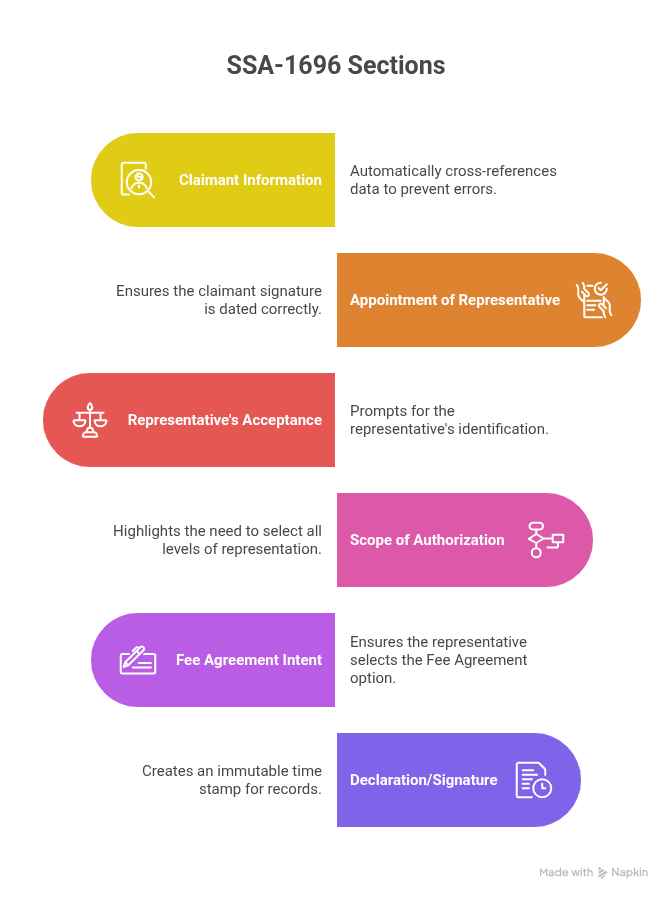
    1. Claimant Identifying Information: Full name, current address, Social Security Number, and claim number (if known). This ensures the form is matched to the correct SSA file.

    2. Representative Identifying Information: Full name, address, telephone, email, and the Representative ID Number (if non-attorney advocate) or State Bar Number (if attorney).

    3. Statement of Appointment: A clear, unambiguous statement signed by the claimant granting the representative authority to act on their behalf.

    4. Acceptance of Appointment: A section where the representative (or supervising attorney) formally accepts the appointment, confirming they have the necessary qualifications. This signature must be dated.

    5. Scope of Representation: A clear indication of the level of administrative action the representative is authorized to pursue (e.g., initial claim, reconsideration, hearing).

    6. Fee Agreement Intent: A mandatory checkbox indicating whether the representative intends to charge a fee and, if so, whether the fee will be based on the SSA-approved Fee Agreement (required to be submitted separately, typically on an SSA-1699, or electronically) or via the Fee Petition process.

    7. Date and Signature: A valid, non-expired signature and date from both the claimant and the representative.


    How to Complete a Disability Representative Appointment Form (SSA-1696)

    For high-volume disability practices, the process of executing the SSA-1696 needs to be a standardized, error-free workflow.

    1. Client Intake and Data Capture: During the initial client meeting, all necessary demographic and claim ID data is captured and immediately populated into the Wansom SSA-1696 template.

    2. Fee Agreement Alignment: The paralegal uses the Wansom system to confirm the Fee Agreement details (25% cap, max amount) are correct for the current statutory period and that the agreement is ready to be filed simultaneously with the SSA-1696.

    3. Claimant Signature and Verification: The claimant reviews, signs, and dates the SSA-1696. The law firm ensures they receive the original or a certified electronic copy.

    4. Representative Acceptance: The authorized representative (attorney) signs and dates the Acceptance of Appointment section.

    5. Secure Submission: The completed SSA-1696 and the Fee Agreement are filed electronically or mailed to the appropriate SSA office (Field Office, DDS, or OHO).

    6. Audit Log and Tracking: The filing date, the SSA office receiving the document, and the claimant’s primary contact information are automatically logged in the Wansom audit trail for future reference, ensuring the firm has verifiable proof of authority.

    The objective is to make the submission of the SSA-1696 a single-step, verified process, removing the administrative risk of forms being signed incorrectly, filed separately, or utilizing outdated SSA fee language.


    Disability Representative Appointment Form Template Example

    The Wansom template for the SSA-1696 is designed to guide the user through the mandatory fields, paying special attention to the often-missed Fee Agreement section.

    Blog image

    Easier Disability Representative Forms with Wansom

    The successful management of a high-volume disability practice hinges on the perfect execution of administrative tasks like the SSA-1696. Wansom is the AI-powered solution that removes the liability inherent in manual form processing.

    Automate Fee Compliance and Prevent Costly Rejections

    Wansom's platform understands the dynamic rules governing the SSA fee structure. When drafting the SSA-1696 and the linked Fee Agreement:

    • Version Control: Wansom ensures your firm is always using the most recent, approved version of the SSA forms, preventing rejections due to outdated documents.

    • Cap Validation: The system runs a background check to confirm the stated Fee Agreement percentage (25%) and the dollar maximum (e.g., $7,200) comply with current SSA regulations, flagging immediate errors before filing.

    • Integrated Filing Strategy: The AI workspace prompts paralegals to file the Fee Agreement concurrently with the SSA-1696, eliminating the common administrative error of filing them separately, which often leads to Fee Petition default.

    Immutable Communication and Authority Tracking

    Once the SSA-1696 is filed, the Wansom system transforms the document's data into actionable compliance records:

    • Centralized Authority Log: Every SSA-1696 and Fee Agreement is stored and tagged with its expiration, scope, and the specific SSA office (e.g., Baltimore, Boston OHO) that received it. This makes it instantly searchable for audits or client inquiries.

    • Substitution of Counsel Management: If a client switches firms, Wansom simplifies the complex process of filing a new SSA-1696 and provides the outgoing firm with a legally sound record of their authorized time spent, facilitating a smoother fee division process.

    • HIPAA Compliant PHI Access: The SSA-1696 is the gateway to PHI access. Wansom's platform securely manages the flow of PHI records obtained via this authority, ensuring all subsequent document handling meets the highest standards of data security (HIPAA and beyond).

    Wansom empowers disability law firms to elevate their administrative compliance from a chaotic paper trail to an organized, secure, and automated audit defense mechanism. By minimizing administrative errors on the SSA-1696, firms maximize their ability to focus on substantive legal arguments and secure timely payment.

    Conclusion:

    The Disability Representative Appointment Form (SSA-1696) is the legal foundation of every successful disability claim. Its correct and timely filing is essential for securing the right to represent the client and, most critically, securing the law firm's rightful contingency fee via the SSA Direct Pay system.

    Generic templates and manual processes introduce an unacceptable level of administrative risk—a risk that costs firms thousands of dollars in lost fees and non-billable hours spent on fee petition litigation.

    Wansom provides legal teams with the definitive, AI-powered workspace to draft, validate, and manage every SSA-1696 and Fee Agreement with guaranteed compliance. Eliminate administrative error, secure your fee, and solidify your practice’s financial foundation.

    Ready to automate the most critical document in your disability practice?

    Start customizing and downloading Wansom's AI-powered, compliant Disability Representative Appointment Form template today.

    Related to Blog: Fee Petitions vs. Fee Agreements: Which is Right for Your Firm?

    Frequently Asked Questions

    1. What is the difference between the SSA-1696 and the Fee Agreement (SSA-1699)?

    The SSA-1696 is the formal document where the claimant names and appoints a representative, granting them authority to act. The Fee Agreement (SSA-1699, often electronic) is a separate but mandatory document that outlines how the representative will be paid (usually 25% of past-due benefits, up to the statutory cap). The SSA requires both documents to be filed together and approved to enable Direct Payment.

    2. Can a non-attorney represent a claimant and use the SSA-1696?

    Yes. The SSA permits both licensed attorneys and accredited non-attorney representatives to use the SSA-1696 to gain representation authority. The SSA maintains a program for non-attorney representatives that requires stringent certification and examination to ensure they meet competency standards.

    3. How does the SSA-1696 expiration work?

    Unlike a Medical Release Form (HIPAA Authorization), the SSA-1696 does not automatically expire once the claim is approved. The appointment of a representative generally remains effective until the SSA has made a final determination on the claim and the time for further appeal has passed, or until the claimant formally revokes the appointment in writing.

    4. What happens if the SSA-1696 is rejected or missing?

    If the SSA-1696 is rejected or not filed, the SSA will not recognize the representative's authority. This means they will not send correspondence to the firm, will not grant access to the claimant’s electronic file (eFolder), and will immediately reject the Fee Agreement. The representative would then have to rely on the costly and time-consuming Fee Petition process to justify and receive payment.

  • Medical Release Form Template with Examples

    Medical Release Form Template with Examples

    For legal professionals, compliance officers, and administrative staff, the act of sharing Protected Health Information (PHI) is a high-stakes legal exercise. Every request for a patient’s medical chart, diagnostic result, or treatment summary requires a valid, legally compliant, and meticulously executed Medical Records Release Form.

    In the United States, this single document serves as the firewall for the Health Insurance Portability and Accountability Act (HIPAA) and its numerous state-level variations. A deficient or outdated release form can instantly torpedo critical personal injury litigation, stall an insurance investigation, or expose a Covered Entity to massive federal fines and litigation.

    Far too many organizations still rely on generic, unverified medical release form templates—a precarious one-size-fits-all approach that ignores the dynamic nature of legal mandates.

    This comprehensive guide is authored for legal and compliance experts, providing an authoritative breakdown of the legal, practical, and technical requirements for the Authorization to Use or Disclose PHI. We will dissect the mandatory components, provide real-world legal use cases, and demonstrate how Wansom’s secure, AI-powered collaborative workspace can automate the creation of audit-ready, state-compliant forms, turning a common liability into a core procedural strength.

    Wansom’s Medical Release Form Template: Compliance at the Core

    Wansom’s Medical Records Release Form Template is not a static document; it is a dynamic, AI-guided blueprint engineered for legal certainty.

    • Audit-Ready Compliance: The template meets all six mandatory elements of HIPAA (45 CFR § 164.508) and is dynamically adjusted to comply with the most stringent state-specific requirements.

    • Targeted Sensitivity: Includes specific, legally distinct sections and mandatory check-boxes to address the disclosure of highly sensitive PHI (e.g., HIV/AIDS status, mental health notes, 42 CFR Part 2 Substance Use Disorder treatment records).

    • AI-Guided Customization: Use Wansom's integrated AI assistant to effortlessly adjust the scope, duration, and parties of the form, ensuring it perfectly matches the unique needs of a specific litigation matter or insurance claim.

    Related to Blog: The Cost of Non-Compliance: A Legal Analysis of Recent HIPAA Fines

    What is a Medical Release Form?

    A medical release form (often referred to as an Authorization to Release Medical Information or a HIPAA Authorization) is a critical legal document that provides the patient's express, written permission for a healthcare provider (the Disclosing Party) to share their Protected Health Information (PHI) with a specified third party (the Recipient).

    This mechanism is the cornerstone of patient privacy protection. While routine information sharing occurs constantly to facilitate safe and effective medical care, providers must obtain a release form whenever the disclosure moves beyond the patient's reasonable expectation of shared information.

    In the US, these forms are fundamentally rooted in compliance with the Health Insurance Portability and Accountability Act (HIPAA). In contrast, many international jurisdictions, such as Australia and the UK, rely heavily on common law duties of confidentiality alongside specific regulations like the GDPR (UK) and the Australian Privacy Principles (APP). However, regardless of the jurisdiction, the core legal principle remains the same: the patient must formally authorize the disclosure of their private medical records outside of routine care.

    Related to Blog: International Data Privacy Laws: GDPR vs. HIPAA for Global Legal Teams

    When to Use a Medical Release Form

    Clinicians are permitted to legally share a patient’s information in many situations involving the routine delivery of care (known as Treatment, Payment, and Healthcare Operations, or TPO). For example, a surgeon can share operative notes with the post-operative nurse without needing a formal release.

    However, the legal imperative to protect patient privacy requires a signed Medical Records Release Form for situations where there is no reasonable expectation on the patient’s behalf that their information would be shared.

    To accurately determine when a release form is mandatory, legal teams must first establish the legal framework governing PHI handling.

    Medical Records Release Forms: Privacy and Confidentiality 101

    While often used interchangeably in lay language, Privacy and Confidentiality have distinct legal meanings that define the scope of a release form's necessity.

    Privacy

    Privacy refers to the laws and regulations that govern how patient information is collected, handled, used, and accessed. These laws mandate security requirements, restrict the use of data for marketing, and establish patient rights over their records.

    • US: Governed by HIPAA (The Privacy Rule).

    • UK/EU: Governed by the General Data Protection Regulation (GDPR).

    • Australia: Governed by the Australian Privacy Principles (APP).

    Confidentiality

    Confidentiality describes the healthcare provider’s ethical and professional obligation to protect information disclosed to them by the patient while delivering care. It applies both to formal written records and informal conversations.

    In the US and UK, while HIPAA/GDPR provides the statutory framework, the common law duty of confidentiality and professional codes of practice also heavily influence a provider's obligation not to disclose PHI without authorization.

    Understanding HIPAA

    HIPAA provides the definitive legal framework in the United States, offering clear definitions of the information that must be protected and the entities responsible for that protection.

    What is Protected Health Information (PHI)?

    According to the HIPAA Privacy Rule, Protected Health Information (PHI) encompasses any individually identifiable health information that relates to:

    • The individual's past, present, or future physical or mental health or condition.

    • The provision of health care to the individual.

    • The past, present, or future payment for the provision of health care to the individual.

    Crucially, PHI is not just clinical details; it includes information that can be used to identify an individual, such as demographics, dates (except year), specific geographic identifiers, and unique identifiers (Social Security Numbers, medical record numbers). The entire purpose of a Medical Release Form is to create a legally sanctioned exception to the non-disclosure rule for PHI.

    Permitted Uses and Disclosures of PHI

    Clinicians and Covered Entities are permitted to use and disclose PHI without an individual’s authorization for specific, necessary purposes:

    1. Treatment, Payment, and Healthcare Operations (TPO): This is the core exception, covering the routine coordination of care, billing the insurance company, and quality assessment activities.

    2. Public Interest and Benefit Activities: Disclosures required by law (e.g., subpoena, mandatory infectious disease reporting), to prevent serious and imminent threat to health or safety, or for workers’ compensation claims.

    3. To the Individual: Giving the patient access to their own PHI.

    Outside of these strictly defined permitted disclosures, a signed Authorization (Medical Release Form) is mandatory before sharing PHI. Furthermore, in all permitted instances, the Minimum Necessary Rule applies: only the minimum amount of information required to fulfill the request should be provided.

    Related to Blog: The Minimum Necessary Rule: Practical Application in Legal and Compliance

    Medical Records Release Form Scenarios

    Knowing when to require a signed authorization is the difference between legal compliance and a major violation. The following scenarios illustrate when a Medical Release Form is generally required versus when it is not.

    A Medical Release Form is Generally NOT Required for:

    • Treatment Purposes: Information shared among healthcare providers or specialists directly involved in a patient’s concurrent care (e.g., an attending physician sharing notes with a consulting specialist).

    • Payment Operations: Sharing information with a health plan or insurance company solely for the purpose of submitting claims and obtaining reimbursement.

    • Healthcare Operations: Using anonymized or de-identified patient data for internal quality assessment, peer review, audits, or administrative functions.

    • Emergencies: Disclosing information to facilitate immediate, life-saving care when obtaining authorization would cause a harmful delay.

    A Medical Release Form IS Usually Needed Before:

    • Third-Party Disclosure: Sharing records with entities not directly involved in TPO, such as employers (outside of workers' compensation), life insurance companies, or attorneys (for litigation or legal counsel).

    • Family Disclosure (Non-Representative): Releasing information to family members (e.g., spouse, parent, adult child) who are not designated as the patient's legal representative (Healthcare Power of Attorney) or guardian.

    • Sensitive Information: Disclosing specially protected categories of information, which often require separate, explicit patient initials on the form. This includes:

      • Substance Use Disorder (SUD) records (governed by the more restrictive 42 CFR Part 2).

      • Mental health psychotherapy notes.

      • HIV/AIDS status or genetic information.

    • Commercial/Non-TPO Use: Using patient information for marketing, fundraising, or research purposes not covered under a waiver granted by an Institutional Review Board (IRB).

    Best Practice for Legal Teams: When the purpose of the disclosure is litigation, insurance evaluation, or any non-routine administrative function, always insist on a valid, complete, and signed Medical Records Release Form.

    Related to Blog: Navigating 42 CFR Part 2: Substance Abuse Records and Legal Discovery

    Challenges with Medical Release Forms

    Even with a template, the manual administration of release forms is fraught with challenges that introduce legal risk, administrative friction, and time delays.

    Breaching Confidentiality Due to Risk

    Clinicians frequently face the ethical and legal dilemma of a Duty to Protect principle (e.g., Tarasoff v. Regents of University of California). This stipulates that if a patient poses a serious and imminent threat of violence to a potential victim, the clinician may be required to breach confidentiality to warn the victim or notify law enforcement.

    • The Challenge: The decision to breach is complex, requiring precise judgment and immediate action.

    • The Solution: Legal guidance on the Duty to Protect must be seamlessly integrated into practice protocols. Wansom’s platform ensures that all documentation generated—whether a referral or an authorization form—is contextualized against legal precedent, allowing legal counsel to quickly audit the compliance record when risk disclosure occurs.

    Release of Information Outside of Healthcare Systems

    Requests from entities like social services, educational institutions, or legal representatives are routine but necessitate strict adherence to disclosure protocols. The manual process often involves unnecessary back-and-forth communication to verify the request's legitimacy.

    Deciding What Information to Send (The Minimum Necessary Rule)

    The Minimum Necessary Rule is often violated in practice. A generic request for "all records" should not lead to the release of the patient's entire chart, especially if only a specific date range or injury is relevant.

    • The Challenge: Staff must manually review lengthy records to redact non-essential information and ensure sensitive data is not accidentally included without explicit authorization.

    • The Wansom Advantage: Wansom's AI is specifically designed for content synthesis. For legal teams, the AI can ingest the full medical record and, based on the specific scope defined in the Wansom template (e.g., "lumbar spine injury records between 2023-2024"), generate a redacted, compliant summary for disclosure, ensuring the minimum necessary information is always provided. This drastically cuts manual review time and enhances compliance integrity far beyond simple form-filling solutions.

    Time and Cost of Releasing Information

    The administrative burden of processing forms and preparing compliant records for disclosure is enormous. The steps include: verification, obtaining patient signature, locating records, manual review/redaction, and secure transmission. This administrative drag is a major hidden cost for legal and healthcare firms alike.

    The transition from manual processes to secure, AI-powered automation is the only sustainable way to manage the escalating volume and complexity of PHI requests.

    Related to Blog: Reducing Legal Practice Overhead: The Economics of Document Automation

    Essential Parts of a Release of Medical Records Form

    To be legally enforceable and HIPAA compliant, a Medical Records Release Form must be viewed as a formal contract of consent. The following components are essential and must be clearly defined in your firm's template:

    1. Patient Information: Full legal name, date of birth, address, and Medical Record Number (MRN). This guarantees correct patient identification.

    2. Specific Description of Information: Details the exact types of records being sought (e.g., "operative reports," "physical therapy notes") and the specific dates of service or date ranges.

    3. Specific Disclosing Party: Clearly names the individual physician, clinic, or hospital authorized to release the records.

    4. Specific Recipient Information: Names the authorized person or entity (e.g., "Law Office of J. Smith," "Acme Insurance Company") who may receive and handle the information.

    5. Statement of Purpose: A clear, concise statement outlining why the records are being requested (e.g., "For litigation purposes in the matter of Doe v. Roe," "To determine eligibility for disability benefits").

    6. Expiration Clause: A date or specific event upon which the authorization expires. This is mandatory; authorizations cannot be indefinite.

    7. Revocation Clause: A clear statement informing the patient of their right to revoke the authorization at any time in writing, along with instructions on how to do so.

    8. Sensitive Information Waiver: Checkboxes and initial spaces for the patient to explicitly authorize the release of highly protected PHI (e.g., Mental Health, SUD, HIV).

    9. Redisclosure Warning: A statement warning the patient that once the PHI is released to the recipient (e.g., a law firm), it may no longer be protected by HIPAA and could be redisclosed.

    10. Authorization Signature and Date: The signed and dated authorization from the patient or their qualified Personal Representative.

    How to Complete a Medical Release Form

    For administrative staff, the process of providing and receiving a complete, valid medical release form must be streamlined and auditable.

    1. Selection: Select the correct, jurisdictionally appropriate Medical Release Form Template from the Wansom Library.

    2. Pre-fill with AI: Use Wansom’s AI to pre-fill known patient demographics, the Recipient Law Firm’s details, and the litigation name/claim number.

    3. Patient Review: The patient completes the highly specific sections: the scope of records, the dates of service, and explicitly initials any sensitive information waivers.

    4. Signature & Validation: The patient (or legal representative) signs and dates the document. Wansom’s platform instantly validates that all mandatory HIPAA fields are complete before acceptance.

    5. Documentation & Audit Trail: A copy of the form is provided to the patient, and the original is stored in the patient’s legal/administrative file. Wansom automatically records the form’s existence, scope, and expiration date in an immutable audit trail—essential for future compliance checks.

    The traditional manual steps of form review and data transcription are replaced by immediate, automated compliance checking.

    Medical Release Form Template Example

    The core structure of a legally robust release form must clearly delineate the parties, the scope, and the patient's rights, adhering to the following structure:

    Blog image

    Related to Blog: Best Practices for Documenting HIPAA Revocation of Authorization

    Easier Medical Release Forms with Wansom

    The complexities of state variations, sensitive data waivers, and the Minimum Necessary Rule make the generic online template obsolete for legal and compliance teams. Wansom is the only secure, AI-powered collaborative workspace designed to solve these specific legal and administrative headaches.

    Here is how Wansom transforms your release form workflow:

    1. Choose a Template from the Legal Library: Access Wansom’s comprehensive, legally vetted library, which includes specialized templates (e.g., California Mental Health Authorization, 42 CFR Part 2 SUD Release).

    2. AI Fill and Contextualize: Instead of manual typing, upload your case file details or use the AI assistant to instantly populate the form with the recipient attorney's details, the case name, and the specific dates of injury. The AI ensures the scope is narrow enough to meet the Minimum Necessary Rule.

    3. Dynamic State Law Adjustments: Simply select the jurisdiction (e.g., New York). The AI instantly adjusts the revocation language, confidentiality disclaimers, and required sensitive data checkboxes to comply with New York’s specific Mental Hygiene Law requirements.

    4. Secure Finalization and Audit: Once signed, the form is stored with enterprise-grade encryption and automatically tracked in a centralized, immutable audit log. You have immediate, verifiable proof of consent, scope, and expiration date—essential for defending against claims of improper disclosure.

    Trusted by leading legal firms for secure, compliant document automation, Wansom meets or exceeds all regional healthcare privacy and security standards (HIPAA, GDPR, etc.), ensuring patient data integrity and legal defensibility.

    Conclusion: Securing Your Practice with Authority

    In the arena of patient privacy, the Medical Records Release Form is the definitive legal document. Its accuracy is non-negotiable. Relying on manually completed or generic templates is a serious administrative and legal vulnerability.

    For legal professionals and compliance teams, the strategic imperative is clear: adopt a dynamic, AI-enabled drafting system that guarantees adherence to the complex tapestry of federal HIPAA rules and stringent state-specific statutes. Wansom provides the secure, collaborative environment you need to automate these critical workflows, transforming the creation of a legally sound medical authorization into a fast, accurate, and audit-ready process.

    Ready to eliminate legal risks and ensure every disclosure is valid and compliant?

    Start customizing and downloading Wansom's AI-powered, state-compliant Medical Records Release Form template today.

    Related to Blog: The Future of Legal Intake: AI-Powered Data Capture


    FAQs About Medical Release Forms

    1. What is a medical authority letter?

    In most common contexts, a medical authority letter refers to a document that grants an individual (a Personal Representative) the legal authority to make healthcare decisions on someone’s behalf, including accessing medical information, especially when the patient lacks decision-making capacity. This authority is most frequently codified in a Durable Healthcare Power of Attorney (POA).

    1. What is the difference between a medical liability release form and a medical release authorization form?

    A medical liability release form (often called a waiver) is a document that limits a healthcare provider’s financial or legal liability for specified adverse outcomes related to a treatment or procedure. In contrast, a medical release authorization form grants permission for the disclosure of private health information. These are two distinct legal instruments used for entirely different purposes.

    1. Can I create my own medical release form template?

    While you are legally permitted to draft your own release of medical information form, it is generally recommended that legal and compliance teams start with a template that has undergone medicolegal review. The complexity of the six HIPAA elements, plus state-specific requirements (especially for sensitive data), makes it extremely difficult to create a compliant form from scratch without inadvertently omitting crucial protective language. Wansom templates are built on comprehensive legal analysis to mitigate this risk.

  • How AI is Transforming Environmental Law

    How AI is Transforming Environmental Law

    The environmental legal landscape is expanding at an exponential rate. From complex international climate treaties to highly localized permitting requirements, the volume, velocity, and variability of regulations now pose an unprecedented challenge to legal and compliance teams worldwide.

    For years, compliance reporting has been a largely manual, costly, and error-prone endeavor, relying on armies of consultants, spreadsheet management, and document review. But as the stakes of non-compliance—ranging from catastrophic fines to reputation damage—continue to climb, this traditional model is no longer sustainable.

    Enter Artificial Intelligence (AI).

    AI is not just optimizing back-office legal operations; it is fundamentally rewriting the playbook for environmental law and compliance reporting. It provides the only viable mechanism for legal teams to digest petabytes of global environmental data, track constantly changing legislation, conduct exhaustive due diligence, and generate complex, jurisdiction-specific reports with verifiable accuracy.

    This deep-dive resource, tailored for legal and compliance professionals, explores how AI is transforming every facet of green law—from global ESG strategies to the successful compilation of technical documents like the NEMA Environmental Approval Document. It is time to look past theoretical applications and understand the practical, immediate, and revolutionary impact of AI in securing environmental compliance.


    Key Takeaways:

    • Environmental regulatory complexity, driven by global ESG standards and rapidly changing laws, has made manual compliance reporting an unsustainable and high-risk operation.

    • AI-powered RegTech uses Natural Language Processing (NLP) to instantly monitor, track changes, and map regulations to specific jurisdictions globally, minimizing oversight risk.

    • Generative AI systems, like the Wansom platform, automate the structural drafting and ensure the internal consistency of massive, legally complex reports, such as the NEMA Environmental Approval Document.

    • For high-stakes processes like NEMA, AI specifically streamlines initial listed activity screening, synthesizes multiple specialist reports, and creates a bulletproof, auditable public participation record.

    • Embracing secure AI allows legal professionals to shift focus from tedious document assembly to strategic risk mitigation and achieving continuous, real-time "hyper-compliance."


    The Crushing Weight of Environmental Regulatory Complexity

    The global shift toward mandatory climate action and Environmental, Social, and Governance (ESG) transparency has created an intricate web of overlapping, and often conflicting, legal frameworks. For any organization operating across borders, or even within complex federal systems, managing regulatory risk has become a colossal data management problem.

    1. The Proliferation of Reporting Standards

    Compliance teams must navigate a constellation of standards:

    • Global Frameworks: Task Force on Climate-Related Financial Disclosures (TCFD), Global Reporting Initiative (GRI), and the new International Sustainability Standards Board (ISSB).

    • Jurisdictional Legislation: The European Union’s Corporate Sustainability Reporting Directive (CSRD), the U.S. EPA’s vast body of regulations, and the foundational National Environmental Management Act (NEMA) in South Africa.

    • Data Inputs: Compliance requires fusing disparate data sources: satellite imagery for land-use change, IoT sensors for emissions monitoring, internal operational data, and complex hydrogeological or biodiversity reports.

    The traditional process involves legal teams reading thousands of pages of legislative updates, cross-referencing requirements, manually collating technical reports, and then painstakingly drafting documentation that adheres to precise structural and substantive mandates. This is a workflow primed for human error, delays, and inefficiency.

    2. The High Cost of Non-Compliance

    The financial and reputational risks associated with environmental non-compliance are severe:

    • Monetary Penalties: Regulators are levying record-breaking fines. The cost of a single major violation can easily wipe out a quarter’s profits.

    • Litigation Risk: Environmental activists, NGOs, and even shareholders are increasingly using regulatory reports and impact statements as grounds for climate litigation or shareholder actions.

    • Project Delays: Failure to secure a crucial environmental permit—such as a NEMA Environmental Authorisation—due to document deficiencies can halt multi-million-dollar projects, resulting in immense opportunity costs.

    This pressure environment necessitates a tool that provides not just speed, but verifiable legal accuracy and auditability. This is where AI excels.

    AI’s Core Applications in Transforming Environmental Legal Workflows

    Artificial intelligence, particularly Large Language Models (LLMs) and specialized machine learning algorithms, is deployed across four critical areas to alleviate the regulatory burden and minimize risk.

    1. Automated Regulatory Monitoring and Change Tracking

    The first challenge in compliance is simply knowing the rules. Regulations, especially those related to rapidly evolving fields like carbon emissions and biodiversity protection, are constantly changing.

    • The AI Solution: AI-powered regulatory technology (RegTech) platforms use Natural Language Processing (NLP) to ingest and analyze millions of pages of global, federal, and local legal text.

    • Real-time Alerts: The AI can flag specific changes (e.g., a shift in maximum allowable effluent standards, or an update to a NEMA Listing Notice), instantly cross-referencing the change against a company’s operational permits and documented compliance status.

    • Jurisdictional Specificity: It maps the regulatory text to geographic location, ensuring a project in the Western Cape of South Africa is only flagged for relevant provincial and NEMA requirements, saving thousands of hours of unnecessary review.

    2. Enhanced Environmental Due Diligence and Impact Assessment (EIA)

    Environmental Impact Assessments (EIAs) are the technical and legal foundation of most major projects. They require consolidating and analyzing highly technical data, including geology, hydrology, biodiversity, and socio-economic factors.

    • The AI Solution: Machine learning algorithms can process and synthesize unstructured data at scale:

    • Geospatial Analysis: Integrating satellite imagery, drone footage, and historical land-use maps with legal definitions of protected areas. The AI identifies potential environmental hotspots or conflicts with protected zones faster and more accurately than human consultants.

    • Data Synthesis: AI reviews thousands of pages of existing legacy reports, studies, and permit applications (often in varying formats) to identify relevant baseline conditions and regulatory precedents for a new project. This dramatically accelerates the pre-feasibility and scoping phases of any major undertaking.

    • Risk Scoring: By cross-referencing the project plan against historic enforcement data and regulatory complexity scores, AI can predict the likelihood of an EIA being challenged or delayed, allowing legal teams to preemptively allocate resources to high-risk areas.

    3. Compliance Report Generation and Document Automation (The Funnel Focus)

    The final, and most crucial, step in the compliance lifecycle is generating the final legal document—the permit application, the quarterly emissions report, or the Environmental Authorisation application. These documents are often massive, highly structured, and must adhere to extremely precise legal formatting.

    • The AI Solution: This is where advanced legal AI workspaces like Wansom shine. Generative AI models, trained specifically on large corpuses of successful environmental submissions, automate the structural drafting of complex reports.

    • Fact-to-Text Conversion: AI takes structured compliance data (e.g., recorded emissions levels, waste disposal volumes, public participation records) and converts it into the legally required narrative and format, complete with mandatory statutory citations.

    • Internal Consistency: It ensures that every reference, cross-reference, and citation (e.g., between the main EIA report and its specialist appendices) is internally consistent, eliminating one of the most common causes of regulatory rejection.

    • Template Customization: Rather than starting from a generic Word document, AI provides a structured, legally sound framework that intelligently prompts the legal user for jurisdiction-specific inputs, drastically reducing the drafting time for complex reports.

    4. Environmental Litigation and Predictive Analytics

    When environmental disputes do arise, AI is proving invaluable in preparing for litigation or negotiating settlements.

    • Case Law Review: NLP rapidly searches decades of case law, regulatory decisions, and enforcement actions to identify favorable precedents, opposing arguments, and the typical severity of penalties for similar violations.

    • Predictive Sentencing/Fining: Machine learning models analyze historical enforcement data to estimate the likely penalty range for a specific violation, giving legal teams a crucial strategic advantage in settlement negotiations.

    • E-Discovery in Environmental Cases: AI efficiently sifts through unstructured data (emails, internal documents, sensor logs) to find the “smoking gun”—or, conversely, the exculpatory evidence—related to a specific pollution event or compliance failure.

    Deep Dive: Mastering the NEMA Environmental Approval Process with AI

    The National Environmental Management Act (NEMA) in South Africa provides a compelling, real-world example of regulatory complexity where AI moves from a luxury to a necessity. NEMA governs all significant environmental activities, and obtaining an Environmental Authorisation (EA) is mandatory for development across numerous sectors.

    The Challenge of the NEMA Application

    A NEMA EA application is not a simple form; it is a meticulously structured, multi-stage legal process. The application process—which can be either a Basic Assessment (BA) or a more intensive Scoping and Environmental Impact Report (S&EIR)—involves:

    • Defining the Scope: Pinpointing the exact Listed Activities (as per the Listing Notices) triggered by the project. A single mistake here can invalidate the entire application.

    • Specialist Studies: Coordinating, synthesizing, and summarizing reports from multiple technical experts (biodiversity, heritage, traffic, etc.).

    • Public Participation: Managing the legally mandated process of notifying, consulting with, and responding to comments from Interested and Affected Parties (I&APs)—a massive administrative and legal liability if mishandled.

    • Drafting the Final Report: Compiling all this information into a single, cohesive document that rigorously adheres to the exact procedural requirements and technical mandates of the NEMA EIA Regulations.

    How AI Specifically Augments NEMA Compliance

    An AI-powered legal workspace can tackle the most time-consuming and error-prone aspects of the NEMA process:

    Stage 1: Initial Screening and Risk Assessment

    • AI Action: The platform ingests the project description and geospatial coordinates. It then instantaneously cross-references this data against the constantly updated NEMA Listing Notices, identifying precisely which activities (e.g., Listing Notice 1, Item 27: “The clearance of an area of 1 hectare or more…”) are triggered.

    • Benefit: Eliminates the risk of missing a triggered activity, preventing costly rejections and delays after months of work.

    Stage 2: Specialist Report Synthesis and Integration

    • AI Action: AI uses NLP to read the specialist reports (e.g., the palaeontology report, the wetland delineation study). It extracts key findings, mandatory mitigation measures, and legal constraints.

    • Benefit: The AI automatically integrates these elements into the relevant sections of the Draft Scoping Report or Environmental Impact Report (EIR). For example, it ensures all mitigation measures from the specialist reports are carried forward verbatim into the final Environmental Management Programme (EMPr).

    Stage 3: Public Participation Management

    • AI Action: While human interaction is mandatory, AI automates the administrative and legal tracking. It logs every I&AP registration, links their comments to the required project changes, and automatically drafts the Response to Comments appendix, ensuring all legal requirements for acknowledging and responding to stakeholder input are met.

    • Benefit: Creates a bulletproof, auditable record of the entire public process, which is often the Achilles' heel of a NEMA application.


    The Wansom Solution: Automating the NEMA Environmental Approval Document

    The complexity of the NEMA process highlights the critical gap in current legal technology: the need for a solution that combines the power of Generative AI with structured, legally vetted templates.

    Wansom was purpose-built to bridge this gap, serving as the secure, collaborative workspace where legal and technical teams can finally automate document drafting, review, and environmental legal research.

    Why You Need the Wansom NEMA Environmental Approval Document Template

    Our proprietary template is not a static form; it is a dynamic, AI-enabled blueprint designed to meet the rigorous requirements of South African environmental law.

    • Structured Compliance Framework: The template incorporates all mandatory headings and appendices required under the NEMA EIA Regulations (2014, as amended), ensuring no required section is missed.

    • AI-Guided Drafting: Using Wansom, the AI guides you through the process, prompting you to fill in the technical data (e.g., coordinates, water usage figures). It then uses this input to draft the explanatory, compliant legal narrative, complete with the correct NEMA statutory citations.

    • Collaborative Review: Legal and compliance teams, environmental consultants, and specialist authors can work simultaneously on the same secure document, with AI tracking all changes and ensuring version control—a critical feature for multi-disciplinary NEMA applications.

    • Audit Trail: Every input, regulatory check, and drafting change is logged, providing an immutable audit trail necessary for regulatory submission and future litigation defence.

    By starting with the Wansom NEMA Environmental Approval Document template, you skip the laborious initial drafting and formatting, dramatically reducing the time-to-submission and minimizing the risk of a technical rejection.


    Implementing AI in Your Legal Practice: Ethical and Practical Considerations

    While the benefits of AI are clear, integrating it into a complex legal practice requires a thoughtful approach. AI is a powerful co-pilot, not a replacement for legal expertise.

    1. The Challenge of "Garbage In, Garbage Out"

    AI’s performance is entirely dependent on the quality of the data it receives.

    • Data Vetting: Legal teams must rigorously vet the internal data (emissions logs, project plans, specialist reports) fed into the AI system. Errors in source data will translate into errors in the final legal submission.

    • Human Review is Non-Negotiable: For high-stakes documents like an Environmental Authorisation application, the final, expert review by a qualified Environmental Assessment Practitioner (EAP) and legal counsel remains essential. AI accelerates the process, but the lawyer retains the ultimate liability and responsibility.

    2. Ensuring Legal Security and Client Confidentiality

    The security of client environmental data—which often contains sensitive trade secrets and financial projections—is paramount.

    • Secure Legal Workspaces: When choosing an AI solution, prioritize secure, private-instance legal workspaces like Wansom. Avoid generic, public LLMs that use your data to train their models, which can lead to breaches of attorney-client privilege or client confidentiality.

    • Jurisdictional Data Compliance: Ensure your AI platform is capable of handling data residency and compliance requirements specific to your operating jurisdiction (e.g., POPIA in South Africa, GDPR in the EU).

    3. The Future of Environmental Law: Hyper-Compliance

    The convergence of AI, IoT, and satellite monitoring is leading to an era of hyper-compliance, where environmental performance can be monitored, measured, and reported almost instantaneously.

    • From Reporting to Continuous Compliance: The future will see legal teams moving away from retroactive quarterly or annual reporting to continuous, real-time compliance monitoring. AI platforms will automatically flag deviations from permit conditions the moment they occur, allowing legal counsel to intervene before a violation takes place.

    • AI-Driven Policy Shaping: Legal teams will use AI not just for compliance, but for strategic advantage—predicting future regulatory trends to inform capital investment and sustainable policy decisions.

    Conclusion

    The revolution in environmental law is here, and it is powered by data and artificial intelligence. The complexity of modern regulation—embodied perfectly by the multi-faceted requirements of the NEMA Environmental Approval Document—simply outpaces the capacity of manual workflows.

    AI doesn't seek to replace the legal professional; it seeks to liberate them from the tedious, repetitive, and high-risk task of document assembly and regulatory cross-checking. It allows lawyers and compliance officers to focus on strategic advice, risk mitigation, and complex problem-solving, rather than administrative drafting.

    For legal teams looking to gain a definitive edge in environmental compliance, efficiency, and risk mitigation, the path is clear: embrace secure, AI-powered collaboration.

    Ready to transform your environmental reporting workflow and secure faster regulatory approvals?

  • Audited Financial Statements with Template

    For most businesses, financial audits aren’t just about compliance—they’re a language of trust. Investors, regulators, and partners look at audited financial statements to gauge whether your company truly reflects the numbers it reports. But drafting one from scratch can be a nightmare of accounting jargon, formatting rules, and legal precision. That’s exactly where Wansom’s Audited Financial Statements Template comes in.

    This article will guide you through what audited financial statements are, why they matter, what every report must include, and how you can use Wansom’s AI-powered template to customize and download a complete, audit-ready version in minutes.

    Related Blog: How to Prepare Audited Financial Statements for Your Business


    Key Takeaways: 

    • Audited financial statements confirm the accuracy of a company’s finances through independent verification.

    • Every report should include an auditor’s opinion, balance sheet, income statement, and cash flow statement.

    • Common challenges include inconsistency, compliance errors, and data duplication—all solvable with AI.

    • Wansom’s template ensures professional formatting and GAAP/IFRS alignment automatically.

    • Businesses can save time and improve credibility by customizing and downloading their audited statements on Wansom.ai.


    What Are Audited Financial Statements?

    Audited financial statements are official financial documents reviewed by an independent auditor to confirm that a company’s financial position and performance are accurately represented. In simpler terms, it’s a professional seal of honesty.

    The process ensures that all financial information complies with generally accepted accounting principles (GAAP) or international standards (IFRS). Businesses use them when seeking funding, fulfilling regulatory requirements, or establishing credibility with stakeholders.

    Related Blog: Balance Sheet, Income Statement, and Cash Flow Templates Explained


    Why Businesses Need Audited Financial Statements

    Audits aren’t just red tape—they’re strategic tools. Here’s why:

    • Investor Confidence: Investors and shareholders trust verified numbers.

    • Regulatory Compliance: Many jurisdictions require audited reports to meet statutory obligations.

    • Loan Approvals: Financial institutions often demand audited records before approving credit.

    • Transparency: Demonstrates accountability and reduces the risk of fraud or misrepresentation.

    • Strategic Planning: Reliable data helps guide management decisions and long-term forecasting.

    In short, your audited financial statements are the backbone of your organization’s integrity.

    Related Blog: Top 5 Mistakes Companies Make in Financial Audit Reports


    The Four Key Components of an Audited Financial Statement

    To ensure your document meets compliance and professional standards, it must contain four essential sections:

    1. The Auditor’s Report

    This is a professional opinion from an independent auditor confirming whether the statements are fair and accurate. It often specifies the audit scope, standards followed, and any exceptions or qualifications noted.

    2. Balance Sheet

    Also called the Statement of Financial Position, this section outlines assets, liabilities, and equity. It’s essentially a snapshot of what your business owns and owes.

    3. Income Statement

    Also known as the Profit and Loss Statement (P&L), it summarizes revenue, expenses, and net profit over a defined period.

    4. Cash Flow Statement

    This reveals how money moves in and out of your business. It divides cash activities into operations, investing, and financing.

    Each section serves a different purpose, but together they form a complete picture of financial health.

    Related Blog: Automate Audit Compliance Documents with AI


    Common Challenges When Preparing Audited Financial Statements

    Many organizations face recurring issues when creating audit documents manually:

    • Inconsistent formatting and missing line items

    • Misaligned accounting standards

    • Lack of traceability in data sources

    • Manual errors and duplicated entries

    • Difficulty managing version control during review

    Wansom’s AI-powered workspace resolves these challenges by automatically generating compliant, formatted, and traceable audit documents that integrate directly with your team’s workflow.

    Related Blog: The Role of AI in Financial Reporting and Accuracy


    How to Prepare Audited Financial Statements with Wansom.ai

    Wansom’s Audited Financial Statements Template is built to save time and eliminate human error. It’s ideal for accountants, finance managers, and compliance officers who need a consistent, accurate, and ready-to-file report.

    Here’s how it works:

    1. Log into Wansom.ai
      Access your secure workspace designed for legal and financial teams.

    2. Choose the Audited Financial Statements Template
      Select the pre-built format, already structured for GAAP and IFRS compliance.

    3. Enter or Upload Financial Data
      You can manually enter data or import from your accounting software.

    4. AI Validation and Review
      Wansom’s AI scans for inconsistencies, missing details, or deviations from accounting standards.

    5. Collaborate with Your Team
      Add your auditor, finance lead, or CFO for review—all in real-time.

    6. Customize and Download
      Export your audit-ready document in PDF or Word format, perfectly formatted for submission or presentation.

    With this workflow, your team can focus on analysis rather than repetitive data entry.

    Related Blog: Getting Started with Wansom: A Complete Guide for Legal and Finance Teams


    What Makes Wansom’s Template Different

    The Wansom Audited Financial Statements Template isn’t just another static PDF—it’s a living document designed for modern financial teams.

    • AI-Powered Consistency: Automatically checks numerical alignment and section integrity.

    • Compliance-First Design: Aligned with both local and international financial reporting standards.

    • Collaboration Tools: Enables secure multi-user editing and audit trails.

    • Instant Formatting: Exports in professional layouts accepted by regulators and investors.

    • Legal Integration: Built to align with legal documentation for corporate filings and compliance.

    When you combine automation with legal intelligence, your audits stop being a burden and start becoming an advantage.

    Related Blog: AI and Financial Compliance: Automating Audit-Ready Documents


    Who Can Benefit from This Template

    The Audited Financial Statements Template is useful for a range of professionals and organizations, including:

    • Medium and large enterprises preparing annual reports

    • Startups raising investment rounds

    • Accounting and audit firms managing multiple clients

    • Compliance officers ensuring regulatory adherence

    • Non-profits needing verified financial transparency

    If your organization handles sensitive financial reporting, Wansom helps you generate compliant, professional, and audit-proof documentation effortlessly.

    Related Blog: Financial Templates You Can Customize with Wansom.ai


    How AI Transforms Financial Auditing

    Traditionally, financial auditing is repetitive, manual, and time-consuming. Wansom’s AI introduces intelligence and efficiency to the process:

    • Detects inconsistencies and missing financial line items

    • Flags data irregularities that could trigger audit concerns

    • Reduces dependency on manual cross-verification

    • Automates compliance checks against reporting standards

    The result: faster audits, higher accuracy, and greater transparency.

    Related Blog: The Future of AI in Legal and Financial Compliance


    Final Thoughts: Automate, Customize, and Simplify

    In finance, accuracy is power—and automation is its ally. Wansom’s Audited Financial Statements Template empowers you to produce professional, compliant, and reliable audit-ready documents with speed and confidence.

    No more formatting frustrations or compliance anxiety. With AI-driven precision, your team can focus on insights rather than paperwork.

    Start your financial audit with confidence—customize and download your template today at Wansom.ai.

  • Consent Withdrawal Request: A Complete Guide with Customizable Template

    Consent Withdrawal Request: A Complete Guide with Customizable Template

    Modern data privacy laws give individuals the right to say one powerful word: “No.”
    A Consent Withdrawal Request is how that right is exercised — a formal document that allows someone to withdraw previously given consent for data processing, communication, or participation.

    In this guide, we’ll unpack the purpose, structure, and compliance requirements behind Consent Withdrawal Requests and show you how to generate one instantly using Wansom.ai, the AI-powered workspace that simplifies legal drafting and compliance automation.

    Related Blog: Getting Started with Wansom: A Complete Guide for Legal Teams


    Key Takeaways:

    1. A Consent Withdrawal Request allows individuals to revoke previously given data-use permission.

    2. Proper documentation ensures compliance with GDPR, CCPA, and Kenya’s Data Protection Act.

    3. Each request should include identity details, purpose, and acknowledgment from the organization.

    4. Wansom.ai automates drafting, compliance checks, and secure PDF downloads.

    5. Standardized templates help organizations maintain transparency and avoid costly data privacy violations.


    What Is a Consent Withdrawal Request?

    A Consent Withdrawal Request is a formal written notice used by an individual (the data subject) to inform an organization that they wish to revoke their consent for specific data use, storage, or processing activities.

    It’s commonly used in contexts such as:

    • Marketing communications

    • Data sharing with third parties

    • Medical research participation

    • HR records and employee data management

    Under laws like the GDPR (General Data Protection Regulation) and Kenya’s Data Protection Act, organizations must respect such requests promptly and update their systems accordingly.

    Related Blog: Understanding Data Subject Rights Under the GDPR


    Why Is Consent Withdrawal Important?

    The principle of consent control lies at the heart of modern privacy frameworks. Allowing individuals to withdraw consent isn’t just ethical — it’s legally required.

    A proper Consent Withdrawal Request ensures:

    • Compliance: Meets GDPR, HIPAA, and other privacy law obligations.

    • Transparency: Demonstrates respect for data subjects’ autonomy.

    • Documentation: Provides proof of compliance in audits or investigations.

    • Trust: Strengthens relationships between organizations and clients.

    Without a proper system for consent withdrawal, businesses risk fines, reputational damage, and regulatory action.

    Related Blog: How to Build a Data Privacy Compliance Framework


    Key Components of a Consent Withdrawal Request

    A strong Consent Withdrawal Request includes these essential elements:

    1. Data Subject Information: Full name, contact details, and identification reference.

    2. Purpose of Withdrawal: Clear description of the consent being withdrawn (e.g., marketing emails, medical data use).

    3. Effective Date: When the withdrawal should take effect.

    4. Acknowledgment by Organization: Confirmation of receipt and actions taken.

    5. Legal References: Relevant data protection laws cited.

    6. Signatures: Verification by both parties for recordkeeping.

    Each clause protects both the requester and the organization, ensuring mutual understanding and compliance.

    Related Blog: Anatomy of a Data Protection Request Form


    Legal Frameworks Governing Consent Withdrawal

    Consent withdrawal is recognized and protected under multiple privacy regulations worldwide:

    • GDPR (Europe): Article 7(3) gives individuals the right to withdraw consent at any time.

    • CCPA (California): Provides consumers control over personal data use and sale.

    • Kenya Data Protection Act (2019): Empowers data subjects to restrict or withdraw consent from data controllers.

    • HIPAA (US Healthcare): Patients can revoke consent for medical record sharing.

    Legal compliance means acknowledging and documenting every consent withdrawal promptly — and maintaining an audit trail of actions taken.

    Related Blog: Comparing Global Data Protection Regulations


    How to Create a Consent Withdrawal Request

    Here’s how to prepare a compliant and professional Consent Withdrawal Request:

    1. Identify the Purpose: Specify the data activity or consent being withdrawn.

    2. Reference the Original Consent: Quote the consent date or document if possible.

    3. Write Clearly: Avoid vague language — clarity ensures enforceability.

    4. Submit Formally: Deliver the request via email, secure portal, or physical form.

    5. Keep Records: Maintain a copy of the withdrawal for future reference.

    6. Follow Up: Ensure confirmation is received and the change is implemented.

    Related Blog: How to Manage Consent in Data Protection Workflows


    How Wansom.ai Simplifies the Process

    With Wansom.ai, legal teams, compliance officers, and organizations can generate a Consent Withdrawal Request Template in minutes.

    Here’s how it works:

    • Smart Customization: Fill in requester details once; the template auto-adjusts throughout the document.

    • Compliance Intelligence: AI ensures all necessary legal references are included based on jurisdiction.

    • Team Collaboration: Share and review drafts securely with your data protection or legal teams.

    • Audit-Ready Output: Every document comes with time stamps and change tracking for compliance reviews.

    • Instant Export: Download your completed document as a PDF or Word file instantly.

    Related Blog: The Role of AI in Compliance Documentation


    Common Mistakes to Avoid

    Avoid these common pitfalls when handling consent withdrawals:

    • Ignoring requests or delaying acknowledgment.

    • Failing to update internal systems after consent is revoked.

    • Using vague language that leaves room for misinterpretation.

    • Not recording the transaction for audit purposes.

    These errors can lead to penalties or reputational damage — something Wansom’s compliance automation helps prevent.

    Related Blog: Top Legal Risks in Data Privacy Management


    When Should You Use a Consent Withdrawal Request Template?

    Use a Consent Withdrawal Request Template when:

    • A client, customer, or employee requests data removal or use limitation.

    • You need standardized documentation for privacy compliance.

    • Your organization manages large volumes of consent-based interactions.

    • You want to automate legal workflows across departments.

    Templates ensure consistency, compliance, and professional quality in every request.

    Related Blog: Document Templates Every Compliance Officer Should Automate


    Conclusion: Take Control of Data Consent with Wansom.ai

    The right to withdraw consent is fundamental to privacy, trust, and compliance. But managing it efficiently requires structure — and that’s where automation shines.

    With Wansom.ai, you can instantly create, review, and export a fully compliant Consent Withdrawal Request. Let AI handle the legal accuracy while you focus on maintaining transparency and data integrity.

    Customize and download your Consent Withdrawal Request Template today at Wansom.ai.

    Related Blog: Getting Started with Wansom: A Complete Guide for Legal Teams

  • Comprehensive Insurance Coverage Contract with Template

    In the complex world of insurance, clarity isn’t optional—it’s protection. Whether you’re a legal professional drafting for a client or a business seeking comprehensive coverage for your assets, a well-structured insurance contract defines the boundaries of trust, responsibility, and financial security.

    In this guide, we’ll unpack everything you need to know about comprehensive insurance coverage contracts—what they are, why they matter, and how to create one that’s both compliant and customized to your specific needs. You’ll also gain access to a ready-to-customize template built on Wansom.ai, an AI-powered legal workspace that simplifies document drafting, review, and compliance management.

    Related Blog: Understanding Contract Automation for Legal Teams


    Key Takeaways:

    1. A comprehensive insurance coverage contract clearly defines risk protection, financial limits, and obligations for both insurer and policyholder.

    2. Using a customizable AI-powered template from Wansom.ai ensures accuracy, compliance, and faster drafting.

    3. Every strong insurance contract should include precise clauses for coverage scope, exclusions, payment terms, and dispute resolution.

    4. AI tools like Wansom help legal teams detect inconsistencies and maintain regulatory compliance with ease.

    5. Businesses can save time and reduce legal risks by customizing and downloading their comprehensive insurance coverage contract directly on Wansom.ai.


    What is a Comprehensive Insurance Coverage Contract?

    A comprehensive insurance coverage contract is a legally binding agreement between an insurer and a policyholder that outlines the terms, conditions, exclusions, and coverage limits of a particular insurance policy. Unlike basic or limited policies, “comprehensive” coverage provides broad protection—typically against damages or losses not caused by a single, specific risk.

    For example, in vehicle insurance, “comprehensive coverage” may include protection against theft, vandalism, fire, or natural disasters. For businesses, comprehensive contracts often merge multiple insurance elements—property, liability, and employee coverage—into one unified framework.

    The goal is simple: reduce ambiguity and ensure that both parties understand the full scope of risk coverage and financial obligation.

    Related Blog: Key Elements of a Legally Binding Insurance Contract


    Why Comprehensive Insurance Contracts Matter

    The insurance industry operates on predictability and trust. However, disputes often arise due to vague policy wording or poorly drafted terms. That’s where a well-written comprehensive insurance coverage contract comes in. It serves as a safeguard against misinterpretation and litigation, ensuring both parties are protected.

    Here’s why this type of contract is essential:

    • Legal Clarity: Defines the exact responsibilities of each party, minimizing disputes.

    • Financial Protection: Outlines indemnity limits and claim procedures clearly.

    • Regulatory Compliance: Ensures adherence to insurance and consumer protection laws.

    • Risk Transparency: Makes it easy to understand exclusions and coverage limits.

    • Operational Efficiency: Enables insurers and clients to operate confidently under clear contractual boundaries.

    Related Blog: Common Legal Pitfalls in Insurance Documentation


    Core Components of a Comprehensive Insurance Coverage Contract

    Every effective insurance coverage contract, whether drafted manually or with AI assistance, should include these core elements:

    1. Parties to the Agreement

    Identifies the insurer and the insured, including business details and legal identities.

    2. Definitions and Interpretations

    Clarifies key terms such as “insured event,” “premium,” “deductible,” and “coverage limit.”

    3. Coverage Scope

    Details what is included under the policy—property, liability, vehicle, medical, or specialized risks.

    4. Exclusions

    Specifies situations or damages not covered under the contract, avoiding ambiguity.

    5. Premium and Payment Terms

    Outlines how and when premiums are paid, renewal procedures, and penalties for non-payment.

    6. Claims Process

    Describes the exact steps for filing, assessing, and settling claims.

    7. Policy Duration and Renewal

    Specifies contract start and end dates, renewal options, and cancellation terms.

    8. Governing Law and Jurisdiction

    Defines the legal framework that governs the contract—crucial for multinational clients.

    9. Dispute Resolution

    Includes mediation or arbitration clauses to prevent costly litigation.

    10. Signatures and Execution

    Legally binds both parties upon signing, physically or digitally.

    Related Blog: The Anatomy of a Legally Sound Insurance Contract


    The Legal Landscape: Compliance and Regulatory Requirements

    Insurance contracts are heavily regulated to protect policyholders and maintain industry integrity. Depending on jurisdiction, compliance often involves the following:

    • Consumer Protection Acts: Ensure fairness and transparency.

    • Insurance Regulatory Authorities: Such as IRA in Kenya, FCA in the UK, or NAIC in the US.

    • Anti-Money Laundering (AML) and Know Your Customer (KYC) Requirements: To prevent fraud.

    • Disclosure Obligations: Both parties must provide accurate and complete information.

    Failure to comply with these requirements can lead to contract invalidation, heavy fines, or license suspension. That’s why many legal teams and insurers are turning to AI tools like Wansom.ai to automate compliance checking and document review—reducing risk while saving time.

    Related Blog: AML/KYC Compliance in the Insurance Sector


    How to Draft a Comprehensive Insurance Coverage Contract

    Traditionally, drafting such a contract required legal professionals to start from scratch, referencing multiple regulations and templates. Today, AI-assisted legal platforms have made this process faster and more accurate.

    Here’s a simplified workflow for creating a robust contract:

    Step 1: Define Coverage Objectives

    Clarify what type of coverage is required—property, liability, auto, or multi-risk.

    Step 2: Collect Policyholder Information

    Gather all relevant personal and business data to personalize the agreement.

    Step 3: Identify Applicable Laws

    Reference insurance regulatory frameworks that apply in your jurisdiction.

    Step 4: Use a Reliable Template

    Start with a verified, customizable template (such as Wansom’s) to maintain compliance and structure.

    Step 5: Customize the Clauses

    Adapt terms, exclusions, and conditions to your client’s unique needs.

    Step 6: Review with AI Assistance

    Use Wansom’s AI contract review to detect inconsistencies, compliance gaps, or missing clauses.

    Step 7: Approve and Execute

    Finalize, review, and digitally sign the contract.

    Related Blog: How AI is Transforming Legal Document Drafting


    Using Wansom.ai to Create Your Contract in Minutes

    At Wansom.ai, you don’t just download a static PDF—you create a customized, intelligent contract. The platform uses advanced AI to generate, refine, and validate legal templates tailored to your business or client’s specific needs.

    Here’s how Wansom simplifies the process:

    • Smart Customization: Fill in details once, and Wansom automatically updates all relevant sections.

    • AI Validation: Detects missing terms, risky clauses, and compliance issues before finalizing.

    • Collaboration: Legal teams can co-edit and comment in real-time.

    • Secure Cloud Storage: Protects sensitive client data.

    • Instant Export: Download as Word or PDF within seconds.

    Related Blog: Introduction to Wansom’s Legal Automation Platform


    Common Mistakes to Avoid When Drafting Insurance Contracts

    Even experienced professionals make errors that can expose clients to financial and legal risk. Here are frequent pitfalls to watch for:

    • Ambiguous Wording: Leads to disputes during claims.

    • Incomplete Exclusions: Can unintentionally extend liability.

    • Non-compliance with Local Laws: Makes the contract unenforceable.

    • Ignoring Renewal Clauses: Causes coverage lapses.

    • Failure to Review Digitally Generated Documents: Always validate even AI-drafted contracts.

    Wansom’s AI-powered document review helps catch these issues automatically, providing a second layer of assurance.

    Related Blog: Legal Drafting Errors and How to Avoid Them


    Why Legal Teams Prefer AI-Generated Templates

    The shift to AI-powered legal drafting isn’t just about speed—it’s about consistency, accuracy, and compliance.
    By using Wansom.ai, firms and insurers benefit from:

    • Time Efficiency: Generate complex contracts in minutes instead of hours.

    • Reduced Human Error: AI-driven validation minimizes oversight.

    • Cost Efficiency: Avoids high legal drafting fees.

    • Scalability: Handle hundreds of contracts simultaneously.

    • Data Security: Built-in encryption ensures confidentiality.

    The result: legal teams can focus on strategic work while automation handles the paperwork.

    Related Blog: Future of AI in Legal Documentation


    When to Use a Comprehensive Insurance Coverage Contract Template

    You should consider using a Comprehensive Insurance Coverage Contract Template when:

    • Drafting a new policy for corporate or individual clients

    • Renewing or revising existing policies

    • Standardizing internal documentation across multiple branches

    • Ensuring compliance with updated laws or regulatory frameworks

    • Integrating contract automation into your workflow

    By starting from a trusted, customizable template, you save time while maintaining professional quality and compliance.

    Related Blog: Contract Templates Every Legal Team Should Automate


    Conclusion: Customize Your Contract and Strengthen Your Coverage

    A comprehensive insurance coverage contract is more than a legal document—it’s a financial safeguard, a compliance requirement, and a trust mechanism. With Wansom.ai, you can go from confusion to clarity in minutes. Our AI engine ensures that every clause, condition, and term aligns with your specific legal and business needs.

    Ready to build your own?
    Customize and download your Comprehensive Insurance Coverage Contract Template today at Wansom.ai—and let AI do the heavy lifting while you focus on delivering value to your clients.

    Related Blog: Getting Started with Wansom: A Complete Guide for Legal Teams