
Tag: AI & Automation

  • The Ethical Implications of AI in Legal Practice

    The Ethical Implications of AI in Legal Practice

    AI is rapidly transforming from a futuristic concept into an indispensable tool in the modern legal workflow. For law firms and in-house legal teams, systems powered by large language models (LLMs) and predictive analytics are driving efficiency gains across legal research, document drafting, contract review, and even litigation prediction. This technological shift promises to alleviate drudgery, optimize costs, and free lawyers to focus on high-value strategic counsel.

    However, the powerful capabilities of AI are inseparable from serious ethical responsibilities, risks, and professional trade-offs. The legal profession operates on a foundation of trust, competence, and accountability. Introducing a technology that can make errors, perpetuate biases, or compromise client data requires proactive risk management and a commitment to professional duties that supersede technological convenience.

    At Wansom, our mission is to equip legal teams with the knowledge and the secure, auditable tools necessary to navigate this new landscape, build client trust, and avoid the substantial risks associated with unregulated AI adoption.


    Key Takeaways:

    • Competence demands that lawyers must always verify AI outputs against the risk of the tool fabricating legal authorities or "hallucinating."

    • Legal teams have a duty of Fairness requiring them to actively audit AI tools for inherent bias that can lead to discriminatory or unjust outcomes for clients.

    • Maintaining Client Confidentiality necessitates using only AI platforms with robust data security policies that strictly guarantee client data is not used for model training.

    • To ensure Accountability and avoid malpractice risks, law firms must implement clear human oversight and detailed record-keeping for every AI-assisted piece of legal advice.

    • Ethical adoption requires prioritizing Explainability and Transparency by ensuring clients understand when AI contributed to advice and how the resulting conclusion was reached


    Why Ethical Stakes Are Real

    The ethics of AI in law is not a peripheral concern; it is central to preserving the integrity of the profession and the administration of justice itself. The consequences of ethical missteps are severe and multifaceted:

    1. Client Trust and Professional Reputation

    An AI-driven mistake, such as relying on a fabricated case citation can instantly shatter client trust. The resulting reputational damage can be irreparable, leading to disciplinary sanctions, loss of business, and long-term damage to the firm's standing in the legal community. Lawyers are trusted advisors, and that trust is fundamentally based on the verified accuracy and integrity of their counsel.

    2. Legal Liability and Regulatory Exposure

    Attorneys are bound by rigorous codes of conduct, including the American Bar Association (ABA) Model Rules of Professional Conduct. Missteps involving AI can translate directly into malpractice claims, sanctions from state bar associations, or other disciplinary actions. As regulatory bodies catch up to the technology, firms must anticipate and comply with new rules governing data use, transparency, and accountability.

    3. Justice, Fairness, and Access

    The most profound stakes lie in the commitment to justice. If AI systems used in legal workflows (e.g., risk assessment, document review for disadvantaged litigants) inherit or amplify historical biases, they can lead to unfair or discriminatory outcomes. Furthermore, if the cost or complexity of high-quality AI tools exacerbates the resource gap between large and small firms, it can negatively impact access to competent legal representation for vulnerable parties. Ethical adoption must always consider the societal impact.

    Related Blog: The Ethical Playbook: Navigating Generative AI Risks in Legal Practice


    Key Ethical Challenges and Detailed Mitigation Strategies

    The introduction of AI into the legal workflow activates several core ethical duties. Understanding these duties and proactively developing mitigation strategies is essential for any firm moving forward.

    1. Competence and the Risk of Hallucination

    The lawyer’s fundamental duty of Competence (ABA Model Rule 1.1) requires not only legal knowledge and skill but also a grasp of relevant technology. Using AI does not outsource this duty; it expands it.

    The Problem: Hallucinations and Outdated Law

    Generative AI’s primary ethical risk is the phenomenon of hallucinations, where the tool confidently fabricates non-existent case citations, statutes, or legal principles. Relying on these outputs is a clear failure of due diligence and competence, as demonstrated by several recent court sanctions against lawyers who submitted briefs citing fake AI-generated cases. Similarly, AI models trained on static or general datasets may fail to incorporate the latest legislative changes or jurisdictional precedents, leading to outdated or incorrect advice.

    Mitigation and Best Practices

    • The Human Veto and Review: AI must be treated strictly as an assistive tool, not a replacement for final legal judgment. Every AI-generated output that involves legal authority (citations, statutes, contractual language) must be subjected to thorough human review and verification against primary sources.

    • Continuous Technological Competence: Firms must implement mandatory, ongoing training for all legal professionals on the specific capabilities and, critically, the limitations of the AI tools they use. This includes training on recognizing overly confident but false answers.

    • Vendor Due Diligence: Law firms must vet AI providers carefully, confirming the currency, scope, and provenance of the legal data the model uses.

    2. Bias, Fairness, and Discrimination

    AI tools are trained on historical data, which inherently reflects societal and systemic biases—be they racial, gender, or socioeconomic. When this biased data is used to train models for tasks like predictive analysis, risk assessment, or even recommending litigation strategies, those biases can be baked in and amplified.

    The Problem: Amplified Inequity

    If an AI model for criminal defense risk assessment is trained predominantly on data reflecting historically disproportionate policing, it may unfairly predict a higher risk for minority clients, thus recommending less aggressive defense strategies. This directly violates the duty of Fairness to the client and risks claims of discrimination or injustice.

    Mitigation and Best Practices

    • Data Audit and Balancing: Firms should audit or, at minimum, request transparency from vendors regarding the diversity and representativeness of the training data. Where possible, internal uses should employ fairness checks on outputs before they are applied to client work.

    • Multidisciplinary Oversight: Incorporate fairness impact assessments before deploying a new tool. This requires input not just from the IT department, but also from ethics advisors and diverse members of the legal team.

    • Transparency in Input Selection: When using predictive AI, be transparent internally about the data points being fed into the model and consciously exclude data points that could introduce or perpetuate systemic bias.

    3. Client Confidentiality and Data Protection

    The practice of law involves handling highly sensitive, proprietary, and personal client information. This creates a critical duty to protect Client Confidentiality (ABA Model Rule 1.6) and to comply with rigorous data protection laws (e.g., GDPR, CCPA).

    The Problem: Data Leakage and Unintended Training

    Using generic or public-facing AI tools carries the risk that proprietary client documents or privileged data could be inadvertently submitted and then retained by the AI provider to train their next-generation models. This constitutes a profound breach of confidentiality, privilege, and data protection laws. Data processed by third-party cloud services without robust encryption and contractual safeguards is highly vulnerable to breaches.

    Mitigation and Best Practices

    • Secure, Privacy-Preserving Tools: Only use AI tools, like Wansom, that offer robust, end-to-end encryption and are explicitly designed for the legal profession.

    • Vendor Contractual Guarantees: Mandate contractual provisions with AI providers that prohibit the retention, analysis, or use of client data for model training or any purpose beyond servicing the client firm. Data ownership and deletion protocols must be clearly defined.

    • Data Minimization: Implement policies that restrict the type and amount of sensitive client data that can be input into any third-party AI system.

    4. Transparency and Explainability (The Black Box Problem)

    If an AI tool arrives at an outcome (e.g., recommending a settlement figure or identifying a key precedent) without providing the clear, logical steps and source documents for that reasoning, it becomes a "black box."

    The Problem: Eroded Trust and Accountability

    A lawyer has a duty to communicate effectively and fully explain the basis for their advice. If the lawyer cannot articulate why the AI recommended a certain strategy, client trust suffers, and the lawyer fails their duty to inform. Furthermore, if the output is challenged in court, lack of explainability compromises the lawyer's ability to defend the advice and complicates the identification of accountability.

    Mitigation and Best Practices

    • Prefer Auditable Tools: Choose AI platforms that provide clear, verifiable rationales for their outputs, citing the specific documents or data points used to generate the result.

    • Mandatory Documentation: Law firms must establish detailed record-keeping requirements that document which AI tool was used, how it was used, what the output was, and who on the legal team reviewed and signed off on it before it was presented to the client or court.

    • Client Disclosure: Implement a policy for disclosing to clients when and how AI contributed materially to the final advice or document, including a clear explanation of its limitations and the extent of human oversight.

    5. Accountability, Liability, and Malpractice

    When an AI-driven error occurs—a missed precedent, a misclassification of a privileged document, or wrong advice—the question of Accountability must be clear.

    The Problem: The Blurry Line of Responsibility

    The regulatory and ethical framework is still catching up. Who is ultimately responsible for an AI error? The developer? The firm? The individual lawyer who relied on the tool? Current ethical rules hold the lawyer who signs off on the work fully accountable. Over-reliance on AI without proper human oversight is a direct pathway to malpractice claims.

    Mitigation and Best Practices

    • Defined Roles and Human Oversight: Clear internal policies must define the roles and responsibilities for AI usage, ensuring that a licensed attorney is designated as the "human in the loop" for every material AI-assisted task.

    • Internal Audit Trails: Utilize tools (like Wansom) that create a detailed audit trail and version control showing every human review and sign-off point.

    • Insurance Review: Firms must confirm that their professional liability insurance policies are updated to account for and cover potential errors or omissions stemming from the use of AI technology.

    Related Blog: Why Wansom is the Leading AI Legal Assistant in Africa


    Establishing a Robust Governance Framework

    Ethical AI adoption requires more than good intentions; it demands structural governance and clear, enforced policies that integrate ethical requirements into daily operations.

    1. Clear Internal Policies and Governance

    A comprehensive policy manual for AI use should be mandatory. This manual must address:

    • Permitted Uses: Clearly define which AI tools can be used for which tasks (e.g., okay for summarizing, not okay for final legal advice).

    • Review Thresholds: Specify the level of human review required based on the task’s risk profile (e.g., a simple grammar check needs less review than a newly drafted complaint).

    • Prohibited Submissions: Explicitly prohibit the input of highly sensitive client data into general-purpose, non-auditable AI models.

    • Data Handling: Establish internal protocols for client data deletion and data sovereignty, ensuring compliance with global privacy regulations.

    2. Mandatory Team Training

    Training should be multifaceted and continuous, covering not just the mechanics of the AI tools, but the corresponding ethical risks:

    • Ethics & Risk: Focused sessions on the duty of competence, the nature of hallucinations, and the risks of confidentiality breaches.

    • Tool-Specific Limitations: Practical exercises on how to test a specific AI tool’s knowledge limits and identify its failure modes.

    • Critical Evaluation: Training junior lawyers to use AI outputs as a foundation for research, not a conclusion, thus mitigating the erosion of professional judgment.

    3. Aligning with Regulatory Frameworks

    Law firms must proactively align their internal policies with emerging regulatory guidance:

    • ABA Model Rules: Ensure policies adhere to Model Rule 1.1 (Competence) and the corresponding comments recognizing the need for technological competence.

    • Data Protection Laws: Integrate GDPR, CCPA, and other national/state data laws into AI usage protocols, particularly regarding cross-border data flows and client consent.

    • Bar Association Guidance: Monitor and follow any ethics opinions or guidance issued by the local and national bar associations regarding the use of generative AI in legal submissions.


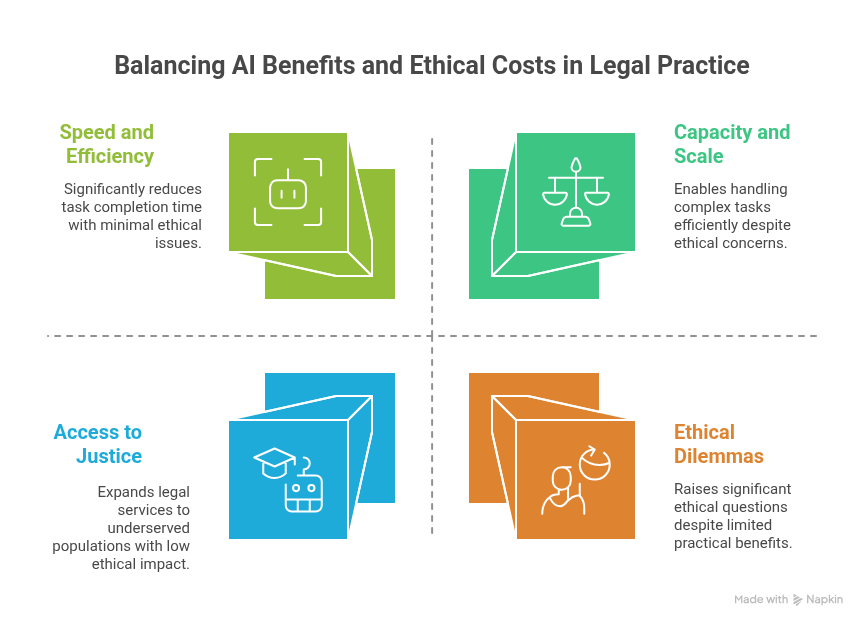
    Balancing Benefits Against Ethical Costs

    The move toward ethical AI is about enabling the benefits while mitigating the harms. When used responsibly, AI offers significant advantages:
    Blog image

    The ethical strategy is to leverage AI for efficiency and scale (routine tasks, summarization, first drafts) while preserving and enhancing the human lawyer’s strategic judgment and accountability (final advice, court submissions, client counseling).

    Related Blog: The Future of Legal Work: How AI Is Transforming Law


    Conclusion: The Moral Imperative of Trustworthy Legal Technology

    AI is a potent force that promises to reshape legal services. Its integration into the daily work of lawyers is inevitable, but its success hinges entirely on responsible, ethical adoption. For legal teams considering or already using AI, the path forward is clear and non-negotiable:

    • Prioritize Competence: Always verify AI outputs against primary legal authorities.

    • Ensure Fairness: Proactively audit tools for bias that could compromise client rights.

    • Guarantee Confidentiality: Demand secure, auditable, and privacy-preserving tools that prohibit client data retention for model training.

    • Enforce Accountability: Maintain clear human oversight and detailed record-keeping for every AI-assisted piece of work.

    Choosing a secure, transparent, and collaborative AI workspace is not merely a performance enhancement; it is a moral imperative. Platforms like Wansom are designed specifically to meet the high ethical standards of the legal profession by embedding oversight checkpoints, robust encryption, and auditable workflows.

    Blog image

    By building their operations on such foundations, law firms can embrace the power of AI without compromising their professional duties, ensuring that this new technology serves not just efficiency, but the core values of justice, competence, and client trust.


  • 10 Everyday Law Firm Tasks AI Can Automate

    The practice of law has long been defined by the meticulous application of human expertise—hours dedicated to deep research, document drafting, and complex analytical thinking. However, the sheer volume of data, coupled with increasing client demands for efficiency and transparent pricing, has created an unsustainable pressure point. This pressure primarily falls on the routine, high-volume tasks that consume associates' time but add minimal strategic value.

    AI is not just a futuristic concept for Silicon Valley firms; it is a suite of tools currently deployed in law firms of all sizes worldwide, fundamentally reshaping the legal workflow. By taking over the tedious, repetitive, and often error-prone tasks that clog up capacity, AI allows lawyers to shift their focus from information gathering to strategic analysis—the work clients truly value. Firms that embrace this technological shift are experiencing competitive advantages, reduced costs, and a significant improvement in work quality.

    This revolution centers on automation. We are moving past simple digitization and into intelligent workflows powered by machine learning (ML) and natural language processing (NLP). The adoption of sophisticated Legal AI is becoming a matter of survival, not just innovation. It’s about leveraging technology to deliver faster, cheaper, and more accurate legal services.


    Key Takeaways:

    1. AI functions as a powerful co-pilot, automating repetitive, low-value legal tasks like e-discovery and document review, allowing lawyers to focus on high-value strategic analysis and client judgment.

    2. Automation provides massive efficiency gains, with AI tools reducing the time and cost associated with high-volume processes like document review and contract triage by up to 80%.

    3. AI transforms decision-making by using litigation analytics to provide data-driven predictions on case outcomes, judge profiling, and opposing counsel strategy, moving beyond traditional legal intuition.

    4. The increased efficiency driven by AI is forcing a strategic shift away from the traditional billable hour model toward predictable, value-based pricing that rewards results.

    5. Successful AI adoption requires rigorous human oversight, strong data security protocols, and verification checks to prevent 'hallucinations' and maintain ethical and professional compliance.


    Is AI Here to Replace the Legal Professional, or Simply Refocus Their Talent?

    This is the most common and critical question facing the industry today. The answer is clear: AI is not designed to replace the nuanced judgment, client empathy, or creative argumentation of a seasoned lawyer. Instead, it is acting as a powerful co-pilot, automating the tasks traditionally performed by junior staff, which previously served as the base of the billable hour pyramid. By eliminating the necessity of countless hours spent on data-intensive processes, AI clears the path for lawyers to dedicate their finite energy to high-value activities: client advisory, complex negotiation, and appellate strategy.

    The law firm of the future is not run by AI, but augmented by it. Automation allows firms to invert the traditional 80/20 rule, where 80% of time was spent collecting information and 20% on strategy. Today’s AI-enhanced firms aim to flip those numbers, dedicating the vast majority of time to strategic advice and client relationship building.

    Further Reading:


    Here are 10 everyday law firm tasks that AI can, and should, automate immediately:

    1. Document Review and E-Discovery: Finding the Needle in the Digital Haystack

    In litigation, M&A, and regulatory compliance matters, firms often face hundreds of thousands, or even millions, of electronic documents (e-discovery). Manually reviewing these documents to identify relevance, privilege, and key information is a time sink that can dwarf the strategic costs of a case.

    How AI Automates It: AI uses machine learning models, trained on millions of legal documents, to quickly categorize, tag, and prioritize documents. After a human lawyer reviews a small seed set of documents, the AI learns what is "hot" (relevant) and what is "cold." It then applies that learning across the entire corpus, accurately identifying relevant documents with vastly superior speed and consistency than a team of human reviewers.

    • Impact: Document review, which historically consumed countless associate hours and budget, can now be reduced by 40% to 80%. Lawyers report that AI systems can find and categorize relevant files in minutes that would take junior lawyers weeks. This efficiency is critical for meeting tight discovery deadlines and significantly cutting client costs. This massive automation is why effective use of AI Tools for Lawyers is now a fundamental competency.

    2. Legal Research and Case Summarisation: Instant Precedent Analysis

    Traditional legal research involves searching large databases, reading through lengthy judgments, and synthesizing complex case law—a process that is both expensive and time-consuming.

    How AI Automates It: Generative AI, combined with proprietary legal databases, allows lawyers to ask complex, natural-language questions (e.g., “Under New York State law, what is the maximum punitive damage cap for a breach of contract case involving fraudulent inducement?”) and receive concise, citable answers grounded directly in case law and statutes.

    Furthermore, AI can summarize entire court opinions, statutes, or regulatory filings in seconds, highlighting the ratio decidendi (the rationale for the decision) and dissenting opinions. This speeds up the research phase dramatically, moving the lawyer quickly into the analysis phase. Tools can also check legal authority citations for validity in real-time, greatly contributing to Reducing Human Error in Drafting before a filing is submitted to the court.

    3. Contract Triage, Review, and Negotiation Prep: Risk Identification at Scale

    In transactional and in-house practices, lawyers must constantly deal with a high volume of contracts, often standard agreements like NDAs, MSAs, and vendor agreements. The task is to quickly identify deviations from standard clauses and assess risk.

    How AI Automates It: AI Contract Lifecycle Management (CLM) systems are game-changers here.

    • Triage: AI automatically identifies the type of agreement and extracts key metadata (parties, effective date, term length) instantly.

    • Risk Review: The system compares the draft contract against the firm’s or client’s pre-approved clause library and policy guidelines. It flags non-standard or risky clauses (like unlimited liability, or a forced arbitration clause in the wrong jurisdiction), allowing a lawyer to focus only on the red flags.

    • Efficiency: A manual contract review and intake process that might take an hour can be executed by AI in under 5 minutes, focusing on high-risk issues like the triage and review of NDAs at massive scale. Studies show up to 80% time savings on standard contract review tasks.

    4. Generation of First Drafts and Routine Legal Documents

    The blank page is the enemy of efficiency. While no AI should generate a final legal product, it is exceptionally good at creating high-quality, boilerplate first drafts, memos, and simple correspondence.

    How AI Automates It: Using approved firm templates and vast data libraries, generative AI can produce drafts that require minimal human editing.

    • Correspondence: Generating routine letters to opposing counsel or clients based on a matter summary.

    • Standard Agreements: Producing initial drafts of a residential lease agreement or a standard confidentiality agreement based on user inputs regarding jurisdiction and parties.

    • Internal Memos: Summarizing meeting transcripts or initial investigation findings into a structured, internal memo format.

    Tools like ChatGPT for Lawyers (when used responsibly and under strict human review) and dedicated legal LLMs can execute this task, allowing the lawyer to use their time editing and refining the content, rather than starting from scratch.

    5. Regulatory Monitoring and Compliance Audits: Staying Ahead of the Curve

    For practices involving financial, healthcare, or environmental law, keeping up with constantly shifting regulatory landscapes is a colossal administrative burden. Missing an update can result in massive fines and non-compliance issues.

    How AI Automates It: AI systems can continuously monitor global legislative and regulatory databases. They identify, track, and flag changes relevant to specific client profiles or industries.

    • Alerting: AI provides instant alerts when new rules are published in a specific jurisdiction (e.g., changes to data privacy laws like GDPR or CCPA).

    • Impact Analysis: The system can analyze a firm’s entire contract portfolio or a client’s internal policy documents against the new regulation, immediately highlighting which documents need revision. This is vital for managing insurance documentation and compliance checks, ensuring all policies adhere to the latest state and federal laws.

    6. Due Diligence and Data Classification in M&A

    Mergers and Acquisitions due diligence involves reviewing thousands of documents—financial records, IP filings, internal memos, and prior litigation records—to assess the target company’s health and risk profile.

    How AI Automates It: AI automates the entire document flow, from ingestion to categorization.

    • Classification: It uses supervised machine learning to classify documents into pre-defined categories (e.g., "Material Contracts," "Employment Records," "IP Agreements").

    • Anomaly Detection: AI flags outliers, such as contracts that lack proper sign-offs, unusually high indemnity clauses, or litigation history involving specific former employees mentioned in employment procedure documents (Procedure for Termination). This ability to rapidly classify and identify critical information is equally vital in litigation preparation, such as analyzing complex medical records and filings necessary for disability appeals (Top 10 Mistakes Attorneys Make in Disability Appeals), where a missed detail can be fatal to the claim.

    Related Blog: How AI powered document review speeds up M&A

    7. Invoice Review and Billable Hour Compliance: Eliminating Billing Friction

    Billing is one of the biggest sources of tension between law firms and corporate clients. Clients demand transparent and compliant billing practices, often rejecting entries that are too vague or outside the scope of the engagement letter.

    How AI Automates It: AI tools analyze time entries against pre-agreed billing guidelines and outside counsel policies.

    • Compliance Checks: The system automatically flags descriptions that are too generic (“Review documents”) or entries that exceed approved rates or maximum daily hours.

    • Prediction: Predictive analytics can estimate the likely cost and time required for a case based on historical data, allowing firms to offer more attractive fixed-fee or value-based arrangements. This automation drastically reduces administrative write-downs and shortens the billing cycle, improving cash flow.

    8. Litigation Analytics and Predictive Strategy: The Data-Driven Advantage

    Lawyers often rely on intuition and past experience when advising clients on whether to settle or proceed to trial, and what motions to file. AI introduces quantitative certainty.

    How AI Automates It: AI analytics platforms ingest vast amounts of public litigation data—court records, judge rulings, opposing counsel performance, and previous case outcomes—and use machine learning to generate predictions.

    • Judge Profiling: It can analyze a specific judge’s history of ruling on similar motions (e.g., summary judgment, Daubert challenges) and even predict likely damages awards.

    • Opposing Counsel Tactics: The system can profile the tendencies and success rates of opposing firms and specific lawyers.

    • Case Outcome Prediction: Based on the facts of the current case and the historical outcomes of similar matters, AI provides a probability range for success, giving clients a data-driven basis for high-stakes decisions. This shifts the lawyer from providing a "gut feeling" to delivering a statistical likelihood.

    9. Client Intake and Conflict Checks: Securing the Engagement Faster

    The process of bringing a new client into the firm—from initial contact to signing the engagement letter and clearing conflicts of interest—is essential but administratively heavy.

    How AI Automates It:

    • Intelligent Forms: AI-powered client intake forms use Natural Language Processing (NLP) to parse unstructured client responses, auto-populate internal matter management systems, and ensure all mandatory disclosures are captured.

    • Conflict Checks: This is a crucial area. AI systems can rapidly cross-reference the names of all related parties, subsidiaries, and counter-parties against the firm's historical client database and internal matter lists to detect any potential conflicts of interest instantaneously. This process, which can take hours of manual database searching, is reduced to seconds, mitigating ethical risks and accelerating the start of the engagement.

    10. Abstracting and Summarizing Depositions and Transcripts

    In complex litigation, depositions can generate thousands of pages of transcripts. Finding key statements, tracking contradictions, or preparing comprehensive summaries for trial preparation is tedious and time-intensive.

    How AI Automates It: Generative AI and NLP tools can analyze these large textual datasets to extract key information automatically.

    • Key Fact Extraction: AI identifies mentions of key dates, names, exhibits, and crucial admissions.

    • Summary Generation: The system generates a condensed, executive summary of the deposition transcript, highlighting the deponent's main assertions and points of vulnerability.

    • Topic Modeling: It can group related sections of the transcript by topic, making it easy for a trial lawyer to quickly jump to all references regarding "product defect" or "knowledge of risk," saving countless hours of manual highlighting and note-taking.


    Beyond Automation: The Fundamental Revaluation of Legal Service

    The automation of these 10 tasks is doing more than just saving time; it is forcing a strategic re-evaluation of what clients are actually purchasing. When machines handle the low-value, repetitive work, the lawyer’s value proposition shifts entirely to judgment, strategy, and empathy.

    This fundamental change is driving the inevitable move away from the Billable Hour. As AI compresses the time required to complete tasks—turning a four-hour research project into a 15-minute verification exercise—the hourly billing model becomes indefensible. Clients are increasingly demanding predictable, value-based, or fixed-fee pricing that rewards results and efficiency, not effort and time logged.

    Managing the Risks: Human Oversight and Ethics

    The rapid adoption of AI is not without critical caveats. The legal profession, bound by strict rules of confidentiality and professional conduct, must approach AI with discipline. Ensuring The Ethical Implications of AI are properly managed is a non-negotiable requirement.

    Every single output from a generative AI model—whether it’s a draft memo, a legal summary, or a conflict check result—must be subjected to human review. Firms must invest heavily in:

    • Data Security: Ensuring client data used to train or run AI models is protected with bank-grade encryption and strict Zero Data Retention policies.

    • Verification: Preventing "hallucinations" (AI generating false or non-existent case citations) by using proprietary, trusted legal data sets.

    • Transparency: Being clear with clients about where and how AI is used in their matter to ensure trust and compliance.

    The Time to Act is Now

    The era of AI in law is no longer theoretical; it is operational. The firms that are winning—attracting top talent, retaining key clients, and demonstrating superior efficiency—are those that have strategically integrated AI automation into their everyday practice.

    By automating tasks like e-discovery, contract review, and routine drafting, law firms are not just streamlining their operations; they are maximizing the strategic potential of their most valuable resource: their lawyers. The shift is already underway, and the competitive gap between firms that embrace automation and those that delay will only widen.

    Blog image

    If you are looking to understand how to systematically implement these efficiencies in your practice, or how AI can specifically transform tasks like contract review and intake, exploring proven platforms is the essential next step.

  • What is Legal AI? Everything Lawyers Need to Know About AI in Legal Practice

    What is Legal AI? Everything Lawyers Need to Know About AI in Legal Practice

    The legal profession is experiencing its most profound transformation since the advent of the internet. Once confined to science fiction, artificial intelligence has rapidly moved from novelty to a practical, high-value set of capabilities that reshape daily workflow across law firms, corporate legal teams, and courts. For lawyers today, the question is no longer if they should use AI, but how to implement it securely, strategically, and ethically—a topic covered extensively in The Ultimate Guide to Legal AI for Law Firms.

    Market estimates vary, but most forecasts agree the Legal AI market is already in the billions of dollars in 2025 and is projected to expand substantially by 2035. Whether the baseline is cited at $1.4 billion or $2.1 billion in 2025, the projected end-state of roughly $7.4 billion by 2035 makes one point obvious: adoption is accelerating, and strategic investment is now a competitive necessity.


    Key Takeaways

    • Legal AI adoption is accelerating, making enterprise-grade AI a strategic priority for competitive firms. Market estimates in 2025 range in the low billions, with projections rising to approximately $7.4 billion by 2035.

    • The lawyer’s primary duty when using AI is verification. Every AI output must be reviewed and validated before it informs advice, filings, or client deliverables.

    • Generative AI shifts the lawyer’s role from drafting to editing and analysis, with conservative estimates suggesting firms can save up to 240 hours per lawyer annually on routine tasks. This efficiency challenge often pits AI vs the billable hour: How legal pricing models are being forced to evolve.

    • Protect client confidentiality by using enterprise-grade, isolated AI workspaces that guarantee non-retention of data and strong encryption.

    • Core high-value applications include automated document review, semantic legal research, first-pass drafting, contract lifecycle management, and centralized institutional knowledge.


    What is Legal AI in practical terms?

    Legal AI is the application of machine learning, natural language processing, and large language models to legal tasks. In practice it performs three distinct functions:

    • Interpretation: reading and extracting meaning from legal text such as cases, contracts, and statutes.

    • Prediction: using historical data to forecast tendencies, outcomes, or risks.

    • Generation: creating legal text such as draft clauses, summaries, or research memos. Unlike earlier rule-based tools or keyword search utilities, modern Legal AI reasons over context, synthesizes multiple sources, and can generate coherent first drafts using generative models. Crucially, it amplifies human judgment rather than replacing it.

    Core components of Legal AI and how they work

    Understanding the technology avoids vendor hype and helps set correct expectations.

    • Natural language processing (NLP): NLP enables the system to parse legal sentences, identify parties, obligations, conditions, restrictions, and to classify documents by type.

    • Machine learning (ML): ML identifies patterns in labeled data and improves performance through supervised feedback. In e-discovery, for example, ML learns relevance from human-coded samples and scales that judgment across millions of documents.

    • Generative AI and large language models (LLMs): GenAI creates new text based on learned patterns. It can draft clauses, summarize opinions, or propose negotiation language. Its power also introduces the risk of confident but false outputs, commonly called hallucinations.


    High-impact use cases and measurable benefits of Legal AI

    The most successful AI initiatives in law firms focus on repeatable, high-volume workflows where precision and turnaround time directly affect outcomes. The following categories represent the strongest ROI across modern legal practice.

    1. Document review and due diligence

    Use case: M&A transactions, litigation discovery, regulatory audits, and large-scale investigations.
    Technologies: Technology-assisted review, clustering engines, predictive coding.
    Value: Review volumes can drop by 50 percent or more while improving the speed at which privileged, confidential, or high-risk materials are identified.
    Implementation tip: Combine AI-generated predictions with human sampling and continuous re-training until your recall and precision scores reach acceptable thresholds.

    2. Semantic legal research and analysis

    Use case: Issue spotting, argument refinement, rapid case synthesis, doctrinal mapping.
    Technologies: Semantic search, citation graph analysis, automated summarization.
    Value: Accelerates access to controlling authorities and strengthens the analytical foundation for strategic decisions.
    Implementation tip: Always verify AI-generated case citations against trusted primary databases. For tool selection guidance, see Best Legal AI Software for Research vs Drafting: Where Each Shines.

    3. First-pass drafting and clause management

    Use case: NDAs, routine commercial agreements, initial drafts of memos or letters.
    Technologies: GenAI drafting systems, clause libraries built on firm precedents.
    Value: Lawyers shift from typing to editing; quality becomes more consistent and drafting cycles shrink significantly.
    Implementation tip: Maintain a curated, approved clause library and configure your AI workspace to prioritize firm-preferred language.

    4. Contract lifecycle management and monitoring

    Use case: Tracking post-execution obligations, renewals, client commitments, and compliance requirements.
    Technologies: Rule-based engines, obligation extraction models, automated alerts.
    Value: Prevents missed deadlines, reduces compliance exposure, and supports automated remediation workflows.
    Implementation tip: Sync CLM outputs with internal calendars or matter management systems to ensure clear ownership of each follow-up action. AI for Corporate Law: Enhancing Compliance and Governance.

    5. Knowledge management and collaborative AI workspaces

    Use case: Transforming firm knowledge into a searchable, queryable internal asset.
    Technologies: Private model fine-tuning, secure search layers, metadata-preserving ingestion pipelines.
    Value: Unlocks institutional expertise, reduces dependence on specific individuals, and improves work consistency across teams.
    Implementation tip: Retain original documents and metadata during ingestion to maintain auditability and avoid knowledge drift. For broader workflow examples, see 10 Everyday Law Firm Tasks AI Can Automate.


    Quantifying the ROI: time, accuracy, and focus

    Adopting AI in your legal workflow, yields three measurable outcomes:

    • Time savings: Routine tasks shrink from hours to minutes. Conservative internal estimates show savings of 1 to 5 hours per user per week for drafting and summarization tasks, which scales to roughly 240 hours per lawyer per year in high-adoption practices. This helps answer the debate: Will AI make lawyers lose their jobs or make them richer?

    • Accuracy gains: Automated clause detection and cross-checking reduce human error in large datasets where manual review is infeasible.

    • Strategic time reallocation: Time reclaimed from repetitive work is redeployed to higher-value counseling and business development.

    The ethical and security imperatives you cannot ignore

    Regulatory and professional obligations place the burden of safe AI use squarely on legal practitioners. There are three critical risk areas.

    Hallucinations and the duty of verification: Generative models can produce plausible-sounding but incorrect citations or analyses. The duty to verify is both ethical and practical. Action checklist:

    Require human review of all AI outputs before client or court use. Confirm primary-source citations in an authoritative legal database. Maintain a mandatory sign-off workflow for any filing or advice based on AI output. For a complete guide on responsible use, read The Ethical Playbook: Navigating Generative AI Risks in Legal Practice [Link: The Ethical Playbook: Navigating Generative AI Risks in Legal Practice].

    5.2 Client confidentiality and data security Feeding client data into consumer-grade AI or public LLMs can risk exposure and unauthorized retention. This falls under the broader topic of The Ethical Implications of AI in Legal Practice [Link: The Ethical Implications of AI in Legal Practice]. Vendor vetting checklist:

    Contractual clause preventing data retention or reuse for model training. Encryption in transit and at rest, including key management. SOC 2 or ISO 27001 attestation. Data isolation or private model hosting options. Clear data deletion and audit capabilities.

    5.3 Algorithmic bias and fairness AI models reflect training data. When that data includes historical bias, models can reproduce or amplify it. Mitigation steps:

    Require vendors to provide bias testing results and fairness metrics. Limit use of predictive models in high-stakes contexts unless proven equitable. Implement human oversight and appeal pathways for AI-driven decisions.


    6. A practical adoption playbook for law firms

    Integrating AI is a program, not a purchase. Use this phased plan to minimize risk and maximize benefit.

    Phase 0:

    Pre-adoption assessment Identify priority use cases with measurable ROI. Map current workflows and data sources. Form a cross-functional adoption committee including partners, IT, compliance, and a legal technologist.

    Phase 1:

    Pilot (30 to 90 days) Select a single use case (e.g., M and A document review or automated NDAs). Choose one vendor and one practice team. Define metrics, success criteria, and review cadence. Train staff and document governance protocols.

    Phase 2:

    Scale Expand to adjacent teams and add 2 to 3 more use cases. Build an internal clause library and validated prompts. Integrate with existing matter management or document repositories.

    Phase 3:

    Institutionalize Incorporate AI use into engagement letters, billing guidelines, and training curriculum. Maintain a vendor review schedule and continuous bias/accuracy audits. Add AI adoption metrics into partner compensation where appropriate.

    9. Prompts and templates: a short prompt primer for lawyers

    Good prompts make outputs reliable and efficient. Start with structured prompts that include context, constraints, and output format.

    Example prompt for a first-pass NDA:

    You are a legal drafting assistant. Using the firm clause library labeled "Standard NDA v3", draft a one-page mutual nondisclosure agreement for a software licensing negotiation governed by Kenyan law. Include a 60-day term for confidentiality obligations, an exception for compelled disclosure with notice to disclosing party, and an arbitration clause in Nairobi. Provide a short explanation of two negotiation risks at the end.

    Example prompt for case summarization:

    Summarize the following judgment into a 300-word executive summary that highlights the facts, ratio, dissenting points if any, and any procedural bars. List key citations with paragraph references and suggest three argument angles for the claimant.

    These structured prompts reduce hallucination risk and create more consistent outputs. For more examples, check out our detailed guide of the Top 13 AI Prompts Every Legal Professional Should Master.

    10. Measuring success and ongoing governance

    Measure both adoption and outcomes. Key metrics to track:

    • Percentage of matters using AI-enabled workflows.

    • Average time to first draft. Error rate in automated clause filling.

    • Client satisfaction scores on matters using AI.

    • Number of AI-related incidents or near misses.

    • Cost savings per matter and change in realization rates.

    • Run quarterly audits to validate performance and a yearly governance review to update policies, training, and vendor agreements.


    The future: new roles and durable competitive advantage

    AI creates new legal roles: legal data scientists, AI compliance managers, and prompt engineers. Firms that invest in these capabilities will not only be more efficient but will be better at turning institutional knowledge into repeatable commercial products and services. In the African context, regionally tuned AI that respects local law, language, and practice patterns will be especially valuable. This is exactly why Why Wansom is the Leading AI Legal Assistant in Africa.

    Conclusion

    Legal AI is not optional. It is an infrastructure shift that requires deliberate strategy, secure platforms, and disciplined governance. Start small, validate quickly, scale deliberately, and keep ethics front and center. Immediate action plan for the next 90 days:

    Select one low-risk, high-volume pilot (document review, NDAs, or research). Pick a vendor that meets your security checklist and sign a limited pilot agreement. Train one practice team and establish the verification workflow. Update the retainer template with an AI disclosure clause. Measure, learn, and expand.

    Blog image

    By following these steps you safeguard professional responsibility while unlocking the productivity and strategic benefits that define the next decade of legal practice.

  • The Future of Legal Work: How AI Is Transforming Law

    The Future of Legal Work: How AI Is Transforming Law

    The legal world is experiencing a seismic shift, one far more profound than the arrival of the internet or the desktop computer. This transformation is driven by Generative AI, and it is fundamentally redefining the relationship between time, expertise, and value.

    For decades, the practice of law relied heavily on manual processes: sifting through mountains of documents, performing arduous legal research, and drafting contracts from scratch. These necessary, but often repetitive, tasks formed the profitable foundation of the billable hour and the traditional law firm pyramid. Today, that foundation is dissolving under the immense power of intelligent automation.

    Law firm partners and Legal Operations managers are no longer asking if AI will change their business; they are scrambling to understand how quickly they must adopt it to remain competitive and profitable. The change is not about replacing lawyers; it’s about augmenting legal intelligence, liberating high-value talent from drudgery, and positioning the modern firm as a truly strategic, efficient, and data-driven partner.

    This article serves as a strategic roadmap for every legal professional navigating this inflection point. We will dissect the three phases of AI adoption, examine the crucial role of secure and collaborative legal tech—like Wansom—and outline the structural changes required to thrive in the new era of law.


    Key Takeaways:

    • Discover how AI is creating an inescapable "efficiency arbitrage" that is forcing law firms to abandon the billable hour and pivot toward profitable value-based pricing.

    • Learn why failing to adopt Generative AI immediately risks the loss of high-value associate talent and the marginalization of your firm by more efficient, modern competitors.

    • Understand how the lawyer's primary role is rapidly evolving from performing manual drudgery to becoming an AI-augmented strategist focused solely on judgment and complex client counsel.

    • Find out how a secure, collaborative legal tech platform is non-negotiable for safeguarding client data while maximizing automation in drafting, review, and legal research.

    • Review the four-step strategic roadmap necessary to successfully implement AI, secure partner buy-in, and redefine compensation structures within your firm for sustained profitability.


    The Unavoidable Collision: Why AI Adoption Is Not Optional

    The decision to integrate AI is no longer a matter of technological curiosity; it is an economic necessity driven by pressure from both the market and the competition. Firms that hesitate risk being marginalized by those that embrace the change.

    The Economic Mandate: Efficiency as the New Arbitrage

    The first pressure point is cost. Corporate legal departments are now run like precision-engineered business units, with Legal Operations professionals demanding cost predictability and efficiency. If a competing firm uses Wansom’s AI-powered document review to complete a due diligence task in 10 hours instead of the traditional 100, the firm charging 100 hours (even if they use the billable hour) loses the work.

    AI creates a massive efficiency arbitrage. The firm that can deliver the same, or better, quality of work for a fraction of the time input wins the business. This economic pressure forces firms away from the volume-based model of the past and toward a value-based pricing structure, where clients pay for the outcome and the expertise, not the time spent clicking.

    The Competitive Mandate: The Race for Talent

    The future of legal work also hinges on talent acquisition and retention. Younger, highly skilled legal professionals, raised in a digital-first world, expect modern tools. They do not want to spend their time performing soul-crushing, high-volume, low-value tasks that they know an AI tool can handle.

    Firms that fail to integrate technology like Legal Automation into their workflows risk losing their best associates to more innovative competitors. AI tools, far from being a threat to jobs, are becoming a key recruiting benefit—a signal that the firm respects its professionals' time and prioritizes sophisticated, strategic work.

    Related Blog: Why


    Phase 1: Automation — Eliminating the Drudgery

    The initial phase of the AI transformation focuses on the elimination of repetitive, predictable, and high-volume tasks. This is where firms see the fastest return on investment and where the majority of billable hour risk resides.

    Legal Document Automation and Review

    The sheer volume of documents generated in modern litigation and transactions is staggering. Traditionally, paralegals and junior associates would manually review tens of thousands of documents for relevancy, privilege, and key clauses—a process that was expensive, error-prone, and slow.

    AI’s Impact: AI-powered document review systems, which are foundational to collaborative workspaces like Wansom, transform this process:

    • Pace and Scale: AI can ingest and process millions of documents in hours, identifying patterns and relationships that a human would take weeks to spot.

    • Relevance Prediction: The system learns from human tagging to predict the relevance and sensitivity of untagged documents, focusing human reviewers only on the most critical files.

    • Wansom’s Advantage: Wansom ensures that this high-speed review occurs within a secure, collaborative workspace. Attorneys can tag, annotate, and share insights on documents reviewed by the AI in real time, dramatically improving team velocity and maintaining data integrity.

    Contract Analysis and Standardization

    For transactional practices (M&A, corporate), contract analysis is the lifeblood. AI now provides comprehensive, instant analysis of complex agreements.

    • Clause Identification: AI can instantly locate, extract, and compare specific clauses (e.g., indemnification, termination, governing law) across hundreds of contracts.

    • Risk Flagging: Advanced AI models can flag deviations from standard or preferred language, identifying potential risks faster than human eyes.

    • Template Generation: This automated analysis feeds directly into legal document automation. Wansom allows legal teams to convert their firm’s best-practice contracts into dynamic templates, ensuring consistency, reducing errors, and accelerating the drafting of initial agreements from days to minutes. This is critical for scaling high-quality, standardized legal output.

    Legal Research Automation

    Traditional legal research, characterized by complex Boolean searches and endless hours spent cross-referencing case law, is rapidly becoming obsolete.

    • Synthesis, Not Search: Modern Generative AI Legal Research tools don’t just return links; they synthesize complex legal doctrines, provide concise summaries of applicable precedents, and identify potential conflicts in case law.

    • Predictive Analytics: AI goes a step further, using massive data sets to predict litigation outcomes, anticipate judicial leanings, and guide strategy—moving research from a search function to a strategic planning tool.


    Phase 2: Augmentation — The Rise of the AI-Powered Lawyer

    While Phase 1 focused on automation (the 'doing' of law), Phase 2 centers on augmentation (the 'thinking' of law). AI becomes a sophisticated co-pilot, enhancing the lawyer’s judgment, strategy, and creative output.

    Generative AI for Drafting and Strategy

    The ability of Generative AI to produce high-quality, context-aware text is the most disruptive force in legal practice today.

    • First-Draft Generation: Lawyers spend an inordinate amount of time on first drafts of motions, memos, and client communications. Wansom’s secure AI features allow lawyers to input a brief prompt—"Draft a motion to dismiss based on lack of personal jurisdiction, referencing these five cases"—and receive a structured, well-cited starting point instantly. This shifts the lawyer's work from creating text to editing and refining strategy.

    • Knowledge Consolidation: For any Collaborative Legal Tech platform, the key is securely leveraging a firm’s internal knowledge. Wansom’s AI can be trained on a firm's own successful motions, proprietary templates, and best-practice advice, making the output instantly relevant to the firm’s specific client base and style. This harnesses institutional knowledge that was once trapped in hard drives and silos.

    Strategic Case Analysis and Simulation

    AI is moving from summarization to simulation, providing powerful tools for strategic decision-making.

    • Issue Spotting and Risk Assessment: For litigation, AI can review all pleadings, discovery, and deposition transcripts to identify latent or hidden issues, contradictions in witness statements, or overlooked procedural requirements that could change the case trajectory.

    • Scenario Planning: By analyzing historical case data and current facts, advanced AI tools can run simulations, estimating the probability of various outcomes (settlement, trial win/loss) under different legal theories or jurisdictions, allowing lawyers to advise clients with data-driven confidence.

    Real-Time Client and Team Collaboration

    The sheer volume of data and the speed of modern legal practice demand instant, secure teamwork.

    • Shared Workspace: Collaborative platforms like Wansom eliminate email chains and version control chaos. All team members—partners, associates, and Legal Operations staff—work on the same live documents and research notes simultaneously, accelerating project delivery.

    • Secure External Access: Crucially, Wansom extends this collaborative efficiency to the client, providing controlled, secure access for in-house counsel to review drafts, track progress, and provide feedback, boosting transparency and client satisfaction.


    The New Imperative: Security and Ethical Use in the AI Era

    For law firms, the adoption of AI is tethered to profound ethical and security responsibilities. The use of generic, consumer-grade AI tools poses unacceptable risks to client confidentiality and data integrity.

    Data Security: The Non-Negotiable Requirement

    Client data is the lifeblood and highest liability of any law firm. The use of large language models (LLMs) requires assurances that sensitive information is not exposed or used to train external, public models.

    • Wansom’s Approach: Secure by Design: Wansom is built specifically for the legal domain, operating within a secure perimeter that ensures client data remains private, encrypted, and isolated. This commitment to security prevents the inadvertent sharing of confidential matter details or trade secrets, which is a major risk when using public AI interfaces.

    Addressing Hallucinations and the Duty of Verification

    Generative AI, while powerful, is not infallible. It is prone to "hallucinations"—generating confident, but false, information, including fake case citations.

    • The Lawyer’s Role: AI does not remove the lawyer’s ultimate duty of care to the client. The AI-powered lawyer must treat AI output (research, drafts) as a sophisticated junior associate’s work—it must be verified, checked against the source, and validated for accuracy and jurisdiction-specific relevance.

    • Wansom’s Solution: By integrating AI directly within the firm's controlled, internal environment, Wansom links AI outputs directly to the source documents or established internal knowledge bases, making the verification process faster and more reliable than using external, ungrounded tools.

    Preserving Institutional Knowledge

    As AI handles more routine work, the firm must ensure the insights gleaned from that work are captured, not lost.

    • Knowledge as a Resource: The legal profession’s ultimate asset is its accumulated experience. The future of legal work relies on platforms that automatically tag, categorize, and synthesize the collective outcomes of thousands of matters, ensuring that the firm's efficiency increases over time. This turns a firm's data into a valuable, proprietary resource.


    The Impact on Law Firm Business Models and Talent Strategy

    The technological shift mandates an equal revolution in the firm’s structure, financial models, and approach to human capital.

    The Financial Pivot: From Hours to Value

    The conflict between AI efficiency and the billable hour is driving an inevitable pivot toward new legal pricing models.

    • Value-Based Pricing: Firms must transition to pricing based on the value delivered, the risk mitigated, or the successful outcome achieved, rather than the effort expended. This requires sophisticated predictive analytics to accurately scope and price fixed-fee or capped-fee arrangements.

    • The Role of Legal Operations (LegalOps): LegalOps professionals are the architects of this change, focusing on process standardization, data quality, and the implementation of technologies that guarantee profitability within the fixed-fee structure. They bridge the gap between legal expertise and business efficiency.

    Talent Strategy: Upskilling the Legal Workforce

    AI fundamentally changes the required skill set for the modern lawyer.

    • The New Junior Associate: The associate’s primary value will no longer be in the execution of discovery or first-drafting. Instead, they will be valued for prompt engineering (knowing how to ask the AI the right questions), data analysis, and strategic editing of AI-generated work.

    • The Partner’s Evolution: Partners will rely on AI to enhance their strategic output and client advisory role. Their focus will shift almost entirely to high-value, non-routine strategic counsel, client relationship management, and complex litigation—the areas where human judgment remains paramount.

    • The Upskilling Imperative: Firms must invest heavily in training programs that teach lawyers how to interact with and validate AI output. The goal is to move from being timekeepers to being high-leverage knowledge workers.


    A Strategic Roadmap for AI Adoption: Four Steps to Transformation

    Implementing AI is a strategic journey that requires methodical planning and dedicated commitment from firm leadership. Here is a practical four-step roadmap for a successful transition.

    Step 1: Define and Standardize Data Workflows

    Before deploying any AI, a firm must standardize the inputs. AI is only as good as the data it is trained on and the structure of the task it is given.

    • Audit and Cleanup: Identify and clean up existing data—client matter histories, firm templates, and successful pleadings. This ensures the AI has a reliable, high-quality knowledge base to draw upon.

    • Template Discipline: Mandate the use of standardized templates for common documents. Wansom facilitates this by making it easy to convert proprietary documents into dynamic, firm-wide templates, guaranteeing consistency in both input and output.

    Step 2: Implement Targeted Pilot Programs

    Avoid the temptation to deploy AI across the entire firm at once. Start with high-volume, low-risk, and predictable tasks where the benefits are easily measurable.

    • Focus Areas: Begin with a pilot in contract review (using AI to identify specific clauses) or due diligence (using AI for first-pass document tagging). These tasks yield quantifiable results (time saved, cost reduced) that can be used to build internal enthusiasm.

    • Measure Margin: The metric should be internal efficiency and margin improvement on fixed-fee work, demonstrating how AI increases profitability.

    Step 3: Gain Partner Buy-in and Redefine Compensation

    No AI initiative will succeed if it is perceived as a threat to partner income. Firm leadership must champion the change.

    • Shift Metrics: Amend partner compensation and associate bonus structures to reward efficiency, profitability (margin), client satisfaction, and technological mastery, moving away from a strict hourly metric.

    • Showcase Success: Use the data from the pilot programs (Step 2) to clearly demonstrate to partners how AI enables higher revenue generation from a smaller, more focused team—freeing up high-value human time for high-margin strategic counsel.

    Step 4: Choose the Right Platform — Security and Collaboration First

    The platform choice determines the success of the long-term strategy. The technology must be secure, integrated, and designed for legal workflow.

    • Beyond Generic LLMs: Avoid reliance on public, general-purpose LLMs that compromise client confidentiality. Select a secure, collaborative legal tech environment built specifically for sensitive legal data.

    • Integration and Future-Proofing: The platform, like Wansom, must integrate seamlessly with existing matter management and financial systems, and be designed to evolve as AI capabilities advance. Wansom is the foundation for an AI-augmented legal future, providing the secure workspace where lawyers can automate, collaborate, and advise with confidence.


    Conclusion: Seizing the Opportunity of AI

    The future of legal work is not coming; it is here. The age of the human lawyer acting as a high-priced robot is over, replaced by the AI-augmented legal strategist.

    Law firms that embrace AI in law now are not simply adopting a new tool; they are fundamentally restructuring their economic model to align with client demands for predictability, transparency, and value. This transformation demands not just a new software subscription, but a secure, collaborative workspace that respects the confidential nature of legal work while maximizing efficiency.

    By implementing a trusted platform like Wansom, your firm can move immediately to automate the drudgery, secure client data, and liberate your most talented lawyers to focus on the high-value strategic counsel that defines the modern, profitable practice. The question isn't whether your firm can afford to adopt AI, but whether it can afford not to.

    Blog image

    Ready to start your journey into the AI-augmented legal future? Check out Wansom

  • How AI is Transforming Insurance Documentation: A Legal Shift

    How AI is Transforming Insurance Documentation: A Legal Shift

    In the highly regulated world of insurance, documentation is the foundation of every legal liability and financial transaction. From the initial Insurance Proposal Form to the final Insurance Claim Release & Settlement Template, every paper and digital document is a high-stakes legal instrument. Historically, the burden of ensuring precision, compliance, and consistency across thousands of policyholder and claims files has driven legal teams toward painstaking, manual processes—a workflow highly susceptible to human error, which, in insurance, translates directly into massive financial and regulatory risk.

    The rise of Artificial Intelligence (AI) is not just an incremental improvement; it is fundamentally redefining the role of legal professionals in the insurance sector. AI-powered collaborative workspaces, such as Wansom, are shifting the focus from manual data entry and drafting to high-value strategic review, automating the lifecycle of documentation from initial contract generation to final dispute resolution.

    This expert guide details the transformative impact of AI on insurance documentation, providing a strategic framework for legal teams to leverage these tools for radical improvements in compliance, speed, and defense readiness.


    Key Takeaways:

    • AI's core function is to enforce consistency and compliance across all documentation, thereby eliminating the systemic Human Error Tax inherent in manual drafting.

    • By scanning regulatory feeds, AI platforms guarantee Dynamic Template Generation, ensuring documents are instantly compliant with rapidly changing AML/CTF and privacy rules.

    • In contract formation, AI provides Contextual Question Generation and confirms policy statements are phrased as legally safer Representations instead of rigid Warranties.

    • For claims closure, AI performs Surgical Clause Analysis on the Claim Release Form, ensuring the client does not inadvertently waive the crucial Waiver of Unknown Claims.

    • AI-guided templates are essential for litigation defense, forcing adherence to Procedural Compliance Checklists and the Ethical Attestation required for defensible Expert Witness Reports.


    The AI Imperative: Mitigating Risk and Guaranteeing Consistency

    AI’s primary value proposition in insurance documentation is its ability to enforce consistency and mitigate the systemic risks inherent in human-driven document creation.

    1. Eliminating the Human Error Tax

    Manual drafting and review are fertile ground for errors—a misplaced decimal point, an incorrect jurisdictional clause, or the omission of a critical disclosure. In insurance law, these errors can invoke the doctrine of contra proferentem (ambiguity interpreted against the drafter) or lead to policy voidance.

    • Pattern Recognition: AI tools scan vast libraries of historical case law and millions of documents to identify statistically high-risk phrases, ensuring that ambiguous or claimant-favorable language is flagged immediately during drafting.

    • Compliance Guardrails: AI automatically checks documents against regulatory mandates (e.g., state-specific disclosure requirements for beneficiary forms) before the document is ever presented to a client or counterparty.

    2. The Speed of Regulatory Change

    Insurance regulation is dynamic, with constant updates in areas like data privacy, AML/CTF, and mandatory disclosure requirements. Manual template updating simply cannot keep pace with this rapid change, exposing firms to regulatory fines.

    • Dynamic Template Generation: AI platforms are trained on continuous regulatory feeds. When a rule changes (e.g., a new state requirement for cancellation notices), the underlying template is updated instantly across the entire platform, guaranteeing that every newly generated document is compliant.

    Related to: Understanding AML/CTF Compliance in Insurance

    3. Securing Data and Access Control

    Insurance documents contain highly sensitive, protected data (PHI, financial history). Managing access, version control, and audit trails manually is a major security liability.

    • Immutable Audit Trails: AI-powered document platforms provide cryptographic, immutable audit trails for every access, change, and e-signature event, creating a perfect defense record for regulatory scrutiny.

    • Role-Based Access: Ensuring that only authorized legal and compliance personnel can access or modify high-risk documents (like the AML/CTF manual) is managed automatically by the platform's intelligent permissions system.

    AI Across the Document Lifecycle: From Inception to Closure

    The true power of AI is realized when it is deployed across all three critical phases of an insurance relationship: Contract Formation, Compliance & Review, and Claims & Litigation.

    Phase 1: Intelligent Contract Formation and Drafting

    AI fundamentally accelerates the creation of the binding agreement, moving beyond simple find-and-replace to context-aware drafting.

    A. Generating the Legally Sound Proposal Form

    The Insurance Proposal Form is the foundational document establishing the policyholder's representations of risk. A single error can lead to a policy being voided ab initio due to material misrepresentation.

    • Contextual Question Generation: AI tailors the questions based on the client's jurisdiction, industry, and previous claims history, ensuring that all legally mandated disclosure fields are included and presented clearly.

    • Warranty vs. Representation Check: AI ensures that high-stakes policy statements are correctly phrased as representations (to the best of knowledge and belief) rather than rigid warranties (guaranteed as true), strategically lowering the policyholder’s risk profile.

    Related to: How to Draft a Legally Sound Insurance Proposal Form (Step-by-Step)

    B. Customizing Comprehensive Coverage Contracts

    Drafting the Comprehensive Insurance Coverage Contract Template for unique commercial clients traditionally takes weeks of manual clause comparison and insertion.

    • Automated Clause Comparison: AI instantly compares a newly drafted contract against historical, high-liability claims data to recommend stronger, claimant-protective language in areas like the Notice of Claim/Loss Clause and the Subrogation Clause.

    • Jurisdictional Clause Insertion: The platform automatically inserts the correct state-specific language for non-judicial clauses, such as the Choice of Law and Jurisdiction section, removing the need for manual verification against regional legal statutes.

    Related to: Essential Clauses in a Comprehensive Insurance Contract

    Phase 2: Compliance, Review, and Risk Identification

    AI’s strength in compliance lies in its non-tiring ability to review documents against regulatory and legal criteria, identifying hidden risks that human reviewers often miss.

    C. Verifying Anti-Money Laundering (AML) Compliance

    The AML/CTF Compliance Manual and its associated documentation are high-risk areas. AI streamlines Customer Due Diligence (CDD) and Enhanced Due Diligence (EDD) procedures.

    • PEPs and Sanctions Screening: AI systems can instantaneously check policyholder names, beneficiaries, and premium sources against global sanctions lists (OFAC, etc.) and politically exposed persons (PEPs) databases, flagging high-risk scenarios before the policy is bound.

    • Red Flag Detection: In the claims phase, AI monitors for patterns indicative of money laundering, such as large, early policy surrenders or suspicious fund transfer requests, which require the immediate filing of an STR/SAR.

    D. Auditing Life Insurance Beneficiary Designations

    Life insurance beneficiary forms are administrative documents with critical legal weight. Errors in these forms are a leading cause of estate litigation.

    • Conflict and Hierarchy Check: AI audits a submitted Life Insurance Beneficiary Form against the client’s known probate status, flagging the high-stakes errors of:

      1. Override Mistake: Identifying contradictions between the designation form (contract law) and the client’s will (probate law).

      2. Minor Naming: Automatically flagging the direct naming of a minor, recommending the insertion of a Custodian under UTMA/UGMA or the designation of a Trust.

    Related to: Life Insurance Beneficiary Forms: Common Mistakes to Avoid

    Phase 3: Claims Closure and Litigation Support

    In the litigation phase, AI accelerates the finalization of settlements and bolsters the evidentiary strength of legal submissions.

    E. Expediting Claim Release and Settlement

    The execution of the Insurance Claim Release & Settlement Template is the final, irreversible act in a claim. AI ensures this document is legally sound and finalized at maximum speed.

    • Release Clause Analysis: AI uses natural language processing (NLP) to perform a surgical review of the document, flagging two critical areas: the extent of the Waiver of Unknown Claims and the precise list of Released Parties, ensuring the client is not giving up more rights than negotiated.

    • Lien Management: The platform integrates with third-party lien verification services, ensuring that Subrogation and Lien Clauses are satisfied before payment is disbursed, mitigating the client's indemnification risk.

    F. Generating Defensible Expert Witness Reports

    An Insurance Expert Witness Report is only as valuable as its adherence to strict evidentiary rules (e.g., Daubert). Manual compliance with these rules is time-intensive.

    • Procedural Compliance Checklist: Wansom’s template, guided by AI, forces adherence to procedural mandates by ensuring the expert has included: the required Ethical and Procedural Attestation statement, the full list of compensation and prior testimony, and the detailed Methodology Section required for Daubert challenges.

    • Fact-to-Opinion Bridge: AI reviews the logical flow, ensuring the expert’s ultimate opinion is directly and defensibly linked to the foundational facts and data cited, bolstering the report’s credibility in arbitration or court.

    Related to: How to Write a Strong Insurance Expert Witness Report

    Wansom: Unifying AI-Driven Legal Workflow

    The transformation of insurance documentation requires a unified, secure platform. Wansom is designed not merely as a repository for templates but as a proactive, intelligent ecosystem that oversees the document lifecycle from creation to archival.

    Wansom’s AI capabilities are embedded at every touchpoint:

    • Centralized Template Management: Instantaneous deployment of templates (like the Official Insurance Claim Form or Insurance Payout Discharge Voucher) that are pre-vetted against the latest regulatory changes.

    • Collaborative Review: Legal and compliance teams can simultaneously review documents, with AI suggesting real-time improvements for clarity, compliance, and risk avoidance, dramatically cutting the time needed for internal sign-off.

    • Immutable Archival: Every final document, including the binding Insurance Ombudsman Complaint Form and settlement agreement, is stored with an auditable, cryptographic timestamp, guaranteeing its non-repudiation in future disputes.

    Conclusion: The New Standard for Legal Precision

    The future of insurance law is inseparable from AI. Manual documentation processes are no longer tenable in a landscape defined by rapid regulatory change and high litigation risk. By adopting AI-powered platforms like Wansom, legal teams are not just achieving time savings; they are establishing a new standard of legal precision, guaranteeing consistency across all documentation, and moving the firm's focus from administrative risk mitigation to strategic advocacy.

    The shift to AI is the difference between drafting a document that might be compliant and generating one that is guaranteed to be legally sound and ready for regulatory scrutiny. This is the competitive advantage of the modern legal practice.

    Transition to Intelligent Documentation

    Stop managing risk and start mastering it. The power of AI to transform your insurance documentation workflow is here.

    Explore the Wansom platform and access the full suite of free, AI-optimized templates.

    Blog image

    Related to: The Complete Legal Guide to Insurance Documentation and Compliance [Free Templates]

  • Why Wansom is the Leading AI Legal Assistant in Africa

    Why Wansom is the Leading AI Legal Assistant in Africa

    In the past five years, few topics have captured the legal world’s imagination quite like artificial intelligence. What started as an experimental tool for research is now shaping how contracts are drafted, disputes are analyzed, and compliance is managed. At the heart of this transformation is the AI legal assistant; software designed to mimic the support once provided only by paralegals, junior associates, or specialist researchers.

    What is an AI Legal Assistant?

    At its simplest, it’s a platform that leverages machine learning, natural language processing (NLP), and automation to help lawyers perform tasks faster, more accurately, and at lower cost. Instead of spending days reviewing case law, attorneys can ask an AI legal assistant to surface the most relevant precedents. Instead of manually drafting every contract clause, firms can use AI-powered drafting tools that produce compliant, customizable templates in minutes.

    Recent reports suggest a majority of law firms in many developed markets have adopted AI tools with estimates ranging from 50-70% in some studies; though detailed analyses specific to African legal systems remain limited.

    That’s where Wansom enters the picture. Unlike Silicon Valley startups, Wansom was designed with African law firms and in-house counsel in my mind thus blending world-class AI capabilities with deep local legal expertise.


    The AI Legal Assistant Revolution: Market Overview 2024

    Legal professionals have long faced two unrelenting pressures: the need to work faster and the need to reduce costs. AI legal assistants emerged as the solution to both, offering automation that reduces repetitive work without compromising on quality.

    Key Global Trends

    • Contract Review and Drafting: Platforms like Spellbook and Harvey AI have shown that 60–70% of standard clauses can be generated or reviewed by AI, freeing lawyers for strategic tasks.

    • Case Law Research: Tools integrated with vast legal databases can cut research time by 40% or more.

    • Compliance and Risk Analysis: AI can flag regulatory risks faster than manual review, especially in highly regulated industries like banking and energy.

    • Client Demand: Corporate clients increasingly expect law firms to adopt technology that improves efficiency.

    Gartner projects that the global legal technology market will surpass $45 billion by 2030, with AI solutions being the fastest-growing segment.


    Africa’s Legal Technology Gap and Opportunity

    While North America and Europe lead in adoption, Africa is positioned as the next frontier for AI in law.

    1. Fragmented Legal Systems: Africa has a mix of common law, civil law, and hybrid systems, making legal work complex for cross-border firms. AI tools that understand these nuances are invaluable.

    2. Language Barriers: With English, French, Portuguese, Arabic, and dozens of local languages in play, multi-language support is critical. Most global AI tools don’t address this.

    3. Resource Constraints: Many African firms cannot afford the subscription costs of giants like LexisNexis. They need tools with localized pricing that scale with firm size.

    4. Data Sovereignty Concerns: Governments in Africa are increasingly adopting data protection regulations (Kenya’s Data Protection Act, Nigeria’s NDPR, South Africa’s POPIA). Firms need AI legal assistants that comply with these frameworks and keep client data within the continent.

    This mix of challenges also creates opportunity. African firms that adopt localized, affordable AI solutions now can leapfrog competitors, offering faster service and stronger compliance to both local and international clients.

    And this is exactly why Wansom has quickly gained traction by filling the gaps left by global competitors.

    Comprehensive AI Legal Assistant Comparison

    Wansom: Built with African Legal Systems in Mind

    Unique Features and Local Advantages

    Wansom isn’t just another AI platform ported into the legal world—it’s purpose-built for African law firms and in-house counsel. Unlike global competitors, it integrates local legal frameworks, including common law jurisdictions (Kenya, Nigeria, South Africa) and civil law systems (Francophone Africa).

    • Multi-language support: English, French, Portuguese, and Arabic—languages used in most African courts and contracts.

    • Local templates: Preloaded with contracts, compliance forms, and pleadings specific to African markets.

    • Affordable pricing: Flexible subscription tiers allow solo practitioners to access the same tools as top firms.

    • Data sovereignty: Wansom ensures client data is stored on servers that comply with African privacy laws.

    Pricing and ROI Analysis

    Unlike LexisNexis (which can cost firms $500–$1,200/month per user), Wansom's pricing starts at a fraction of that, with tiered options for small, mid-sized, and large practices.

    ROI is straightforward:

    • 40% faster legal research

    • 60% reduction in drafting time for standard contracts

    • Lower operational overhead (no need for expensive Western subscriptions)


    Harvey AI: The Silicon Valley Contender

    Harvey AI made headlines in 2023 after securing partnerships with major international law firms like Allen & Overy. Built on OpenAI’s GPT technology, it excels in general-purpose legal drafting and document summarization.

    Strengths

    • Cutting-edge NLP for high-quality legal text generation

    • Backed by strong investor funding and rapid feature rollouts

    • Strong adoption in Western corporate law firms

    Limitations in African Context

    • Jurisdictional blind spots: Struggles with African case law databases and local statutes.

    • High cost: Subscription packages are expensive by emerging market standards.

    • Data residency issues: Client data is typically stored in U.S. or EU servers, creating compliance risks under African privacy regimes.

    Cost-Benefit Analysis

    While Harvey shines for multinational firms operating out of London or New York, its lack of localized legal intelligence makes it a risky investment for African practices serving domestic clients.


    LexisNexis: The Traditional Giant’s AI Push

    LexisNexis has been a cornerstone of legal research for decades. In recent years, it has layered AI-powered tools on top of its massive legal database, positioning itself as a hybrid between old-school authority and modern AI.

    Strengths

    • Unparalleled database access: Case law, statutes, and legal commentary from around the world.

    • Integrated legal analytics: Predictive tools for litigation outcomes.

    • Brand authority: Trusted by courts and top firms globally.

    Limitations

    • Accessibility gap: LexisNexis’ African coverage remains limited compared to U.S./EU databases.

    • Cost barrier: Premium subscriptions remain out of reach for many African firms.

    • Complexity: Requires significant training to maximize its AI features.

    Market Positioning

    For global firms with offices in Johannesburg or Lagos, LexisNexis can add value. For most mid-sized or boutique African firms, however, Wansom provides more relevant, cost-efficient functionality.


    Spellbook: The Document Review Specialist

    Spellbook takes a narrower approach, focusing almost exclusively on contract drafting and review. Built on AI technology, it integrates directly into Microsoft Word, making it attractive for lawyers already working in that environment.

    Strengths

    • Seamless Word integration: No need to learn a new interface.

    • Speed in drafting: Can auto-suggest clauses and identify risks in real time.

    • Strong adoption among startups: Particularly in North America’s venture law space.

    Limitations

    • Niche focus: Lacks broader functionality like case law research, compliance analysis, or litigation support.

    • Weak African relevance: Templates are U.S./Canada-heavy and don’t reflect African jurisdictions.

    • Scalability issues: Works well for contract lawyers, less so for full-service firms.

    Integration Capabilities

    For African firms focused purely on corporate contracts, Spellbook may offer incremental value. But for general practice firms that handle litigation, compliance, and advisory work, Wansom's broader toolkit is far more practical.


    Why Wansom Outperforms Competitors in Africa

    The comparison makes one truth clear: while Harvey, LexisNexis, and Spellbook each have strengths, none of them were designed with African law in mind.

    • Local Legal System Integration: Wansom incorporates African statutes, case law, and localized templates.

    • Regulatory Compliance: Aligns with Kenya’s DPA, Nigeria’s NDPR, South Africa’s POPIA, and similar frameworks.

    • Cost-Effectiveness: Scalable pricing puts world-class AI within reach of firms of all sizes.

    For African law firms, this isn’t just about convenience it’s about competitiveness in a globalized legal market.


    Measurable ROI and Time Savings

    Across African firms piloting Wansom in 2025, data showed:

    • 40–60% faster legal research using AI-assisted case law search.

    • 50–70% reduction in time to draft standard contracts and pleadings.

    • Lower overhead: Many firms canceled high-cost global subscriptions.

    • Competitive edge: Firms could bid for larger corporate clients, showcasing AI efficiency.

    These numbers aren’t theoretical—they’re tracked performance metrics validated by client feedback.


    Client Satisfaction and Adoption

    Beyond efficiency, adoption rates and satisfaction matter for long-term competitiveness. Surveys of Wansom users in Kenya, Nigeria, and South Africa showed:

    • 92% of users found the AI assistant “very helpful” or “indispensable.”

    • 87% said they would recommend Wansom to colleagues.

    • 71% of firms expanded their subscription from pilot use to full-firm integration within 6 months.

    The consistency of these results demonstrates more than novelty—it shows systemic impact.


    Why Wansom Wins in Practice

    While Harvey, LexisNexis, and Spellbook may impress on paper, their real-world African performance falters:

    • They lack localized precedent databases.

    • Their cost structures price out many African practices.

    • Data sovereignty concerns make them legally risky.

    Wansom succeeds precisely because it isn’t “parachuted in” from Silicon Valley or London. It’s an African-built solution, with global best practices but tuned to the continent’s realities.

    For African firms, choosing Wansom just about adopting AI—it’s about ensuring sustainable growth, compliance, and client trust in a competitive legal market.

  • Will AI make lawyers lose their jobs or make them richer?

    New data reveals a stark divide emerging in the legal profession as artificial intelligence creates both unprecedented opportunities and existential threats

    Lawyers with AI skills now command a 56% salary premium—earning $203,500 compared to $129,900 for traditional practitioners—while overall legal employment continues to grow at 5.2% annually. The profession isn't facing extinction but evolution, with AI creating a new class of highly compensated tech-savvy attorneys while potentially eliminating entry-level positions.

    The Great Divide: Winners and Losers in the AI Revolution

    The legal profession stands at a crossroads that would make Charles Dickens proud: it is the best of times for some lawyers, the worst of times for others. Recent labor market data reveals an unprecedented wage gap opening between AI-skilled attorneys and their traditional counterparts, fundamentally reshaping who prospers in modern legal practice.

    Lawyers equipped with artificial intelligence capabilities are experiencing a financial renaissance. The median advertised salary for AI-skilled lawyers has reached $203,500, representing a staggering 56% premium over the $129,900 national average for all attorneys. This gap has accelerated dramatically from the 49% premium reported just two years ago, signaling an increasingly valuable and rare skill set.

    "AI is not just enhancing how lawyers work, it's redefining who gets hired, who does not, and how much they're worth," said Dustin Ruge, CEO of Law Leaders, reflecting on the seismic shifts reshaping legal careers.

    The Numbers Don't Lie: Employment vs. Enrichment

    Record Employment Despite AI Fears

    Contrary to widespread anxiety about robot lawyers replacing human attorneys, employment data tells a remarkably different story. The Bureau of Labor Statistics projects legal employment will grow 5.2% through 2033—matching the average for all occupations. Even more striking, 82.2% of 2024 law school graduates secured positions requiring bar admission, representing a two-percentage-point increase from the previous year.

    Harvard Law's David Wilkins observes that global uncertainties and technological complexities are actually driving demand: "The good news—at least for lawyers!—is that all these issues will increase the demand for lawyers with the skills, expertise, and judgment to help clients across the public and private sectors navigate these complex problems."

    The Productivity Revolution

    The transformation isn't happening through job elimination but through radical productivity enhancement. In high-volume litigation, AI-powered systems have reduced associate time from 16 hours to 3-4 minutes for complaint responses—productivity gains exceeding 100-fold. Firms report capturing 30% more billable time through AI automation, while 65% of AI-using lawyers save between one and five hours weekly.

    This efficiency explosion creates a paradox: lawyers are simultaneously becoming more valuable and more efficient, leading to higher compensation rather than job losses.

    The Entry-Level Squeeze

    While overall employment remains robust, a concerning trend is emerging at the profession's entry point. Legal recruiters report that "entry-level positions are increasingly vanishing in firms that now rely on AI Co-Pilots and Agents to handle repetitive research and intake work."

    The impact is already visible in hiring patterns. Paul Weiss chair Brad Karp recently stated that junior lawyers will be "significantly replaced" by AI technology, while firms like Pierson Ferdinand LLP have replaced associate attorneys entirely with AI automation.

    Employment projections reflect this shift: while lawyer positions are expected to grow 5.2%, paralegal and legal assistant roles will expand only 1.2%—well below the national average. The traditional ladder of legal career progression is being reconfigured, with fewer rungs at the bottom.

    The Skills Premium: What Makes AI Lawyers Valuable

    Geographic and Sector Variations

    The AI skills premium varies significantly by location and legal sector. In the United States, the wage premium can reach 52%, while in the United Kingdom, it averages 45%. Legal professionals in artificial intelligence startups command even higher premiums, with average salaries of $205,000—86% above typical startup compensation.

    Corporate counsel positions requiring AI expertise offer annual salaries ranging from $145,000 to $175,000, with top positions at major companies reaching $289,000. Legal paraprofessionals specializing in AI can expect salaries between $60,000 and $85,000, compared to $40,000-$60,000 for their traditional counterparts.

    The Evolution of Legal Work

    AI is fundamentally changing what lawyers do rather than eliminating what they do. Instead of spending years on repetitive document review and research, junior lawyers can now focus on strategic capabilities, client interactions, case strategy, and business development.

    New hybrid roles are emerging that combine legal expertise with technical knowledge:

    • Legal Knowledge Engineers

      who structure legal information for machine consumption

    • Legal Process Designers

      who reimagine service delivery models

    • Legal Data Analysts

      who extract insights from legal data

    • AI Ethics Counsel

      who specialize in governance of automated systems

    The Firm-Level Reality Check

    No Mass Layoffs in Sight

    AmLaw100 firms interviewed for a Harvard Law School study reported no anticipated reduction in attorney headcount. Associate hiring and lateral movements remain unaffected by AI implementation. In fact, some firms are expanding headcount by adding new positions for data scientists and AI engineers.

    "With all of this smart software assisting the lawyers, none of the firms interviewed are anticipating any reduction in the need for the number of practicing attorneys," the Harvard study found.

    The billable hour model, despite predictions of its demise, continues to dominate 80% of fee arrangements. Rather than eliminating hours, AI is enabling lawyers to capture more billable time and focus on higher-value analysis and strategy.

    Strategic Positioning

    Leading firms are treating AI as a competitive differentiator rather than a cost-cutting tool. About one-third of major firms have developed practice methodologies that AI tools enhance, creating proprietary advantages in service delivery.

    The most successful implementations go beyond routine task automation to create entirely new capabilities. Forward-thinking litigation teams leverage AI-powered predictive analytics to analyze vast datasets of past cases, judges, and opposing counsel behaviors, providing empirical evidence that complements lawyer judgment.

    The Client Pressure Point

    Corporate clients are increasingly sophisticated about AI capabilities and expect law firms to share efficiency gains. Recent benchmarks show AI-enabled associates can draft NDAs 70% faster than their non-AI counterparts. When such gains are visible, clients demand to benefit from them.

    This client pressure is driving innovation in legal pricing models. Alternative fee arrangements are forecast to rise from 20% of law firm revenue in 2023 to over 70% by 2025, largely driven by AI-enabled efficiency gains.

    The Risk Assessment: What Could Go Wrong

    The Goldman Sachs Reality Check

    While early predictions suggested 44% of legal tasks could be automated, updated Goldman Sachs analysis indicates only 17% of legal jobs face AI displacement risk. A 2025 National Bureau of Economic Research study found AI chatbots had no statistically significant impact on hours worked or wages earned across professions, including law.

    The reality appears to be that AI serves as "a tireless but legally unqualified intern" requiring constant human oversight. The complexity of legal work and the profession's risk-averse culture provide natural barriers to wholesale automation.

    Implementation Challenges

    The gap between AI expectations and reality remains significant. Bloomberg Law's 2025 survey found that while 39% of attorneys expected AI to accelerate alternative fee arrangements, only 9% reported actual increases in AFA adoption.

    Firms face substantial implementation challenges: transitioning from legacy systems, establishing security credentials, setting up training programs, and managing integration complexities. These practical hurdles are slowing AI adoption and tempering its immediate impact.

    Looking Forward: The Two-Track Profession

    The Winning Formula

    The lawyers positioned to thrive in the AI era share common characteristics:

    • Early AI adoption

      to command immediate salary premiums

    • Focus on high-value work

      requiring human judgment and creativity

    • Client relationship expertise

      that AI cannot replicate

    • Strategic thinking capabilities

      that complement AI efficiency

    • Continuous learning mindset

      to adapt to evolving technologies

    The Education Imperative

    Law schools are beginning to adapt, with forward-thinking institutions offering courses in legal technology, process design, and data analysis alongside traditional doctrinal education. However, the pace of change demands that practicing lawyers take ownership of their professional development.

    As one legal innovation expert noted: "Law schools are beginning to adapt, but the real education is happening in firms that are willing to invest in training their people to work alongside AI systems."

    The Verdict: Enrichment Through Evolution

    The evidence overwhelmingly supports a narrative of professional evolution rather than extinction. AI is creating a bifurcated legal profession where adaptation determines prosperity. The lawyers who embrace AI technology early, develop complementary skills, and focus on high-value client service are experiencing unprecedented compensation growth.

    Meanwhile, the profession overall continues to expand, driven by increasing regulatory complexity, global uncertainties, and the need for human judgment in an increasingly automated world. The key insight is that AI doesn't replace lawyers—it replaces tasks, freeing attorneys to focus on work that requires uniquely human capabilities.

    Harvard's David Wilkins captures the opportunity: "We are seeing a world of increased risk, instability, and uncertainty, but also one with new and exciting opportunities for lawyers." The question isn't whether lawyers will survive the AI revolution, but whether they'll position themselves to profit from it.

    The legal profession's future belongs to those who view AI not as a threat to be feared but as a tool to be mastered. In this transformation, the winners won't be determined by their ability to compete with machines, but by their capacity to collaborate with them.

  • Why law firms are Racing to Hire Data Scientists and Software Engineers

    Why law firms are Racing to Hire Data Scientists and Software Engineers

    As AI reshapes legal services, top law firms are abandoning the "buy vs. build" debate and recruiting elite technology talent to create competitive advantages from within

    Major law firms have launched an unprecedented hiring spree for data scientists and software engineers, with Latham & Watkins, Cleary Gottlieb, DLA Piper, and Reed Smith creating new technology roles in recent months. This shift from buying legal tech to building it internally represents a fundamental reimagining of how elite firms compete in an AI-driven marketplace where technological superiority increasingly determines market position.

    The Acquisition That Changed Everything

    When Cleary Gottlieb acquired Springbok AI earlier this year, it wasn't just another tech purchase—it was a declaration of war on the traditional vendor model. The transaction brought ten data scientists into Cleary's fold, marking a dramatic departure from the decades-old practice of outsourcing technology development to third-party vendors.

    AI in law is big business. That transaction brought ten data scientists into Cleary's fold and marked a departure from outsourcing everything according to a Reuters report and a report in the Financial Times. The message was clear: law firms are no longer content to be passive consumers of legal technology—they want to be its creators.

    The War for AI Talent

    Global firms have spent the first half of the year stocking up on data scientists and machine learning engineers. Many law firm technology leaders say the vendor market has fallen short of their firms' needs. The numbers tell a compelling story of systematic investment in technical talent across BigLaw.

    The Hiring Surge by the Numbers:

    • Latham & Watkins, Cleary Gottlieb, DLA Piper, and Reed Smith have all hired technology specialists to newly created roles in the last month alone

    • Morgan, Lewis & Bockius is actively recruiting directors of AI and innovation

    • Across London large firms like Freshfields, Linklaters and Slaughter and May are already recruiting for data science roles

    • Over 49,000 law-related data science jobs are currently available in the United States

    This isn't just about filling IT support roles. These firms are recruiting PhD-level data scientists, machine learning engineers, and software architects—the same talent pool that tech giants like Google, Meta, and OpenAI compete for aggressively.

    Why Now? The Competitive Imperative

    The timing of this talent acquisition reflects several converging pressures that make in-house tech development not just attractive, but essential for survival.

    Client Pressure for Innovation

    Law firms often debate growth objectives when drafting strategic plans, and for a long time the advantages of scale were not apparent in the legal industry. Often law firm strategy would avoid a path of "growth for growth's sake." However, recent aggressive hiring in the lateral partner markets from firms with very deep financial pockets have demonstrated how significant an advantage scale is.

    Clients are no longer willing to pay premium rates for work that can be automated. They're demanding transparency about AI usage and expecting efficiency gains to translate into cost savings. Major law firms are choosing to invest heavily in legal technology to improve efficiency, streamline processes, and meet growing client expectations.

    Vendor Market Limitations

    Many law firm technology leaders say the vendor market has fallen short of their firms' needs. Firms' top brass recognizes the inevitability of widespread AI adoption and disruption and seeks expertise from the tech community. Off-the-shelf solutions simply can't address the specific workflows, security requirements, and competitive needs of elite legal practices.

    The Scale Advantage

    Similarly, the transition to AI capable law firms also advantages those firms with the financial strength to make these investments without risking partner well-being (profits). As one lawyer stated, "We are making huge investments…it's not just the money but the time it takes to evaluate new AI products and the jettison the ones that are not useful."

    Only the largest, most profitable firms can afford to build internal technology teams. This creates a powerful competitive moat that threatens to leave smaller firms permanently disadvantaged.

    What These Teams Actually Do

    The data scientists and engineers being hired aren't working on generic productivity tools. They're developing highly specialized applications that leverage each firm's unique data, workflows, and competitive positioning.

    Custom AI Model Development

    These teams build proprietary large language models trained on firm-specific data. While ChatGPT might help with general legal research, a custom model trained on decades of a firm's successful briefs, contracts, and case strategies provides exponentially more value.

    Predictive Analytics for Legal Strategy

    Forward-thinking litigation teams are leveraging AI-powered predictive analytics to transform strategy by analyzing vast datasets of past cases, judges, and opposing counsel behaviors. These systems don't make strategy decisions. Instead, they provide empirical evidence that complements lawyer judgment.

    Workflow Automation and Integration

    The report also reveals that disconnected tools significantly impact non-billable time. Entering data in multiple systems (40%) was most frequently reported as the non-billable task that law firm professionals spend the most time on. Internal teams solve this by building integrated platforms that eliminate data entry redundancy and create seamless workflows.

    Competitive Intelligence Systems

    Data scientists are building systems that analyze market trends, competitor strategies, and client behavior patterns to identify new business opportunities and optimize pricing strategies.

    The Skills Premium: What Firms Are Paying

    The competition for top tech talent is driving compensation to unprecedented levels. According to research for the Demand for Skilled Talent report, the most evident skills gap on technology teams is within AI, machine learning and data science. AI expertise has become increasingly valuable as organizations seek professionals who can develop and implement solutions.

    Salary Ranges for Legal Tech Roles:

    • Data Scientists: $120,000 – $195,000+ base salary

    • AI/Machine Learning Engineers: $150,000 – $250,000+

    • Senior Technology Architects: $200,000 – $350,000+

    But money isn't the only draw. Technology hiring trends in 2025 indicate that candidates place a high value on exposure to AI and machine learning projects, as these skills significantly enhance their career trajectories. Law firms offer these professionals the opportunity to work on cutting-edge applications with real-world impact.

    The Build vs. Buy Revolution

    The traditional legal tech market operated on a simple premise: vendors build generic solutions, and law firms adapt their processes to fit the software. This model is collapsing as firms realize that competitive advantage comes from technology that reflects their unique strengths.

    Douwe Groenevelt, formerly head of legal at ASML and now running AI consultancy Viridea, says embedding AI creates competitive distinction. When every firm uses the same commercial software, no one has an advantage. When firms build proprietary tools, they can create sustainable competitive moats.

    Investment Beyond Hiring

    Firms aren't just hiring individual contributors—they're building entire technology departments:

    • Wilson Sonsini backed SingleFile Technologies Inc., a compliance filing software provider. Orrick has invested in DraftWise, Priori Legal, and AltaClaro, looking for tools that align with the firm's data security and AI principles

    • A&O Shearman, Cooley, and Orrick are leading the charge in legal tech investment and development

    • Many firms are creating Chief Technology Officer and Chief Innovation Officer positions

    Skills-Based Hiring Revolution

    This tech talent acquisition is part of a broader shift toward skills-based hiring across BigLaw. Firms are increasingly prioritizing skills-based hiring, valuing practical abilities like legal tech proficiency, project management, and client communication over traditional markers of success.

    According to a 2024 report by the National Association for Law Placement (NALP), 55% of Am Law 200 firms now use skills-based assessments during the recruiting process, up from just 30% in 2020. This trend extends beyond lawyers to encompass the entire professional services ecosystem.

    The Talent Bridge Challenge

    One of the biggest challenges firms face is bridging the gap between legal and technical expertise. To bridge the language barrier between lawyers and technologists, global firms have spent the first half of the year stocking up on data scientists and machine learning engineers, often with legal backgrounds.

    The most valuable hires are those who understand both domains:

    • Former lawyers who transitioned to data science

    • Computer scientists with law degrees

    • Product managers from legal tech companies

    • Engineers with experience in regulatory compliance

    Impact on Traditional Legal Careers

    This shift raises important questions about the future of legal careers. Expect firms to hire fewer associates where AI engineering can handle repeatable work but make no mistake: young lawyers will still be needed. Their skills must evolve. Understanding large language models and how they work matters far more than knowing how to code them from scratch.

    Law schools are beginning to respond. The rise of AI and data privacy law is prompting law schools to integrate specialized courses on emerging technologies. Tomorrow's lawyers will need to be as comfortable with algorithms as they are with precedents.

    The Competitive Landscape Transformation

    The firms investing most heavily in technology talent are creating sustainable competitive advantages that will be difficult for competitors to match. The magnitude of investment required will be difficult for many mid-sized firms, and it illuminates the competitive threat.

    This creates a bifurcated market:

    • Technology Leaders:

      Firms with internal tech teams that can build custom solutions, integrate complex workflows, and offer truly differentiated services

    • Technology Followers:

      Firms dependent on vendor solutions that offer limited differentiation and increasing commoditization

    The Client Value Proposition

    Ultimately, this massive investment in technical talent serves client needs. A notable 88% of law firm professionals agree that technology can improve client relationships. When asked about past technology investments, improving team and client collaboration (38%) and producing consistent quality work (37%) were most frequently cited as motivators for firms to invest in technology in the past year.

    Clients increasingly expect:

    • Faster turnaround times through automation

    • More accurate work through AI-assisted review

    • Transparent pricing based on value rather than time

    • Access to sophisticated analytics and reporting

    • Integration with their own technology systems

    Looking Ahead: The New Law Firm Operating Model

    Alex Brown of Simmons predicts more deals like the Springbok and Wavelength ones. Demand for talent with both AI and data science skills is high and competition will be intense. Growth of in-house data science capacity gives firms an edge.

    The law firms of 2030 will look dramatically different from today's partnerships. They will be hybrid organizations that combine legal expertise with sophisticated technology capabilities, competing as much on their technical infrastructure as their legal skills.

    Key Predictions:

    • More law firms will acquire tech startups to gain talent and intellectual property

    • Chief Technology Officer roles will become standard at AmLaw 100 firms

    • Technology capability will become a primary factor in client selection

    • Firms without internal tech teams will face increasing marginalization

    Strategic Implications for the Legal Industry

    The great tech talent grab represents more than just another hiring trend—it's a fundamental reimagining of what law firms need to be successful. With advances in technology deployment, financial scale, and management discipline, second tier firms will likely face a significant threat in an extremely competitive marketplace.

    For law firm leaders, the message is clear: building internal technology capability isn't just about efficiency—it's about survival. The firms that successfully combine legal expertise with technical innovation will define the future of legal services. Those that don't risk becoming expensive anachronisms in an AI-driven world.

    The race for tech talent in BigLaw isn't just changing how legal services are delivered—it's determining which firms will lead the profession into its next chapter. And in this race, the fastest often win it all.

  • AI vs the billable hour: How legal pricing models are being forced to evolve

    The legal profession is currently grappling with an existential question: If a generative AI tool can perform a complex legal research task that once took a junior associate 40 billable hours in under 10 minutes, what exactly is the client paying for?

    This is not a theoretical exercise; it is the fundamental challenge of the AI era. For decades, the billable hour has been the standard unit of value, tying a lawyer's income directly to their time input. However, this ancient model is now colliding head-on with an exponential surge in technological efficiency. The result is a system that increasingly punishes the very innovation that clients demand. When firms adopt technology like Wansom’s AI-powered document automation to become faster, the traditional model threatens to penalize them with reduced revenue.

    The tension is immediate and acute: clients demand predictable costs and demonstrable value, while the traditional firm is incentivized by input. This article will dissect the fatal flaws of time-based billing in a post-AI landscape, explore the alternative fee arrangements (AFAs) that are replacing it, and provide a strategic roadmap for law firm leaders and legal operations managers to leverage technology for a profitable transition to value-based legal fees. The time for mere discussion is over; this is the moment for action, driven by the unavoidable evolution of legal pricing models.


    Key Takeaways:

    • Discover why the introduction of high-efficiency AI tools has created an "Efficiency Penalty" that makes the traditional billable hour model financially unsustainable for law firms.

    • Understand the core shift in client demand, where sophisticated corporate legal departments are now prioritizing predictability and value alignment over time-based input.

    • Explore the four essential alternative fee arrangements (AFAs): Fixed, Value-Based, Subscription, and Hybrid that are replacing hourly billing and driving margin certainty.

    • Learn how a specific legal pricing technology stack, including AI-powered prediction and matter management, is required to profitably quote and manage AFAs.

    • Gain strategic insights into overcoming internal challenges, such as reorienting partner compensation and managing risk aversion, to secure your firm's competitive future.


    The Billable Hour: Why It's Survived for Over a Century

    Despite decades of criticism, the billable hour has proven remarkably resilient, maintaining its position as the dominant mechanism for valuing legal services. To understand the current revolution, we must first understand the foundation it rests upon.

    A Brief History of Effort-Based Billing

    The billable hour is a relatively recent invention, primarily gaining widespread adoption across the United States and the wider professional services sector in the 1950s and 1960s. Before this, lawyers often billed a lump sum “for services rendered,” relying on a subjective assessment of the work’s complexity, the client’s wealth, and the desired outcome.

    The shift to time-tracking was driven by two key factors: the rapid expansion of large law firms and the subsequent need for centralized management and transparent monitoring. As firms grew from small partnerships into corporate entities, partners required a simple, measurable metric to manage a burgeoning workforce of associates and project profitability across different practice groups. The hour provided a unit of measurement that was simple, predictable to track (at least internally), and seemingly objective, linking pay and promotion directly to effort.

    Persistence in the Modern Firm

    Today, the billable hour still accounts for the majority of legal work, but its persistence is often driven more by cultural inertia and entrenched compensation structures than by client preference.

    • Simplicity of Compensation: For partners, the billable hour provides a clear, if flawed, metric for associate performance and contribution. It underpins the entire pyramidal structure of the firm, from hiring and training to partnership track decisions.

    • Risk Aversion: Lawyers are trained to be risk-averse. The billable hour provides a perceived safety net: no matter how inefficiently a task is handled, the time will theoretically be covered. Alternative models, like fixed fees, require the firm to bear the risk of inefficiency.

    However, this reliance is rapidly changing. While the billable hour history is long, recent reports show an accelerating move toward alternative fee arrangements, with some market analysts predicting that AFAs could account for as much as 72% of legal revenue among early adopters by 2025. The survival of the model is now officially in doubt.


    The AI Disruption: How Technology Is Breaking the Time-Value Connection

    The core of the AI legal pricing conflict lies in the efficiency paradox. AI is designed to automate, accelerate, and standardize routine tasks. When a task’s timeline is dramatically compressed, the logic of rates times hours collapses entirely.

    The Tools Redefining the Work

    Modern legal technology has moved past simple e-discovery and entered the realm of cognitive assistance. Specific AI tools transforming legal work include:

    1. Generative AI for Drafting: Tools like Wansom’s AI assistant can produce high-quality first drafts of contracts, motions, and compliance documents in minutes by referencing internal knowledge bases and pre-vetted templates.

    2. Contract Analysis AI: AI platforms can instantly review massive data rooms, flagging anomalies, identifying critical clauses, and summarizing key risks—work that formerly consumed weeks of billable associate time.

    3. Legal Research Automation: Modern AI-driven legal research tools process case law, statutes, and regulatory documents exponentially faster than human researchers, providing synthesized summaries and conclusions.

    The efficiency gains are no longer marginal. Data indicates that in high-volume litigation matters, AI-powered systems have shown productivity increases exceeding 100 times, reducing tasks from 16 hours to just minutes.

    The Efficiency Penalty Problem

    The efficiency paradox dictates that every time a lawyer uses technology to work faster and deliver a better result, they reduce the potential revenue under the billable hour model. This is the Efficiency Penalty Problem.

    Firms are essentially penalized for investing in technology, creating perverse incentives:

    • Hiding Technology Usage: Lawyers may feel pressure to hide or obscure the use of automation tools in billing descriptions to justify the time taken.

    • Discouraging Adoption: Why should a partner push for the adoption of legal automation tools if those tools directly cut into the fee base of their associates, thereby threatening the entire compensation structure?

    • Billing Conflicts: If a partner instructs an associate to use the AI assistant to draft a standard indemnity clause that takes three minutes, and the client receives a bill for the traditional 0.5 hours the task used to take, the firm is exposed to an ethical and transparency risk.

    The only way to resolve this conflict is to move the pricing mechanism away from the effort expended and toward the value delivered. The market is already doing this, with clients now demanding that the efficiency gains from AI legal technology adoption translate directly into cost savings or, more accurately, cost predictability.


    What Corporate Clients Are Demanding Instead

    The true engine of change in legal pricing models comes from the buyers of legal services: the sophisticated corporate client. In-house legal departments are no longer passive recipients of itemized bills; they are highly analytical cost centers focused on budget management and predictable outcomes.

    Client Dissatisfaction and the Push for Transparency

    Survey data on client dissatisfaction with the billable hour is overwhelming and paints a clear picture:

    • A significant majority of corporate clients, over 75%, express a strong preference for predictable pricing and feel frustrated by the lack of transparency in traditional hourly billing.

    • The model is perceived as incentivising inefficiency. Clients recognize that a slow lawyer is a profitable lawyer under the hourly model.

    • The rise of the Legal Operations function, spearheaded by groups like the Corporate Legal Operations Consortium (CLOC), has professionalized the management of external legal spend. Legal ops managers view the billable hour as an inherently inefficient mechanism that makes budget predictability impossible.

    The New Client Mandate: Value Alignment

    Corporate clients are demanding pricing structures that align the law firm’s profitability with the client’s success. The priority is shifting from input (time) to output (result).

    This demand for alternative fee arrangements (AFAs) is driven by four core client expectations:

    1. Predictability: The ability to budget legal spend accurately on a quarterly or annual basis.

    2. Transparency: Clear, upfront definition of the work included in the fee, preventing surprise invoices.

    3. Risk-Sharing: Pricing structures where the firm shares some financial risk for success (or failure).

    4. Efficiency Dividend: The expectation that the firm's investment in legal technology (like Wansom’s contract analysis AI) should benefit the client, not just the firm’s internal margin.

    Firms that can meet this mandate are gaining a massive competitive edge, moving from being viewed as a cost center to a true business partner.


    Alternative Pricing Models Gaining Traction

    The demise of the billable hour does not mean the end of profitability; it signifies the birth of more sophisticated, margin-guaranteeing legal pricing models. The successful modern firm must become fluent in a variety of alternative fee arrangements (AFAs), selecting the best model based on the matter’s complexity, predictability, and value proposition.

    1. Fixed Fees and Flat Rates

    Fixed fees represent the most common and accessible alternative. They involve charging a single, set price for a clearly defined scope of work.

    • When They Work Best: This model is ideal for commoditized, high-volume, and highly predictable tasks where the process is standardized. Examples include incorporation, standard document drafting (NDAs, master service agreements), and specific regulatory filings.

    • Implementation Challenges: The primary challenge is scope definition. Historically, fixed fees carried significant risk of scope creep, forcing firms to absorb unbilled time.

    • The AI Solution: This is where legal automation and Wansom’s pre-vetted templates are indispensable. By automating 80% of the drafting and standard review process, the firm shrinks its cost base dramatically, guaranteeing a healthy margin on the fixed price, even for competitive rates. The technology de-risks the fixed fee.

    2. Value-Based Pricing

    Value-based legal fees are the ultimate expression of the post-AI model. Instead of paying for effort, the client pays for the outcome, the risk mitigated, or the economic benefit derived.

    • Defining Value: Value is not easily defined by time. It might be securing a $50 million deal, preventing a $10 million regulatory fine, or achieving a swift settlement that saves the client months of internal distraction.

    • Structuring the Arrangement: This often involves a lower base fee combined with a significant bonus or Success Fee upon achieving specific, pre-determined milestones or outcomes. It requires a radical shift in lawyer mindset—from timekeeper to business consultant.

    • Examples: A firm might charge a fixed fee for initial discovery and due diligence, but a percentage-based value-based legal pricing fee on the total transaction amount upon closing a complex merger.

    3. Subscription and Retainer Models

    The "legal as a service" trend is fueled by the predictable, ongoing nature of many corporate legal needs, particularly in compliance, HR, and routine contracting.

    • The Model: Clients pay a predictable monthly or annual fee for access to a defined scope of legal services, often focused on preventative, ongoing maintenance rather than reactive crisis management.

    • Technology Enabling Subscriptions: Wansom’s matter management and document automation tools enable this model by providing a technological ceiling on the work required. If a client is paying a $10,000 monthly retainer for standard contract reviews, the firm's profitability is secured by ensuring Wansom's AI handles those reviews with maximum efficiency and minimal human touch-time. This turns a high-volume process into a predictable, high-margin revenue stream.

    4. Blended and Hybrid Approaches

    For complex litigation or large, multi-phased transactions, a hybrid approach is often the most pragmatic and least risky for both parties.

    • The Blend: This involves combining fixed fees for predictable phases (e.g., initial research, standard document preparation) with an hourly rate for unpredictable, strategic phases (e.g., expert witness preparation, trial argument).

    • Flexibility and Mitigation: These blended and hybrid approaches allow firms to demonstrate predictability while protecting against catastrophic, unforeseen time sinks. Crucially, it provides a gentle on-ramp for traditional firms nervous about completely abandoning the hourly rate.


    The Technology Stack Required for Modern Legal Pricing

    The strategic adoption of billable hour alternatives is impossible without a robust legal pricing technology infrastructure. Value-based billing requires data, process standardization, and predictive capability—the exact opposite of the ad-hoc time logging that defined the past.

    1. The Core Platform: Matter Management and Analytics

    A modern firm needs a central system that integrates time, resources, and profitability, regardless of the billing method.

    • Time Tracking with Context: Even in fixed-fee matters, lawyers still need to track their time internally to measure margin. The difference is the purpose of the tracking: it moves from being a billing tool to an efficiency analysis tool.

    • AI-Powered Pricing Prediction: Tools like Wansom’s platform use historical data—including time spent, task complexity, and final outcome—to create highly accurate cost baselines for future fixed-fee quotes. This ability to accurately predict the total cost of delivery is the single most important enabler of profitable AFAs.

    • Financial Management: Seamless integration between matter management and law firm financial software ensures that profitability analysis is instantly available, allowing firms to adjust AFA structures in real-time.

    2. Document Automation and Process Standardization

    To guarantee margin on a fixed fee, the process must be standardized and replicable.

    • Wansom’s Role: Wansom’s pre-vetted legal templates and document automation capabilities force standardization. By replacing ad-hoc document creation with a guided, technology-driven workflow, firms remove the variables that cause cost overruns and scope creep.

    • Auditable Efficiency: The technology provides an auditable trail of efficiency, which can be presented to clients to demonstrate how the firm is passing along the benefit of its tech investment in the form of a predictable fee.


    Implementation Challenges: Why Many Firms Still Hesitate

    Despite the clear benefits and client pressure, a significant number of firms remain hesitant, trapped by the legacy structures of their profession. Understanding these challenges is key to successfully executing a transition.

    1. Partner Compensation and Cultural Resistance

    This is the most significant hurdle. When partner compensation is tied to billable hours, any change that appears to reduce hours is an immediate threat to income and status.

    • The "Rainmaker" Model: Partners who are successful under the old model have little incentive to change. The firm must proactively reform its performance metrics to reward matter profitability (margin), efficiency, and client satisfaction over sheer volume of hours billed.

    • Risk Aversion: The fear of underpricing a fixed fee due to unforeseen complications is a powerful deterrent. This requires dedicated training in legal project management and reliance on the predictive capabilities of new legal pricing technology.

    2. Data Gaps and Estimation Anxiety

    To quote a fixed fee profitably, a firm needs vast amounts of historical data on true cost, not just billable cost. Many firms lack the clean, granular data required to make accurate estimates.

    • Solution: The first phase of any AFA transition must be the disciplined adoption of tools like Wansom that capture the necessary data points (internal time, resource allocation, and document creation time) to build a robust law firm pricing strategy knowledge base.

    3. Change Management and Training

    Transitioning to AFAs is a law firm change management project, not just a finance one. It requires educating every lawyer to think like a product manager who must define scope, manage process, and justify value, rather than merely logging time. This requires substantial investment in training programs that redefine legal success.

    The Future: What Legal Pricing Will Look Look in 5 Years

    The evolution of legal pricing models is on an exponential curve. Within the next five years, the hybrid model will solidify, and pricing will become hyper-personalized, dynamic, and driven almost entirely by data.

    1. Data as the Ultimate Pricing Authority

    AI legal services pricing will be characterized by:

    • Hyper-Accurate Scoping: AI will move beyond simple data logging to predict the probability of scope-creep based on the matter type and client history, allowing firms to build in appropriate risk premiums to fixed fees.

    • Dynamic Pricing: In some practice areas, pricing may adjust automatically based on real-time market demand and firm capacity, similar to airline or hotel pricing.

    2. Bifurcation of Legal Service Value

    The market will clearly separate two types of legal work, each with a distinct pricing model:

    1. Commoditized, Routine Services: All work that can be largely automated (document drafting, simple M&A due diligence, compliance reviews). This will be delivered via fixed fee legal services or legal subscription models with razor-thin margins and massive volume, enabled by platforms like Wansom.

    2. Bespoke, Strategic Services: High-stakes litigation, complex regulatory strategy, novel legal questions. This will be priced at a premium based on true value-based legal fees—the scarcity of human judgment and expertise, not the time spent.

    The firm’s profitability will depend entirely on its ability to execute the commoditized work with maximum technological efficiency, freeing up partner time to capture the premium fees for strategic counsel.

    Conclusion: Adapt or Get Left Behind

    The collision between AI efficiency and the time-based billable hour is not an industry crisis, it is the greatest opportunity for profitable transformation the legal sector has seen in a century. The billable hour alternatives are no longer a niche proposition for a few innovative firms; they are becoming the market expectation.

    The key to success lies in one strategic decision: embracing the technology that allows you to confidently quote fixed, value-based prices with guaranteed margin. Wansom provides the foundational technology—from the AI assistant that slashes research time to the document automation that standardizes output—required to master this new economic model.

    Don't wait for your competitors to set the new pricing standard. Start small, identify a predictable service area, implement the necessary technology, and demonstrate the increased profitability and client satisfaction that comes with modern, value-aligned billing.

    Secure your firm’s competitive future today.

    Blog image

    Click here to explore Wansom's platform solutions and download our detailed blueprint for transitioning to Value-Based Legal Fees.

  • The True Cost of AI for Law Firms: What You Need to Know Before You Invest

    The True Cost of AI for Law Firms: What You Need to Know Before You Invest

    Beyond the Software: Hidden Costs of AI Integration

    Many firms focus solely on software licensing, but the true cost of AI integration extends far beyond that.

    1. Infrastructure Readiness: Building Your AI Foundation

    Before your firm can effectively leverage AI, you need a robust technological foundation. This includes:

    • Data Preparation:

      AI thrives on data. You'll need to dedicate resources to cleaning, organizing, and digitizing your firm's existing data.

    • Robust VPN & Security:

      Secure access to AI tools is paramount, especially when dealing with sensitive legal information. Ensure end-to-end encryption for all legal communications.

    • Cloud Compatibility:

      Assess where your data is stored for compliance and ensure secure migration of on-premise systems to the cloud if necessary.

    • Integration with Core Systems:

      Your chosen AI tool must seamlessly integrate with existing systems like Office365 and Document Management Systems to avoid workflow disruptions.

    2. Training & Change Management: Empowering Your Team

    Technology is only as good as the people using it. Investing in your team is a critical, often overlooked, cost.

    • Comprehensive Training:

      All staff, from paralegals to partners, need comprehensive training on how to effectively utilize AI tools.

    • Change Management:

      Overcoming resistance to new technologies and fostering a culture of adoption is vital for successful AI implementation.

    3. Software Licensing & Customization: Understanding Your Options

    Software costs can vary significantly based on your deployment model.

    • Subscription Fees (SaaS):

      Cloud-based AI solutions often come with monthly subscription fees, averaging around $29 per user per month.

    • On-Premise Deployment: If you choose to host the AI software on your firm's servers, be prepared for additional costs:

      • Hardware:

        This includes powerful servers, GPUs, and robust storage.

      • Software Licenses:

        One-time purchase licenses for the core AI platform.

      • IT Infrastructure:

        Networking, cooling, and the personnel required to manage it all.

      • Costs for on-premise deployment can start from around $12,000.

    • Model Fine-Tuning & Customization:

      For firms wanting to train an AI model on their specific data, costs can start from $8,000, depending on your needs and data volume.

    The ROI: Why AI is a Smart Investment for Law Firms

    While the initial investment in AI can seem substantial, the return on investment (ROI) and strategic benefits for law firms are compelling.

    Metric

    Before AI

    After AI

    Impact & Benefit

    Document Review Time

    Weeks to Months (for large litigations)

    Days to Weeks (up to 50-80% faster)

    Faster case preparation, reduced billable hours, client satisfaction.

    Legal Research Efficiency

    Hours to Days (manual search & analysis)

    Minutes to Hours (AI-powered insights)

    Quicker identification of relevant precedents, stronger arguments.

    Contract Review Accuracy

    ~70-85% (human error prone)

    ~95%+ (AI identifies nuances & discrepancies)

    Reduced risk of errors, stronger contractual positions.

    Billable Hours Allocated to Routine Tasks

    20-30% of junior associate time

    <10% (AI handles data entry, initial drafts)

    Free up highly skilled staff for higher-value, complex work.

    Client Intake Process

    1-2 hours (manual data collection & conflict checks)

    15-30 minutes (AI automates checks & data entry)

    Faster onboarding, improved client experience, higher capacity.

    By understanding both the costs and the significant benefits, law firms can make informed decisions about integrating AI, ultimately leading to greater efficiency, accuracy, and client satisfaction.

    Looking for a private and secure legal AI workspace? Learn more at Wansom.ai.