Category: supporting templates

This are the blogs that aim to help in ranking our legal templates higher in the search engine.

  • Disability Representative Appointment Form with Template

    Disability Representative Appointment Form with Template

    For legal teams specializing in Social Security Disability (SSD) and Supplemental Security Income (SSI) claims, the Appointment of Representative (Form SSA-1696) is the single most critical document initiating the attorney-client relationship. This form is not merely an administrative checkbox; it is the legal instrument that:

    1. Grants a representative (attorney or non-attorney advocate) formal authority to act on behalf of a claimant.

    2. Sets the mandatory framework for the contingency fee agreement, which is strictly regulated by the Social Security Administration (SSA).

    3. Establishes the communication pipeline between the legal firm and the SSA’s various offices, from the initial application stage to the Office of Hearings Operations (OHO).

    A deficient, incomplete, or incorrectly filed Disability Representative Appointment Form can result in fee disputes, communication breakdowns, and catastrophic delays for the claimant, potentially jeopardizing the financial health of the law firm. In high-volume disability practices, the manual handling of these forms is a primary source of administrative liability.

    This comprehensive guide is written for legal professionals, paralegals, and compliance officers. We provide a deep dive into the mandatory requirements of the SSA-1696, cover the strict SSA fee guidelines, and detail how Wansom’s secure, AI-powered collaborative workspace automates the compliance of this crucial document, turning administrative compliance into a streamlined, profit-protective process.


    Key Takeaways: 

    1. Correct filing is mandatory to ensure the SSA approves the linked Fee Agreement (SSA-1699) and initiates the efficient Direct Payment system, avoiding costly Fee Petitions.

    2. Any errors on the SSA-1696, such as incorrect fee caps or missing signatures, lead to immediate rejection, resulting in delays and financial risk for the law firm.

    3. Wansom’s template automates compliance by validating the scope of representation (Title II vs. Title XVI) and confirming required signatures before submission.

    4. The system integrates essential fee cap checks, ensuring the agreement adheres to current statutory limits and preventing common administrative oversights.

    5. Every action related to the SSA-1696 is logged in an Immutable Audit Trail, providing a secure, legally defensible record for OIG compliance and fee dispute defense.

    Related to Blog: Navigating the Direct Pay System: A Compliance Guide for Disability Firms


    What is a Disability Representative Appointment Form?

    A Disability Representative Appointment Form is the formal, legally required document that grants authorization for an attorney or accredited non-attorney advocate to represent a claimant seeking Social Security benefits, most commonly Title II (Social Security Disability Insurance, or SSDI) and/or Title XVI (Supplemental Security Income, or SSI).

    The official SSA document is designated as Form SSA-1696. Its purpose is rooted in the Social Security Act, which permits claimants to be represented by counsel throughout the application, reconsideration, and hearing/appeals process.

    The SSA-1696 serves four primary legal functions:

    1. Formal Notice of Appearance: It notifies the SSA that the representative is now the primary legal contact for all case correspondence.

    2. Authority to Access PHI: It grants the representative access to the claimant’s Protected Health Information (PHI) and other non-medical records contained in the SSA electronic file (e.g., the electronic folder or eFolder).

    3. Authority to Bind the Claimant: It allows the representative to act on the claimant’s behalf, including receiving notices, submitting evidence, and potentially waiving appeal rights (with the client’s explicit consent).

    4. Fee Calculation Framework: It is the required prerequisite for submitting the Fee Agreement to the SSA for approval, which governs how the representative will be paid from any retroactive (back pay) benefits.

    In recent years, the SSA has also introduced the option for representatives to file an electronic version, often referenced in the system as the SSA-1699 (Electronic Appointment of Representative). However, the foundational legal requirements encapsulated in the paper SSA-1696 remain the same, requiring meticulous attention to detail and full compliance with the SSA's internal regulations.

    Related to Blog: SSA eFolder Management: Secure Access and Document Handling for Legal Teams


    When to Use the Appointment of Representative Form

    The Disability Representative Appointment Form is mandatory whenever a third party—whether a licensed attorney, a paralegal working under an attorney, or a non-attorney advocate—intends to interact with the SSA on behalf of the claimant. It ensures the SSA only communicates with authorized parties, protecting the claimant's privacy and safeguarding the integrity of the fee structure.

    Legal Authority and the Social Security Act

    The authority to appoint a representative is granted under 42 U.S.C. § 406 of the Social Security Act. This section also grants the SSA explicit authority to approve or disapprove of the representative's fee. Because the fee structure is codified in federal law, the SSA-1696 and the accompanying Fee Agreement must adhere to exceptionally strict rules.

    The SSA-1696 is required in the following legal scenarios:

    • Initial Filing: When a representative takes on a case at the initial application or reconsideration levels.

    • Hearing Level: When a representative is brought in for the first time after a claimant has already filed an initial claim and needs representation before an Administrative Law Judge (ALJ) at the OHO.

    • Substitution of Counsel: If a claimant changes representatives, a new SSA-1696 is required, specifying the substitution and often requiring the SSA to formally approve the fees for the previous representative.

    • Appeals: When a representative files an appeal at the Appeals Council or in Federal Court.

    Without a properly filed SSA-1696, the SSA cannot recognize the attorney-client relationship, will not send the law firm important notices (like medical development requests or hearing notices), and, most importantly, will not approve the fee agreement necessary for direct payment of the representative.


    Key Concepts: Representation, Fees, and Scope 101

    To correctly execute the Disability Representative Appointment Form, legal staff must have a robust understanding of three interlocking concepts that define the authority and compensation framework.

    The Claimant and the Representative

    • The Claimant: The individual filing for benefits. The claimant must sign the SSA-1696, even if they have a designated representative payee (someone who manages their money).

    • The Representative: This can be an attorney or a non-attorney. The SSA grants representation rights to:

      1. Licensed attorneys in good standing.

      2. Non-attorneys who have completed the SSA's stringent non-attorney representative certification process.

      3. Lay advocates or friends/family, but their authority and ability to collect fees are significantly limited.

    The Contingency Fee Agreement: The Crux of the Matter

    The SSA strictly regulates the fees a representative can charge. For most cases, the representative must file a Fee Agreement along with the SSA-1696.

    • The Statutory Cap: The standard fee agreement allows the representative to receive 25% of the claimant's past-due benefits (back pay), up to a statutory maximum. This cap is subject to change but has long been the primary method of payment. (As of 2024, the maximum fee cap is generally $7,200 for approved agreements).

    • Direct Payment: The SSA typically withholds the approved fee amount from the claimant’s back-pay benefits and pays the representative directly. This process is initiated only when the Fee Agreement, attached to a valid SSA-1696, is approved.

    • Fee Petitions: If the representative believes the statutory cap is insufficient for the work performed (e.g., if the case involved Federal Court or complex appellate work), they must file a separate Fee Petition with the SSA, which is a complex, time-intensive process requiring detailed hourly records.

    Scope of Authority (Title II vs. Title XVI)

    The disability claim process involves two primary benefit types, which often have different financial and filing requirements:

    • Title II (SSDI): Based on the claimant’s own work history and FICA contributions. These benefits are generally more straightforward for fee calculation.

    • Title XVI (SSI): A needs-based program for low-income individuals. This often involves complex asset and resource analysis, and representatives must be careful that their fees are not paid from portions of the retroactive SSI award intended for a representative payee or a dedicated account.

    The SSA-1696 must clearly indicate the types of claims and benefits the representative is authorized to pursue, ensuring the scope of authority matches the claimant's underlying legal matter.


    Understanding the SSA and OHO Process

    Successfully navigating the SSA requires understanding the hierarchical structure that processes the SSA-1696 and ultimately approves the fee.

    Initial and Reconsideration Stages

    At the beginning stages, the Field Office or a state’s Disability Determination Services (DDS) handles the claim. When an SSA-1696 is filed here, it primarily establishes the representative's authority to communicate with medical providers and submit evidence.

    The Office of Hearings Operations (OHO)

    The vast majority of represented disability claims are won at the hearing level before an Administrative Law Judge (ALJ), which is overseen by the OHO. Once a case reaches the OHO, the ALJ's office becomes the central authority for approving the Fee Agreement and determining the scope of representation. This is where the SSA-1696 and the Fee Agreement are most frequently reviewed and subject to scrutiny.

    Direct Payment and Fee Approval

    The SSA’s Direct Payment system is the mechanism by which representatives are paid directly from the claimant’s past-due benefits. The two main prerequisites for Direct Payment are:

    1. A fully completed and approved SSA-1696 (Appointment of Representative).

    2. A fully completed and approved SSA-1699 (Fee Agreement), which must adhere to the 25%/$7,200 cap (or the current statutory limit).

    If the forms are incomplete, the SSA defaults to the Fee Petition process, forcing the legal firm to spend dozens of hours justifying their fee, which significantly erodes profitability.


    Challenges with the Appointment of the Representative Form

    For legal teams, the administrative execution of the SSA-1696 introduces three critical challenges that Wansom's platform is designed to eliminate.

    Non-Compliant Fee Agreements and Form Rejections

    The most financially impactful challenge is the rejection of the Fee Agreement (SSA-1699). The SSA can reject the agreement for even minor technicalities:

    • The fee cap is listed incorrectly.

    • The agreement is signed before the date of the SSA-1696.

    • The representative's signature or the claimant's signature is missing or illegible.

    • The form version is outdated, or critical sections are left blank.

    Rejection means the representative must revert to the time-intensive Fee Petition process, turning a routine administrative task into a costly, months-long endeavor that delays payment and strains the client relationship.

    Auditing and Oversight Risk

    The SSA Office of the Inspector General (OIG) actively audits disability representative fees, looking for instances where representatives have collected amounts above the statutory cap or failed to properly disclose all sources of payment.

    • The Challenge: High-volume practices often struggle to centrally track all Fee Agreements, payments received, and the exact back-pay amount awarded across hundreds of cases, leaving them vulnerable to an OIG audit that can demand repayment of fees.

    • The Solution: Wansom provides a centralized, secure log that automatically cross-references the filed SSA-1696 with case outcomes, creating an instant, immutable, and searchable compliance audit trail of all fee calculations.

    Ensuring Appropriate Scope and Communication Authority

    The SSA requires clear communication authority. If the SSA-1696 is not filed promptly and accurately, the SSA may accidentally send confidential hearing notices or medical development requests directly to the claimant, who may fail to act on them. This administrative lapse can lead to the dismissal of the claim. The form must clearly establish the law firm as the authorized party for all SSA correspondence.


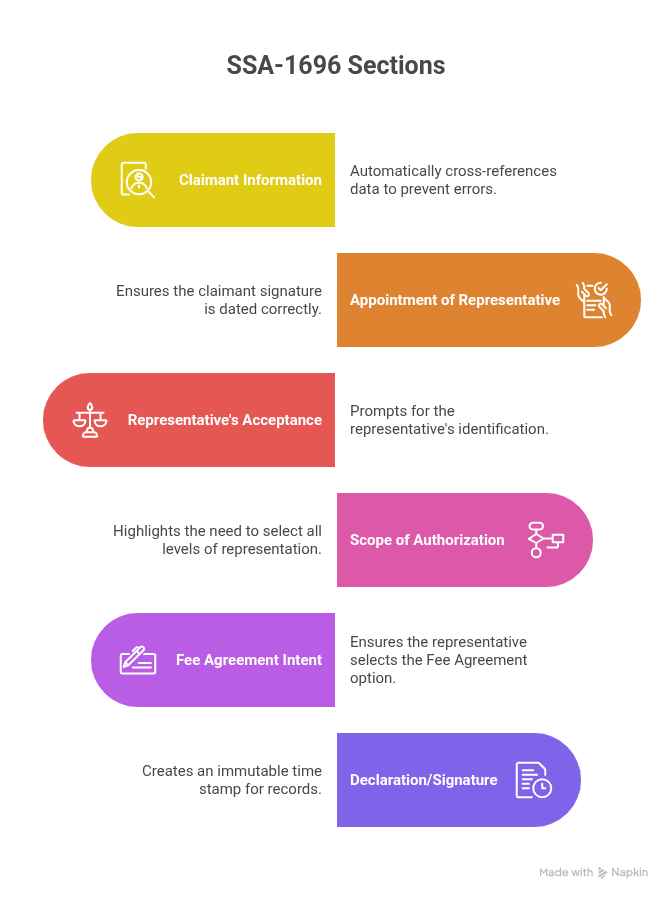
    Essential Parts of an SSA-1696 Form for Legal Compliance

    For a Disability Representative Appointment Form to be legally compliant and functional, it must meticulously satisfy the following SSA requirements. Legal teams must ensure their templates or drafting processes enforce these fields:

    1. Claimant Identifying Information: Full name, current address, Social Security Number, and claim number (if known). This ensures the form is matched to the correct SSA file.

    2. Representative Identifying Information: Full name, address, telephone, email, and the Representative ID Number (if non-attorney advocate) or State Bar Number (if attorney).

    3. Statement of Appointment: A clear, unambiguous statement signed by the claimant granting the representative authority to act on their behalf.

    4. Acceptance of Appointment: A section where the representative (or supervising attorney) formally accepts the appointment, confirming they have the necessary qualifications. This signature must be dated.

    5. Scope of Representation: A clear indication of the level of administrative action the representative is authorized to pursue (e.g., initial claim, reconsideration, hearing).

    6. Fee Agreement Intent: A mandatory checkbox indicating whether the representative intends to charge a fee and, if so, whether the fee will be based on the SSA-approved Fee Agreement (required to be submitted separately, typically on an SSA-1699, or electronically) or via the Fee Petition process.

    7. Date and Signature: A valid, non-expired signature and date from both the claimant and the representative.


    How to Complete a Disability Representative Appointment Form (SSA-1696)

    For high-volume disability practices, the process of executing the SSA-1696 needs to be a standardized, error-free workflow.

    1. Client Intake and Data Capture: During the initial client meeting, all necessary demographic and claim ID data is captured and immediately populated into the Wansom SSA-1696 template.

    2. Fee Agreement Alignment: The paralegal uses the Wansom system to confirm the Fee Agreement details (25% cap, max amount) are correct for the current statutory period and that the agreement is ready to be filed simultaneously with the SSA-1696.

    3. Claimant Signature and Verification: The claimant reviews, signs, and dates the SSA-1696. The law firm ensures they receive the original or a certified electronic copy.

    4. Representative Acceptance: The authorized representative (attorney) signs and dates the Acceptance of Appointment section.

    5. Secure Submission: The completed SSA-1696 and the Fee Agreement are filed electronically or mailed to the appropriate SSA office (Field Office, DDS, or OHO).

    6. Audit Log and Tracking: The filing date, the SSA office receiving the document, and the claimant’s primary contact information are automatically logged in the Wansom audit trail for future reference, ensuring the firm has verifiable proof of authority.

    The objective is to make the submission of the SSA-1696 a single-step, verified process, removing the administrative risk of forms being signed incorrectly, filed separately, or utilizing outdated SSA fee language.


    Disability Representative Appointment Form Template Example

    The Wansom template for the SSA-1696 is designed to guide the user through the mandatory fields, paying special attention to the often-missed Fee Agreement section.
    Blog image

    Easier Disability Representative Forms with Wansom

    The successful management of a high-volume disability practice hinges on the perfect execution of administrative tasks like the SSA-1696. Wansom is the AI-powered solution that removes the liability inherent in manual form processing.

    Automate Fee Compliance and Prevent Costly Rejections

    Wansom's platform understands the dynamic rules governing the SSA fee structure. When drafting the SSA-1696 and the linked Fee Agreement:

    • Version Control: Wansom ensures your firm is always using the most recent, approved version of the SSA forms, preventing rejections due to outdated documents.

    • Cap Validation: The system runs a background check to confirm the stated Fee Agreement percentage (25%) and the dollar maximum (e.g., $7,200) comply with current SSA regulations, flagging immediate errors before filing.

    • Integrated Filing Strategy: The AI workspace prompts paralegals to file the Fee Agreement concurrently with the SSA-1696, eliminating the common administrative error of filing them separately, which often leads to Fee Petition default.

    Immutable Communication and Authority Tracking

    Once the SSA-1696 is filed, the Wansom system transforms the document's data into actionable compliance records:

    • Centralized Authority Log: Every SSA-1696 and Fee Agreement is stored and tagged with its expiration, scope, and the specific SSA office (e.g., Baltimore, Boston OHO) that received it. This makes it instantly searchable for audits or client inquiries.

    • Substitution of Counsel Management: If a client switches firms, Wansom simplifies the complex process of filing a new SSA-1696 and provides the outgoing firm with a legally sound record of their authorized time spent, facilitating a smoother fee division process.

    • HIPAA Compliant PHI Access: The SSA-1696 is the gateway to PHI access. Wansom's platform securely manages the flow of PHI records obtained via this authority, ensuring all subsequent document handling meets the highest standards of data security (HIPAA and beyond).

    Wansom empowers disability law firms to elevate their administrative compliance from a chaotic paper trail to an organized, secure, and automated audit defense mechanism. By minimizing administrative errors on the SSA-1696, firms maximize their ability to focus on substantive legal arguments and secure timely payment.

    Conclusion:

    The Disability Representative Appointment Form (SSA-1696) is the legal foundation of every successful disability claim. Its correct and timely filing is essential for securing the right to represent the client and, most critically, securing the law firm's rightful contingency fee via the SSA Direct Pay system.

    Generic templates and manual processes introduce an unacceptable level of administrative risk—a risk that costs firms thousands of dollars in lost fees and non-billable hours spent on fee petition litigation.

    Wansom provides legal teams with the definitive, AI-powered workspace to draft, validate, and manage every SSA-1696 and Fee Agreement with guaranteed compliance. Eliminate administrative error, secure your fee, and solidify your practice’s financial foundation.

    Ready to automate the most critical document in your disability practice?

    Start customizing and downloading Wansom's AI-powered, compliant Disability Representative Appointment Form template today.

    Related to Blog: Fee Petitions vs. Fee Agreements: Which is Right for Your Firm?

    Frequently Asked Questions

    1. What is the difference between the SSA-1696 and the Fee Agreement (SSA-1699)?

    The SSA-1696 is the formal document where the claimant names and appoints a representative, granting them authority to act. The Fee Agreement (SSA-1699, often electronic) is a separate but mandatory document that outlines how the representative will be paid (usually 25% of past-due benefits, up to the statutory cap). The SSA requires both documents to be filed together and approved to enable Direct Payment.

    2. Can a non-attorney represent a claimant and use the SSA-1696?

    Yes. The SSA permits both licensed attorneys and accredited non-attorney representatives to use the SSA-1696 to gain representation authority. The SSA maintains a program for non-attorney representatives that requires stringent certification and examination to ensure they meet competency standards.

    3. How does the SSA-1696 expiration work?

    Unlike a Medical Release Form (HIPAA Authorization), the SSA-1696 does not automatically expire once the claim is approved. The appointment of a representative generally remains effective until the SSA has made a final determination on the claim and the time for further appeal has passed, or until the claimant formally revokes the appointment in writing.

    4. What happens if the SSA-1696 is rejected or missing?

    If the SSA-1696 is rejected or not filed, the SSA will not recognize the representative's authority. This means they will not send correspondence to the firm, will not grant access to the claimant’s electronic file (eFolder), and will immediately reject the Fee Agreement. The representative would then have to rely on the costly and time-consuming Fee Petition process to justify and receive payment.


  • Audited Financial Statements with Template

    For most businesses, financial audits aren’t just about compliance—they’re a language of trust. Investors, regulators, and partners look at audited financial statements to gauge whether your company truly reflects the numbers it reports. But drafting one from scratch can be a nightmare of accounting jargon, formatting rules, and legal precision. That’s exactly where Wansom’s Audited Financial Statements Template comes in.

    This article will guide you through what audited financial statements are, why they matter, what every report must include, and how you can use Wansom’s AI-powered template to customize and download a complete, audit-ready version in minutes.

    Related Blog: How to Prepare Audited Financial Statements for Your Business


    Key Takeaways: 

    • Audited financial statements confirm the accuracy of a company’s finances through independent verification.

    • Every report should include an auditor’s opinion, balance sheet, income statement, and cash flow statement.

    • Common challenges include inconsistency, compliance errors, and data duplication—all solvable with AI.

    • Wansom’s template ensures professional formatting and GAAP/IFRS alignment automatically.

    • Businesses can save time and improve credibility by customizing and downloading their audited statements on Wansom.ai.


    What Are Audited Financial Statements?

    Audited financial statements are official financial documents reviewed by an independent auditor to confirm that a company’s financial position and performance are accurately represented. In simpler terms, it’s a professional seal of honesty.

    The process ensures that all financial information complies with generally accepted accounting principles (GAAP) or international standards (IFRS). Businesses use them when seeking funding, fulfilling regulatory requirements, or establishing credibility with stakeholders.

    Related Blog: Balance Sheet, Income Statement, and Cash Flow Templates Explained


    Why Businesses Need Audited Financial Statements

    Audits aren’t just red tape—they’re strategic tools. Here’s why:

    • Investor Confidence: Investors and shareholders trust verified numbers.

    • Regulatory Compliance: Many jurisdictions require audited reports to meet statutory obligations.

    • Loan Approvals: Financial institutions often demand audited records before approving credit.

    • Transparency: Demonstrates accountability and reduces the risk of fraud or misrepresentation.

    • Strategic Planning: Reliable data helps guide management decisions and long-term forecasting.

    In short, your audited financial statements are the backbone of your organization’s integrity.

    Related Blog: Top 5 Mistakes Companies Make in Financial Audit Reports


    The Four Key Components of an Audited Financial Statement

    To ensure your document meets compliance and professional standards, it must contain four essential sections:

    1. The Auditor’s Report

    This is a professional opinion from an independent auditor confirming whether the statements are fair and accurate. It often specifies the audit scope, standards followed, and any exceptions or qualifications noted.

    2. Balance Sheet

    Also called the Statement of Financial Position, this section outlines assets, liabilities, and equity. It’s essentially a snapshot of what your business owns and owes.

    3. Income Statement

    Also known as the Profit and Loss Statement (P&L), it summarizes revenue, expenses, and net profit over a defined period.

    4. Cash Flow Statement

    This reveals how money moves in and out of your business. It divides cash activities into operations, investing, and financing.

    Each section serves a different purpose, but together they form a complete picture of financial health.

    Related Blog: Automate Audit Compliance Documents with AI


    Common Challenges When Preparing Audited Financial Statements

    Many organizations face recurring issues when creating audit documents manually:

    • Inconsistent formatting and missing line items

    • Misaligned accounting standards

    • Lack of traceability in data sources

    • Manual errors and duplicated entries

    • Difficulty managing version control during review

    Wansom’s AI-powered workspace resolves these challenges by automatically generating compliant, formatted, and traceable audit documents that integrate directly with your team’s workflow.

    Related Blog: The Role of AI in Financial Reporting and Accuracy


    How to Prepare Audited Financial Statements with Wansom.ai

    Wansom’s Audited Financial Statements Template is built to save time and eliminate human error. It’s ideal for accountants, finance managers, and compliance officers who need a consistent, accurate, and ready-to-file report.

    Here’s how it works:

    1. Log into Wansom.ai
      Access your secure workspace designed for legal and financial teams.

    2. Choose the Audited Financial Statements Template
      Select the pre-built format, already structured for GAAP and IFRS compliance.

    3. Enter or Upload Financial Data
      You can manually enter data or import from your accounting software.

    4. AI Validation and Review
      Wansom’s AI scans for inconsistencies, missing details, or deviations from accounting standards.

    5. Collaborate with Your Team
      Add your auditor, finance lead, or CFO for review—all in real-time.

    6. Customize and Download
      Export your audit-ready document in PDF or Word format, perfectly formatted for submission or presentation.

    With this workflow, your team can focus on analysis rather than repetitive data entry.

    Related Blog: Getting Started with Wansom: A Complete Guide for Legal and Finance Teams


    What Makes Wansom’s Template Different

    The Wansom Audited Financial Statements Template isn’t just another static PDF—it’s a living document designed for modern financial teams.

    • AI-Powered Consistency: Automatically checks numerical alignment and section integrity.

    • Compliance-First Design: Aligned with both local and international financial reporting standards.

    • Collaboration Tools: Enables secure multi-user editing and audit trails.

    • Instant Formatting: Exports in professional layouts accepted by regulators and investors.

    • Legal Integration: Built to align with legal documentation for corporate filings and compliance.

    When you combine automation with legal intelligence, your audits stop being a burden and start becoming an advantage.

    Related Blog: AI and Financial Compliance: Automating Audit-Ready Documents


    Who Can Benefit from This Template

    The Audited Financial Statements Template is useful for a range of professionals and organizations, including:

    • Medium and large enterprises preparing annual reports

    • Startups raising investment rounds

    • Accounting and audit firms managing multiple clients

    • Compliance officers ensuring regulatory adherence

    • Non-profits needing verified financial transparency

    If your organization handles sensitive financial reporting, Wansom helps you generate compliant, professional, and audit-proof documentation effortlessly.

    Related Blog: Financial Templates You Can Customize with Wansom.ai


    How AI Transforms Financial Auditing

    Traditionally, financial auditing is repetitive, manual, and time-consuming. Wansom’s AI introduces intelligence and efficiency to the process:

    • Detects inconsistencies and missing financial line items

    • Flags data irregularities that could trigger audit concerns

    • Reduces dependency on manual cross-verification

    • Automates compliance checks against reporting standards

    The result: faster audits, higher accuracy, and greater transparency.

    Related Blog: The Future of AI in Legal and Financial Compliance


    Final Thoughts: Automate, Customize, and Simplify

    In finance, accuracy is power—and automation is its ally. Wansom’s Audited Financial Statements Template empowers you to produce professional, compliant, and reliable audit-ready documents with speed and confidence.

    No more formatting frustrations or compliance anxiety. With AI-driven precision, your team can focus on insights rather than paperwork.

    Start your financial audit with confidence—customize and download your template today at Wansom.ai.

  • Consent Withdrawal Request: A Complete Guide with Customizable Template

    Consent Withdrawal Request: A Complete Guide with Customizable Template

    Modern data privacy laws give individuals the right to say one powerful word: “No.”
    A Consent Withdrawal Request is how that right is exercised — a formal document that allows someone to withdraw previously given consent for data processing, communication, or participation.

    In this guide, we’ll unpack the purpose, structure, and compliance requirements behind Consent Withdrawal Requests and show you how to generate one instantly using Wansom.ai, the AI-powered workspace that simplifies legal drafting and compliance automation.

    Related Blog: Getting Started with Wansom: A Complete Guide for Legal Teams


    Key Takeaways:

    1. A Consent Withdrawal Request allows individuals to revoke previously given data-use permission.

    2. Proper documentation ensures compliance with GDPR, CCPA, and Kenya’s Data Protection Act.

    3. Each request should include identity details, purpose, and acknowledgment from the organization.

    4. Wansom.ai automates drafting, compliance checks, and secure PDF downloads.

    5. Standardized templates help organizations maintain transparency and avoid costly data privacy violations.


    What Is a Consent Withdrawal Request?

    A Consent Withdrawal Request is a formal written notice used by an individual (the data subject) to inform an organization that they wish to revoke their consent for specific data use, storage, or processing activities.

    It’s commonly used in contexts such as:

    • Marketing communications

    • Data sharing with third parties

    • Medical research participation

    • HR records and employee data management

    Under laws like the GDPR (General Data Protection Regulation) and Kenya’s Data Protection Act, organizations must respect such requests promptly and update their systems accordingly.

    Related Blog: Understanding Data Subject Rights Under the GDPR


    Why Is Consent Withdrawal Important?

    The principle of consent control lies at the heart of modern privacy frameworks. Allowing individuals to withdraw consent isn’t just ethical — it’s legally required.

    A proper Consent Withdrawal Request ensures:

    • Compliance: Meets GDPR, HIPAA, and other privacy law obligations.

    • Transparency: Demonstrates respect for data subjects’ autonomy.

    • Documentation: Provides proof of compliance in audits or investigations.

    • Trust: Strengthens relationships between organizations and clients.

    Without a proper system for consent withdrawal, businesses risk fines, reputational damage, and regulatory action.

    Related Blog: How to Build a Data Privacy Compliance Framework


    Key Components of a Consent Withdrawal Request

    A strong Consent Withdrawal Request includes these essential elements:

    1. Data Subject Information: Full name, contact details, and identification reference.

    2. Purpose of Withdrawal: Clear description of the consent being withdrawn (e.g., marketing emails, medical data use).

    3. Effective Date: When the withdrawal should take effect.

    4. Acknowledgment by Organization: Confirmation of receipt and actions taken.

    5. Legal References: Relevant data protection laws cited.

    6. Signatures: Verification by both parties for recordkeeping.

    Each clause protects both the requester and the organization, ensuring mutual understanding and compliance.

    Related Blog: Anatomy of a Data Protection Request Form


    Legal Frameworks Governing Consent Withdrawal

    Consent withdrawal is recognized and protected under multiple privacy regulations worldwide:

    • GDPR (Europe): Article 7(3) gives individuals the right to withdraw consent at any time.

    • CCPA (California): Provides consumers control over personal data use and sale.

    • Kenya Data Protection Act (2019): Empowers data subjects to restrict or withdraw consent from data controllers.

    • HIPAA (US Healthcare): Patients can revoke consent for medical record sharing.

    Legal compliance means acknowledging and documenting every consent withdrawal promptly — and maintaining an audit trail of actions taken.

    Related Blog: Comparing Global Data Protection Regulations


    How to Create a Consent Withdrawal Request

    Here’s how to prepare a compliant and professional Consent Withdrawal Request:

    1. Identify the Purpose: Specify the data activity or consent being withdrawn.

    2. Reference the Original Consent: Quote the consent date or document if possible.

    3. Write Clearly: Avoid vague language — clarity ensures enforceability.

    4. Submit Formally: Deliver the request via email, secure portal, or physical form.

    5. Keep Records: Maintain a copy of the withdrawal for future reference.

    6. Follow Up: Ensure confirmation is received and the change is implemented.

    Related Blog: How to Manage Consent in Data Protection Workflows


    How Wansom.ai Simplifies the Process

    With Wansom.ai, legal teams, compliance officers, and organizations can generate a Consent Withdrawal Request Template in minutes.

    Here’s how it works:

    • Smart Customization: Fill in requester details once; the template auto-adjusts throughout the document.

    • Compliance Intelligence: AI ensures all necessary legal references are included based on jurisdiction.

    • Team Collaboration: Share and review drafts securely with your data protection or legal teams.

    • Audit-Ready Output: Every document comes with time stamps and change tracking for compliance reviews.

    • Instant Export: Download your completed document as a PDF or Word file instantly.

    Related Blog: The Role of AI in Compliance Documentation


    Common Mistakes to Avoid

    Avoid these common pitfalls when handling consent withdrawals:

    • Ignoring requests or delaying acknowledgment.

    • Failing to update internal systems after consent is revoked.

    • Using vague language that leaves room for misinterpretation.

    • Not recording the transaction for audit purposes.

    These errors can lead to penalties or reputational damage — something Wansom’s compliance automation helps prevent.

    Related Blog: Top Legal Risks in Data Privacy Management


    When Should You Use a Consent Withdrawal Request Template?

    Use a Consent Withdrawal Request Template when:

    • A client, customer, or employee requests data removal or use limitation.

    • You need standardized documentation for privacy compliance.

    • Your organization manages large volumes of consent-based interactions.

    • You want to automate legal workflows across departments.

    Templates ensure consistency, compliance, and professional quality in every request.

    Related Blog: Document Templates Every Compliance Officer Should Automate


    Conclusion: Take Control of Data Consent with Wansom.ai

    The right to withdraw consent is fundamental to privacy, trust, and compliance. But managing it efficiently requires structure — and that’s where automation shines.

    With Wansom.ai, you can instantly create, review, and export a fully compliant Consent Withdrawal Request. Let AI handle the legal accuracy while you focus on maintaining transparency and data integrity.

    Customize and download your Consent Withdrawal Request Template today at Wansom.ai.

    Related Blog: Getting Started with Wansom: A Complete Guide for Legal Teams

  • Comprehensive Insurance Coverage Contract with Template

    In the complex world of insurance, clarity isn’t optional—it’s protection. Whether you’re a legal professional drafting for a client or a business seeking comprehensive coverage for your assets, a well-structured insurance contract defines the boundaries of trust, responsibility, and financial security.

    In this guide, we’ll unpack everything you need to know about comprehensive insurance coverage contracts—what they are, why they matter, and how to create one that’s both compliant and customized to your specific needs. You’ll also gain access to a ready-to-customize template built on Wansom.ai, an AI-powered legal workspace that simplifies document drafting, review, and compliance management.

    Related Blog: Understanding Contract Automation for Legal Teams


    Key Takeaways:

    1. A comprehensive insurance coverage contract clearly defines risk protection, financial limits, and obligations for both insurer and policyholder.

    2. Using a customizable AI-powered template from Wansom.ai ensures accuracy, compliance, and faster drafting.

    3. Every strong insurance contract should include precise clauses for coverage scope, exclusions, payment terms, and dispute resolution.

    4. AI tools like Wansom help legal teams detect inconsistencies and maintain regulatory compliance with ease.

    5. Businesses can save time and reduce legal risks by customizing and downloading their comprehensive insurance coverage contract directly on Wansom.ai.


    What is a Comprehensive Insurance Coverage Contract?

    A comprehensive insurance coverage contract is a legally binding agreement between an insurer and a policyholder that outlines the terms, conditions, exclusions, and coverage limits of a particular insurance policy. Unlike basic or limited policies, “comprehensive” coverage provides broad protection—typically against damages or losses not caused by a single, specific risk.

    For example, in vehicle insurance, “comprehensive coverage” may include protection against theft, vandalism, fire, or natural disasters. For businesses, comprehensive contracts often merge multiple insurance elements—property, liability, and employee coverage—into one unified framework.

    The goal is simple: reduce ambiguity and ensure that both parties understand the full scope of risk coverage and financial obligation.

    Related Blog: Key Elements of a Legally Binding Insurance Contract


    Why Comprehensive Insurance Contracts Matter

    The insurance industry operates on predictability and trust. However, disputes often arise due to vague policy wording or poorly drafted terms. That’s where a well-written comprehensive insurance coverage contract comes in. It serves as a safeguard against misinterpretation and litigation, ensuring both parties are protected.

    Here’s why this type of contract is essential:

    • Legal Clarity: Defines the exact responsibilities of each party, minimizing disputes.

    • Financial Protection: Outlines indemnity limits and claim procedures clearly.

    • Regulatory Compliance: Ensures adherence to insurance and consumer protection laws.

    • Risk Transparency: Makes it easy to understand exclusions and coverage limits.

    • Operational Efficiency: Enables insurers and clients to operate confidently under clear contractual boundaries.

    Related Blog: Common Legal Pitfalls in Insurance Documentation


    Core Components of a Comprehensive Insurance Coverage Contract

    Every effective insurance coverage contract, whether drafted manually or with AI assistance, should include these core elements:

    1. Parties to the Agreement

    Identifies the insurer and the insured, including business details and legal identities.

    2. Definitions and Interpretations

    Clarifies key terms such as “insured event,” “premium,” “deductible,” and “coverage limit.”

    3. Coverage Scope

    Details what is included under the policy—property, liability, vehicle, medical, or specialized risks.

    4. Exclusions

    Specifies situations or damages not covered under the contract, avoiding ambiguity.

    5. Premium and Payment Terms

    Outlines how and when premiums are paid, renewal procedures, and penalties for non-payment.

    6. Claims Process

    Describes the exact steps for filing, assessing, and settling claims.

    7. Policy Duration and Renewal

    Specifies contract start and end dates, renewal options, and cancellation terms.

    8. Governing Law and Jurisdiction

    Defines the legal framework that governs the contract—crucial for multinational clients.

    9. Dispute Resolution

    Includes mediation or arbitration clauses to prevent costly litigation.

    10. Signatures and Execution

    Legally binds both parties upon signing, physically or digitally.

    Related Blog: The Anatomy of a Legally Sound Insurance Contract


    The Legal Landscape: Compliance and Regulatory Requirements

    Insurance contracts are heavily regulated to protect policyholders and maintain industry integrity. Depending on jurisdiction, compliance often involves the following:

    • Consumer Protection Acts: Ensure fairness and transparency.

    • Insurance Regulatory Authorities: Such as IRA in Kenya, FCA in the UK, or NAIC in the US.

    • Anti-Money Laundering (AML) and Know Your Customer (KYC) Requirements: To prevent fraud.

    • Disclosure Obligations: Both parties must provide accurate and complete information.

    Failure to comply with these requirements can lead to contract invalidation, heavy fines, or license suspension. That’s why many legal teams and insurers are turning to AI tools like Wansom.ai to automate compliance checking and document review—reducing risk while saving time.

    Related Blog: AML/KYC Compliance in the Insurance Sector


    How to Draft a Comprehensive Insurance Coverage Contract

    Traditionally, drafting such a contract required legal professionals to start from scratch, referencing multiple regulations and templates. Today, AI-assisted legal platforms have made this process faster and more accurate.

    Here’s a simplified workflow for creating a robust contract:

    Step 1: Define Coverage Objectives

    Clarify what type of coverage is required—property, liability, auto, or multi-risk.

    Step 2: Collect Policyholder Information

    Gather all relevant personal and business data to personalize the agreement.

    Step 3: Identify Applicable Laws

    Reference insurance regulatory frameworks that apply in your jurisdiction.

    Step 4: Use a Reliable Template

    Start with a verified, customizable template (such as Wansom’s) to maintain compliance and structure.

    Step 5: Customize the Clauses

    Adapt terms, exclusions, and conditions to your client’s unique needs.

    Step 6: Review with AI Assistance

    Use Wansom’s AI contract review to detect inconsistencies, compliance gaps, or missing clauses.

    Step 7: Approve and Execute

    Finalize, review, and digitally sign the contract.

    Related Blog: How AI is Transforming Legal Document Drafting


    Using Wansom.ai to Create Your Contract in Minutes

    At Wansom.ai, you don’t just download a static PDF—you create a customized, intelligent contract. The platform uses advanced AI to generate, refine, and validate legal templates tailored to your business or client’s specific needs.

    Here’s how Wansom simplifies the process:

    • Smart Customization: Fill in details once, and Wansom automatically updates all relevant sections.

    • AI Validation: Detects missing terms, risky clauses, and compliance issues before finalizing.

    • Collaboration: Legal teams can co-edit and comment in real-time.

    • Secure Cloud Storage: Protects sensitive client data.

    • Instant Export: Download as Word or PDF within seconds.

    Related Blog: Introduction to Wansom’s Legal Automation Platform


    Common Mistakes to Avoid When Drafting Insurance Contracts

    Even experienced professionals make errors that can expose clients to financial and legal risk. Here are frequent pitfalls to watch for:

    • Ambiguous Wording: Leads to disputes during claims.

    • Incomplete Exclusions: Can unintentionally extend liability.

    • Non-compliance with Local Laws: Makes the contract unenforceable.

    • Ignoring Renewal Clauses: Causes coverage lapses.

    • Failure to Review Digitally Generated Documents: Always validate even AI-drafted contracts.

    Wansom’s AI-powered document review helps catch these issues automatically, providing a second layer of assurance.

    Related Blog: Legal Drafting Errors and How to Avoid Them


    Why Legal Teams Prefer AI-Generated Templates

    The shift to AI-powered legal drafting isn’t just about speed—it’s about consistency, accuracy, and compliance.
    By using Wansom.ai, firms and insurers benefit from:

    • Time Efficiency: Generate complex contracts in minutes instead of hours.

    • Reduced Human Error: AI-driven validation minimizes oversight.

    • Cost Efficiency: Avoids high legal drafting fees.

    • Scalability: Handle hundreds of contracts simultaneously.

    • Data Security: Built-in encryption ensures confidentiality.

    The result: legal teams can focus on strategic work while automation handles the paperwork.

    Related Blog: Future of AI in Legal Documentation


    When to Use a Comprehensive Insurance Coverage Contract Template

    You should consider using a Comprehensive Insurance Coverage Contract Template when:

    • Drafting a new policy for corporate or individual clients

    • Renewing or revising existing policies

    • Standardizing internal documentation across multiple branches

    • Ensuring compliance with updated laws or regulatory frameworks

    • Integrating contract automation into your workflow

    By starting from a trusted, customizable template, you save time while maintaining professional quality and compliance.

    Related Blog: Contract Templates Every Legal Team Should Automate


    Conclusion: Customize Your Contract and Strengthen Your Coverage

    A comprehensive insurance coverage contract is more than a legal document—it’s a financial safeguard, a compliance requirement, and a trust mechanism. With Wansom.ai, you can go from confusion to clarity in minutes. Our AI engine ensures that every clause, condition, and term aligns with your specific legal and business needs.

    Ready to build your own?
    Customize and download your Comprehensive Insurance Coverage Contract Template today at Wansom.ai—and let AI do the heavy lifting while you focus on delivering value to your clients.

    Related Blog: Getting Started with Wansom: A Complete Guide for Legal Teams

  • AML/CTF Compliance Manual for Insurance Companies: Complete Guide + Customizable Template

    Financial crime is evolving rapidly, and the insurance industry is one of its quieter but most vulnerable targets. Money launderers have learned that insurance products can serve as convenient vehicles for hiding illicit funds. Regulators, in response, have raised expectations for how insurers identify and manage such risks.

    For any insurance company, having a clear and practical AML/CTF Compliance Manual is no longer a nice-to-have. It is an essential safeguard for maintaining regulatory compliance, preventing fines, and protecting your company’s reputation.

    In this complete guide, we’ll explore what an AML/CTF manual is, why insurance companies must have one, the key components it should contain, and how you can create your own using Wansom’s customizable and compliant-ready template.


    Key Takeaways:

    • An AML/CTF Compliance Manual is essential for insurance companies to meet global regulatory standards and prevent financial crimes.

    • Wansom provides a customizable AML/CTF Compliance Manual template that simplifies policy creation and compliance management.

    • Proper AML/CTF frameworks help insurance companies detect, report, and mitigate suspicious financial activities efficiently.

    • Regulatory updates demand that compliance manuals are regularly reviewed, updated, and aligned with local and international laws.

    • Using AI-powered tools like Wansom ensures accuracy, faster drafting, and real-time collaboration for compliance documentation.


    What is an AML/CTF Compliance Manual?

    An AML/CTF (Anti-Money Laundering and Counter-Terrorism Financing) Compliance Manual is the foundational document that outlines how an insurance company identifies, assesses, and manages risks related to money laundering and terrorism financing.

    It guides employees on what to look for, how to report suspicious activities, and how to ensure compliance with both local and international regulations.

    Think of it as both a playbook and a shield. It helps your organization demonstrate to regulators that you have robust controls in place, while also giving staff the confidence to act correctly when they spot red flags.

    Core functions of an AML/CTF manual include:

    • Defining internal responsibilities and reporting structures

    • Explaining how customer due diligence (CDD) and Know Your Customer (KYC) are conducted

    • Outlining suspicious transaction monitoring and reporting protocols

    • Specifying record-keeping and audit processes

    • Establishing employee training and awareness programs

    A well-written manual not only satisfies regulatory requirements but also improves internal efficiency by reducing uncertainty in compliance decisions.

    Related Blog: Understanding KYC Requirements in Insurance Compliance


    Why AML/CTF Compliance is Critical for Insurance Companies

    The insurance sector faces unique challenges in combating financial crime. Products such as life insurance, investment-linked policies, and annuities can be used to move, disguise, or store illicit funds.

    Regulators have increasingly held insurance companies to the same standards as banks and financial institutions. Failure to comply can lead to severe penalties, public scrutiny, and loss of market confidence.

    Key reasons AML/CTF compliance matters:

    1. Regulatory Obligation: Supervisory authorities like the Financial Action Task Force (FATF) and regional regulators mandate insurers to have robust AML/CTF systems.

    2. Reputational Risk: A single compliance breach can destroy years of brand trust.

    3. Operational Integrity: Internal compliance processes reduce exposure to fraud and ensure your company stays audit-ready.

    4. Customer Protection: AML/CTF policies reinforce transparency, making the insurance sector safer for legitimate clients.

    In short, your compliance manual isn’t just paperwork. It’s an insurance policy for your business itself.

    Related Blog: How FATF Recommendations Affect Insurance Companies


    Key Components of an AML/CTF Compliance Manual

    A compliance manual should be comprehensive but practical. It must translate complex legal obligations into clear, actionable guidance.

    Below are the key elements every insurance AML/CTF manual should include:

    1 Governance and Responsibilities

    Define the roles of your Compliance Officer, Board of Directors, senior management, and staff. Every employee should understand their part in preventing financial crime.

    2 Risk Assessment Framework

    Document your company’s risk-based approach. This means assessing customer types, products, distribution channels, and geographic exposure.

    3 Customer Due Diligence (CDD) and Enhanced Due Diligence (EDD)

    Outline how you verify customer identities, especially for high-risk clients or politically exposed persons (PEPs).

    4 Ongoing Monitoring and Suspicious Activity Reporting (SAR)

    Explain your process for detecting, investigating, and reporting suspicious transactions to authorities.

    5 Record Keeping and Retention Policies

    Specify how long records are maintained and how they can be retrieved during audits or investigations.

    6 Employee Training and Awareness

    Include a framework for ongoing AML/CTF education and testing to ensure all staff understand their obligations.

    7 Independent Audit and Review

    Define how and when your AML framework will be independently tested for effectiveness and compliance.

    Related Blog: Step-by-Step Guide to Building a Risk-Based AML Program


    AML/CTF Legal and Regulatory Frameworks for Insurers

    Insurance companies operate under a growing patchwork of AML/CTF laws that vary by jurisdiction but share similar foundations. Understanding these frameworks helps ensure your manual remains compliant across all relevant regions.

    Global Frameworks:

    • The Financial Action Task Force (FATF) provides international standards that most countries align with.

    • United Nations Conventions require nations to criminalize money laundering and terrorism financing.

    Regional and Local Examples:

    • EU AML Directives: Require insurers to implement CDD and suspicious activity reporting measures.

    • UK Money Laundering Regulations 2017: Applies to insurers offering investment-related products.

    • US Bank Secrecy Act (BSA) and Patriot Act: Enforces strict AML controls on financial institutions, including insurers.

    • Kenya’s Proceeds of Crime and Anti-Money Laundering Act (POCAMLA): Mandates insurance companies to conduct customer due diligence and report suspicious transactions.

    Insurance firms must keep their manuals up to date as new regulations or FATF recommendations emerge.

    Related Blog: Understanding FATF and Global AML Standards for Insurers


    How to Create an AML/CTF Compliance Manual for Your Insurance Company

    Building an AML/CTF manual from scratch can feel daunting, but breaking the process into structured steps makes it manageable.

    Step 1: Define Scope and Objectives

    Determine which parts of your business are covered by the manual. This includes subsidiaries, agents, or intermediaries.

    Step 2: Conduct a Risk Assessment

    Evaluate your products, customer types, and delivery channels to understand where financial crime risks are highest.

    Step 3: Map Legal Obligations

    Identify the laws and regulations applicable to your jurisdiction and integrate their requirements into your manual.

    Step 4: Draft Policies and Procedures

    Translate your obligations into internal procedures. Keep the language practical and relevant to your operations.

    Step 5: Review and Approve

    Have your compliance or legal team review the manual, then get board approval before rollout.

    Step 6: Train and Implement

    Educate employees about their responsibilities and ensure they can access the manual easily.

    Step 7: Review Regularly

    Schedule annual or event-driven reviews to ensure your manual remains accurate and effective.

    Related Blog: How to Write an Effective Compliance Policy for Your Organization


    Common Mistakes in AML/CTF Manuals

    Even experienced compliance teams can overlook key details. Below are frequent pitfalls that reduce the effectiveness of AML/CTF manuals:

    • Copying Generic Templates: Manuals should reflect your company’s specific risks and operations, not generic text.

    • Ignoring Updates: Laws and FATF recommendations evolve constantly. Outdated manuals create compliance gaps.

    • Lack of Employee Training: A strong manual is useless if staff do not understand it.

    • Insufficient Record Keeping: Missing documentation can lead to regulatory penalties even if processes were followed.

    • Weak Governance: Without clear ownership, policies often remain unimplemented.

    Addressing these weaknesses can save your organization from regulatory trouble and reputational harm.

    Related Blog: Top Compliance Mistakes That Put Insurers at Risk


    The Benefits of Using a Customizable AML/CTF Template

    Creating a compliance manual manually takes time and requires specialized expertise. Wansom simplifies this through its customizable AML/CTF Compliance Manual Template for Insurance Companies.

    With Wansom’s AI-powered legal workspace, you can:

    • Generate your AML/CTF manual in minutes using an editable, compliant template.

    • Customize clauses, policies, and responsibilities to fit your firm’s unique structure.

    • Collaborate with your team in real time to review and approve the manual.

    • Export your final version as a secure PDF, ready for audit or regulatory submission.

    • Keep your manual automatically updated with regulatory changes.

    The template is structured by compliance experts and aligns with FATF principles, regional laws, and insurance-specific best practices. It also includes built-in guidance for tailoring your policies based on company size and jurisdiction.

    Related Blog: How AI is Transforming Legal Drafting for Compliance Teams


    Why Choose Wansom for Your Compliance Needs

    Wansom is more than just a document template provider. It is a full-featured AI workspace designed for legal and compliance professionals who need to create, review, and maintain complex documentation quickly and accurately.

    With Wansom, you can:

    • Draft, review, and collaborate securely in one platform.

    • Automate repetitive sections like policy statements or definitions.

    • Access built-in legal research tools for referencing AML laws and regulatory guidelines.

    • Maintain version control and document traceability for audits.

    • Store your compliance documentation securely with encryption and access control.

    These features make Wansom an invaluable partner for insurance companies aiming to stay ahead in an increasingly regulated environment.

    Related Blog: Wansom Overview: How Legal Teams Use AI to Work Smarter


    How to Get Started

    You can get started in three simple steps:

    1. Visit Wansom’s AML/CTF template page.

    2. Click Customize Template to open the editable version.

    3. Personalize the document, download it as a secure PDF, and share it with your compliance or legal team.

    Within minutes, you will have a fully structured AML/CTF Compliance Manual tailored to your insurance business, ready for immediate use.

    Related Blog: Getting Started with Wansom: Complete Setup Guide


    Final Thoughts

    An AML/CTF Compliance Manual is not just a regulatory checkbox. It is the backbone of a responsible, trusted insurance operation. Having a clear, accessible, and up-to-date manual reflects your company’s integrity and commitment to protecting the financial system.

    Using Wansom’s customizable AML/CTF template allows your team to focus on execution rather than drafting, ensuring faster compliance and more confident governance.

    To get started, visit Wansom and customize your AML/CTF Compliance Manual today.

    Related Blog: Creating a Compliance-First Culture in Insurance Firms

  • Top 7 Mistakes People Make When Settling Insurance Claims

    Top 7 Mistakes People Make When Settling Insurance Claims

    The insurance claims process is often described as a negotiation, but for the average claimant, it can feel more like navigating an adversarial legal labyrinth. When disaster strikes—be it an auto accident, a major property loss, or a personal injury—policyholders turn to their insurers for financial restitution and support. However, what starts as a simple claim notification quickly escalates into a complex exchange of evidence, statements, and financial offers.

    The core difficulty lies in the inherent conflict of interest. As a policyholder, your goal is to be made whole—to receive full and fair compensation for all damages, both immediate and long-term. The insurance company, on the other hand, is a business legally and fiscally obligated to its shareholders, meaning its primary goal is to settle claims quickly and minimize its payout obligation.

    This structural tension creates a fertile ground for costly, often irreversible, mistakes on the part of the claimant. A single misstep—whether in documenting the loss, communicating with an adjuster, or signing the final release document—can erode the value of your claim by thousands of dollars or, worse, lead to outright denial.

    At Wansom, we understand that for legal teams, the most valuable part of a case often comes down to the precision of the final settlement instrument. But for the policyholder approaching the settlement phase, the journey is fraught with pitfalls. This authoritative guide, crafted by Wansom’s legal content strategists, details the Top 7 Mistakes People Make When Settling Insurance Claims. Understanding these errors is the first step toward securing the compensation you deserve, establishing an iron-clad legal position, and recognizing the critical necessity of using an expert-vetted resource like the Wansom Insurance Claim Release & Settlement Template to finalize your claim correctly.


    Key Takeaways:

    • Always read your full insurance policy to understand exclusions and conditions precedent, treating the document as a binding legal contract, not just a guarantee.

    • Your claim's value hinges on meticulous, time-stamped documentation; insufficient evidence is the fastest way to get a lowball settlement offer.

    • Protect your legal position by never admitting fault or giving a recorded statement until you have fully documented the loss and assessed all potential injuries.

    • Avoid the financial catastrophe of settling too early before you reach Maximum Medical Improvement (MMI) and accurately calculate all future and non-economic damages.

    • The final settlement document is a permanent legal release that must be reviewed for hidden clauses, especially those concerning the release of unknown claims and liability traps.


    Foundational Errors: Preparation & Policy Knowledge

    The first and most damaging category of mistakes happens long before any settlement offer is made. These are the foundational errors that weaken a claim’s legal basis and documentation, giving the insurance company leverage from day one.

    Mistake 1: Not Reading Your Full Policy 

    The single most common error is treating an insurance policy as a guarantee rather than the complex, legally binding contract that it is. Many claimants only discover the intricacies of their coverage when they attempt to file a claim, often to their detriment.

    The Contractual Duty to Know Your Terms

    An insurance policy is hundreds of pages of legal text dictating the precise conditions under which the insurer is obligated to pay. Failing to read and comprehend this document means you are operating blind, unaware of crucial clauses like:

    • Exclusions: What the policy specifically does not cover (e.g., mold damage, earth movement, specific types of negligence). If you claim a loss that falls under an exclusion, your claim will be denied, wasting time and resources.

    • Conditions Precedent: Actions you must take before the insurer is obligated to pay (e.g., providing timely notice, filing a sworn proof of loss statement, cooperating with the investigation). Failure to meet a condition precedent is a legal basis for claim denial.

    • Deductibles and Limits: Understanding your policy limits prevents you from having unrealistic expectations or settling for less than your maximum coverage. Similarly, knowing your deductible helps you decide if filing a claim is even financially worthwhile (Mistake #2 in the search results often refers to filing minor claims that barely exceed the deductible).

    • Subrogation Clauses: This clause grants the insurer the right to step into your shoes and sue a third party responsible for the loss after they have paid your claim. Understanding this is vital in complex third-party claims.

    SEO Insight & Legal Strategy: By failing to understand the legal scope of the coverage, the claimant hands over the interpretive authority entirely to the insurer’s adjusters and legal team. For Wansom, this mistake highlights the fundamental need for legal literacy in claims. Wansom’s AI tools are designed precisely to assist legal professionals in quickly distilling policy ambiguities, but policyholders must still grasp the basics. Legal teams must be prepared to combat the insurer’s interpretation of exclusions if the claimant did not read the policy.

    Mistake 2: Delaying the Claim Report

    Most insurance policies contain language requiring the policyholder to provide "prompt" or "timely" notice of a loss. What constitutes "prompt" is often subjective but is generally interpreted by courts as notice given as soon as reasonably possible. Delaying notification is a critical mistake for several reasons:

    The Doctrine of Prejudice to the Insurer

    In many jurisdictions, an insurer seeking to deny a claim due to delayed notice must prove that the delay caused "prejudice" to their ability to investigate and defend the claim. However, proving a time-related delay is itself detrimental is often easy for the insurer.

    • Loss of Evidence: Witnesses move, accident scenes are cleaned, property damage worsens, and memory fades. A delay of even a few days can destroy crucial, time-sensitive evidence (like video surveillance footage or fresh tire marks).

    • Mitigation of Damages: Policies typically require the claimant to take reasonable steps to mitigate further damages immediately after a loss (e.g., boarding up a broken window, turning off the water supply). Delaying the report can be perceived as delaying mitigation, potentially reducing the final payout for the resulting, preventable damage.

    • Breach of Contract: If the delay is significant, the insurer can argue a breach of the notice clause, leading to claim denial, even if the claim is otherwise valid.

    SEO Insight & Legal Strategy: Prompt action is essential. Policyholders must treat the moment of loss as a legal event, initiating documentation and reporting immediately. This mistake directly connects to the legal profession’s role in ensuring all procedural requirements are met, making Wansom's tools vital for verifying compliance with reporting timelines.

    Mistake 3: Insufficient or Bad Documentation

    An insurance claim is fundamentally an evidence-based argument. If you cannot prove a loss occurred, the extent of the damage, and the reasonable cost of repair or replacement, the insurer will base its offer solely on its own, low estimates. Inadequate documentation is the fastest way to undervalue your own claim.

    Evidentiary Standards for Claims

    Comprehensive documentation goes far beyond a single photo. It requires a meticulous, organized "proof of loss" dossier:

    • Chronological Evidence: Time-stamped photos of the scene before cleanup, video walkthroughs, and detailed journals of symptoms (for injury claims) or daily loss-related activities.

    • Financial Records: Receipts for every expense—medical bills, temporary housing, rental cars, repair estimates from multiple vendors. It is crucial to document both actual cash value (ACV) and replacement cost value (RCV) for property losses.

    • Third-Party Reports: Official police reports, fire department reports, and independent appraisals.

    • Medical and Expert Documentation: Detailed physician’s notes, prognostic statements outlining future care needs, and opinions from structural engineers or vocational experts (in liability cases).

    The Proof of Loss Trap: Many policies require a sworn Proof of Loss statement, often within 60 days. This formal document, signed under penalty of perjury, must accurately detail the loss. If the initial documentation is poor, the claimant is often forced to estimate low on this form, which then locks in a lower claim value.

    SEO Insight & Legal Strategy: This section reinforces the need for systematic, secure, and collaborative document management—the core service of Wansom. By detailing the volume and type of required evidence, we position Wansom as the workspace solution for handling and reviewing this massive inflow of information, making the eventual settlement negotiation—and the drafting of the final release—more straightforward.


    Navigating the Adjuster and Settlement Offer

    Once a claim is reported and documented, the process shifts to communication and negotiation. This is where claimants, operating without legal counsel, frequently make communication-based errors that prejudice their case.

    Mistake 4: Admitting Fault or Speculating

    Immediately following an accident or loss, stress and emotional distress are high. In a moment of panic or politeness, many people apologize or make statements that can be interpreted as an admission of fault ("I’m so sorry, I didn’t see the stop sign"). This is a severe error, particularly in liability claims.

    H4: The Danger to Future Legal Defense

    Insurance policies contain a clause that prohibits the insured from voluntarily assuming any obligation or admitting liability without the insurer's written consent. When a policyholder admits fault, several negative legal consequences can ensue:

    • Breach of Cooperation: The insurer may argue the policyholder breached their duty to cooperate, prejudicing the insurer’s ability to defend against a third-party claim.

    • Judicial Admission: The statement of fault can be presented as evidence against the policyholder in subsequent litigation.

    • Compromising Subrogation Rights: If the insurer pays out, an admission of fault makes it nearly impossible for them to recover their payment from the other party (subrogation), potentially leading to the insurer denying coverage.

    The Rule: A claimant should only provide facts about what happened (who, what, where, when) and never offer opinions, conclusions, or admissions of fault. Determination of legal fault is for the authorities, adjusters, or courts, not the claimant.

    SEO Insight & Legal Strategy: This mistake is about controlling the narrative and protecting legal rights. Wansom is positioned as the platform where legal teams develop the precise, factual narrative required, avoiding the emotional or speculative language that sinks claims.

    Mistake 5: Giving a Recorded Statement Too Soon

    The insurance adjuster will almost certainly request a recorded statement early in the claims process. They often present this as a necessary, routine part of opening the file. While cooperation is required, the timing of this statement is critical.

    Locking in Testimony Before Discovery

    The primary purpose of a recorded statement, from the insurer's perspective, is to lock the claimant into a specific version of events before all evidence (medical reports, repair estimates, witness statements) has been fully gathered and analyzed. The adjuster is trained to ask open-ended or slightly leading questions to elicit favorable responses that can be used later to:

    • Find Inconsistencies: If your later documentation (medical reports, police reports) contradicts your early, unscripted statement, the insurer will use this to challenge your credibility.

    • Minimize Injuries: For personal injury claims, adjusters often ask about your health immediately after the accident. If you say, "I felt fine," that statement can be used to argue that your later-diagnosed severe injuries (like whiplash or concussions) were not related to the incident.

    • Establish a Low Baseline: By guiding your testimony toward minimal loss, they set a low psychological and financial baseline for the ensuing negotiation.

    The Right to Refuse: A claimant has the right to refuse a recorded statement until they have consulted with legal counsel and fully prepared their evidence. It is always better to wait until you are fully recovered or have the final prognosis on your injuries before giving a definitive account.

    SEO Insight & Legal Strategy: The need for strategic communication during the claim process reinforces the value of expert guidance. Wansom's document drafting tools can help legal teams prepare clients for depositions and recorded statements by crafting precise, legally vetted narratives based on objective evidence.

    Mistake 6: Settling Too Early or Accepting the First Offer

    This is perhaps the most financially devastating mistake. Insurance companies are highly motivated to offer a low, fast settlement (a "lowball offer")—especially for personal injury claims—because they know that if a claimant accepts and signs the final release, the case is closed forever.

    Failing to Calculate Full Long-Term Damages 

    An initial offer often only covers the most obvious, immediate costs (e.g., initial emergency room visit, cost of a totaled car). What is routinely missed are the significant, long-term damages:

    • Future Medical Expenses: Physiotherapy, follow-up surgeries, long-term medication, and permanent mobility aids. These costs can be astronomically high and must be projected by medical experts.

    • Lost Earning Capacity: Not just lost wages for time missed, but the difference between what the claimant could have earned over their lifetime versus what they will earn due to permanent disability or impairment.

    • Non-Economic Damages: Pain and suffering, emotional distress, and loss of consortium or enjoyment of life. These are intangible but represent a significant portion of a full settlement value.

    The Finality of the Release: Accepting an early, inadequate offer and signing the settlement agreement means the claimant cannot go back for more money if a more serious injury manifests six months later. The settlement release forever bars any future claim related to that incident. Waiting until you have reached Maximum Medical Improvement (MMI) or have final, comprehensive estimates is essential before engaging in final settlement discussions.

    SEO Insight & Legal Strategy: This section directly addresses the high stakes of the settlement stage, emphasizing the permanence of the final document. The mention of MMI, lost earning capacity, and non-economic damages positions the content as high-level legal guidance, naturally leading to the solution: the Wansom Insurance Claim Release & Settlement Template, which is designed to codify the full negotiated value.

    The Final Step: Signing the Release Agreement

    All the previous mistakes lead to the final, most critical, and legally complex point in the entire claims process: the execution of the settlement agreement and the signing of the release. This is where the claimant transitions from negotiation to a binding legal closure.

    Mistake 7: Signing a Release Without Reviewing Terms

    The document the insurer provides is often called a Release of All Claims or a Settlement and Release Agreement. It is not a receipt for payment; it is a legally enforceable contract. It is almost always drafted by the insurance company’s legal team and is therefore structured to provide maximum legal protection for the insurer and the released party, often at the claimant’s expense.

    Signing this document without meticulous legal review of its clauses is the single most significant mistake a claimant can make, as it seals the claim's fate and can create future liability.

    Key Pitfalls in a Settlement Release 

    The language within a settlement release can contain devastating hidden clauses:

    1. Release of Unknown Claims: This is the most dangerous clause. It states that the claimant releases all claims related to the incident, whether those injuries or damages are known or unknown at the time of signing. If your back injury worsens a year later, this clause prevents any further compensation.

    2. Overly Broad Scope of Release (Released Parties): Insurers often try to release not just the at-fault party and the insurance company, but also their "agents, employees, directors, successors, affiliates, and contractors." This broad language can prevent the claimant from pursuing a legitimate claim against a separate, potentially liable entity (e.g., a specific maintenance company or manufacturer).

    3. Indemnification and Hold Harmless Clauses: This clause is a severe financial trap. It can require the claimant (the person receiving the money) to legally defend and pay back the insurance company or the released party if a third party tries to sue them later regarding the same accident. This is often used to ensure the claimant pays all medical liens, but if worded poorly, it creates massive, unforeseen liability for the claimant.

    4. Failure to Properly Address Liens (Medical or Government): Liens (such as those from Medicare, Medicaid, or workers' compensation) have a statutory right to reimbursement from the settlement proceeds. If the release fails to clearly define who is responsible for paying these liens, the claimant can be left legally liable to pay the government entity out of their own pocket, even after the settlement funds are gone.

    5. Factual Errors: Simple mistakes in the document—incorrect names, dates of loss, or the final settlement amount—can render the agreement void or require costly legal action to correct.

    The Wansom Imperative: The complexity and finality of the settlement release document make expert review non-negotiable. This is the precise point in the claims life cycle where Wansom’s secure, AI-powered platform provides indispensable value. Legal teams leverage our tools to ensure that the document accurately reflects the negotiated terms, protects the client from indemnity traps, and properly manages the critical "release of claims" language, turning a complex, high-risk document into a legally sound contract.

    Conclusion

    Securing a fair insurance payout is never automatic; it is the direct result of diligence, evidence, and legal precision. The seven costly mistakes detailed in this guide—from failing to read the policy's fine print to the severe legal trap of signing a flawed release—demonstrate the imbalance of expertise between the claimant and the insurer.

    Successfully navigating this process requires a fundamental shift in perspective: view the entire claims journey not as a customer service interaction, but as a formal legal proceeding. By meticulously documenting every loss, controlling your communication, and refusing to settle before understanding the full extent of long-term damages, you reclaim control of the financial narrative.

    The final act of the claims process is also the most critical: executing the Release of All Claims. This single legal document determines the permanence of your settlement and protects your rights, or forever bars them. Ensuring this instrument is free from hidden clauses, indemnity traps, and errors is the essential last step toward financial recovery and peace of mind. For legal teams focused on protecting their clients at this critical juncture, Wansom provides the tools to ensure this final legal document is perfect.

    Take Control: Customize Your Release Today

    Don't let the stress of a claim lead you to the most expensive mistake of all: accepting a low offer and signing an inadequate release. Empower your final settlement with the precision of Wansom's AI-driven platform. Protect your financial recovery and secure the peace of mind that comes with a legally sound closure.

    Blog image

    Download Wansom's Insurance Claim Release & Settlement Template and customize it now to ensure your settlement is fair, final, and fully protective of your long-term interests.

  • How Startups Can Retain Top Talent Without Breaking the Bank

    In the high-stakes world of startups, the battle for talent is fierce. You’re not just competing with other early-stage companies; you're going head-to-head with tech giants that can offer a seemingly endless stream of perks and salaries. This often leads to a tough question for founders and HR leaders: How do you compete and, more importantly, retain top talent when your budget is a fraction of what the competition can offer? The answer is simple yet powerful: you don't compete on their terms. Instead, you play to your strengths and build a retention strategy that money can't buy.

    This guide is for every startup founder who believes their mission is more valuable than a paycheck. We’ll show you how to leverage the unique advantages of a small, agile team to create a culture of loyalty and purpose. We'll explore strategies that go beyond compensation, from fostering psychological safety to providing unparalleled growth opportunities. By the end, you'll see that effective employee retention for startups is not about outspending the competition but about outsmarting them. We will also introduce a critical, cost-effective tool—the Key Employee Retention Agreement—that provides a legal safeguard for your most valuable people without breaking the bank.


    Key Takeaways

    • Startups cannot win a salary war with large corporations; instead, they must focus on non-monetary retention strategies.

    • The greatest retention tools for startups are a sense of ownership, a culture of autonomy, and unparalleled opportunities for professional growth.

    • Building a psychologically safe environment where employees feel valued and heard is a powerful, low-cost strategy for building loyalty.

    • Strategic tools like competitive equity, focused professional development, and the Key Employee Retention Agreement are essential for securing top talent.

    • A well-crafted Key Employee Retention Agreement is a powerful legal safeguard that protects your business's future without a significant immediate financial outlay.


    The Problem with the Salary War

    For a startup, trying to win a salary war is a losing proposition. Large corporations have immense financial resources, and they can offer salaries, bonuses, and benefits that are simply out of reach for most early-stage companies. Chasing a higher number on a pay stub not only strains your limited resources but also attracts a type of talent that may be more motivated by short-term gain than long-term commitment to your mission. This approach can also lead to a dangerous cycle of inflation, where you're constantly raising salaries to keep up, leaving you vulnerable to sudden departures.

    Furthermore, the cost of employee turnover is especially devastating for a startup. Losing a key team member doesn't just mean a financial hit; it can cause a significant disruption to your product roadmap, cripple team morale, and result in the loss of critical institutional knowledge. In a small team, every departure is felt deeply, impacting everything from development speed to client relationships. The focus, therefore, must shift from reactive salary matching to proactive, cost-effective retention that builds lasting loyalty.

    The Startup Advantage: Building an Irresistible Culture

    While you may not be able to offer a six-figure salary to every candidate, a startup has unique advantages that are far more compelling to a specific type of employee. These advantages are rooted in the very nature of a small, dynamic organization.

    1. Ownership and Direct Impact

    In a large corporation, a new employee might spend months working on a single feature that is part of a much larger, multi-year project. In a startup, every team member has a direct line of sight to the company's mission. They can see how their code, their design, or their sales call directly impacts the business's success and its customers. This feeling of ownership is a powerful motivator. You can empower employees by giving them real responsibility and celebrating their individual contributions. When an employee feels like a co-creator, not just a cog in a machine, they are far less likely to leave.

    2. Rapid Growth and Unparalleled Learning

    The fast-paced, sometimes chaotic, environment of a startup is a hothouse for professional growth. Employees are exposed to a wide range of challenges and are often asked to wear multiple hats, forcing them to learn new skills at an accelerated rate. This is an invaluable benefit for ambitious talent who prioritize professional development. By providing them with a constant stream of new, exciting challenges, you can create a learning environment that is far more appealing than the rigid, slow-moving hierarchies of a large company.

    3. Autonomy and Trust

    Without the layers of bureaucracy found in larger organizations, startups can offer a degree of autonomy that is almost impossible to replicate. You can give your employees the freedom to manage their schedules, make their own decisions, and take full ownership of their projects. This autonomy is a signal of deep trust. When an employee feels trusted and respected, their motivation increases, and their commitment to the company strengthens.

    4. Psychological Safety and Community

    In a small team, a sense of community is easier to build. This environment fosters psychological safety at work, a concept where employees feel safe to take risks, share honest feedback, and admit mistakes without fear of punishment. This is a powerful driver of workforce loyalty and is often cited by startup employees as a key reason they chose to stay. You can build this by fostering open communication, celebrating failures as learning opportunities, and creating a safe space for dialogue.

    Strategic Tools for Securing Top Talent

    Beyond culture, there are specific, low-cost strategies that startups can use to secure their most important assets. These are not a replacement for a positive work environment, but they are powerful tools for ensuring you protect your investment.

    5. Competitive Equity and Vesting

    While you may not be able to match salaries, you can offer a piece of the pie. A competitive equity package with a clear vesting schedule aligns the employee's long-term financial goals with the company's success. This turns an employee into a co-owner and gives them a powerful incentive to stay and contribute to the company's growth. The vesting schedule acts as a built-in retention tool, as the employee has to stay with the company to fully realize the value of their shares.

    6. Focused Professional Development

    Instead of offering a generic stipend, you can be highly strategic with your professional development budget. Identify your key talent and invest in specialized training, certifications, or a mentorship program that directly contributes to their growth and the company's needs. This personalized approach shows that you are committed to their long-term career and is often more valuable than a generic benefit.

    7. The Key Employee Retention Agreement

    This is perhaps the most strategic, cost-effective retention tool for a startup. A Key Employee Retention Agreement is a legally binding document that secures a top employee for a specified period, typically in exchange for a future financial incentive. Unlike an immediate bonus that strains your cash flow, this agreement provides a clear, documented commitment without the immediate financial outlay. It’s an ideal solution for startups that need to guarantee the continuity of their most critical talent during a pivotal growth phase, such as a funding round, a major product launch, or an acquisition. It gives you stability and legal protection when you need it most, all without engaging in a costly salary war.

    Create Your Own Key Employee Retention Agreement

    With Wansom, creating, signing, and storing all your essential documents becomes seamless and efficient. Our platform, which includes customizable templates like the Key Employee Retention Agreement, allows you to quickly generate legal documents tailored to your needs, saving you valuable time and ensuring accuracy.

    Wansom also streamlines the signing process, allowing all parties to sign electronically from anywhere, eliminating the need for physical paperwork and expediting the agreement process.

    Additionally, our platform is a centralized, secure hub for securely storing all your documents, providing easy access and organization whenever you need it. Whether you're managing retention agreements, non-compete clauses, or any other type of legal document, Wansom simplifies the entire lifecycle, empowering you to focus on your business objectives with confidence.

    Conclusion

    Building a successful business in 2025 hinges on your ability to attract and, more importantly, retain your most valuable employees. The strategies outlined in this guide—from fostering a strong culture and providing growth opportunities to offering flexibility and investing in legal safeguards—are not just trends; they are foundational pillars of a successful organization.

    By implementing these practices, you can create an environment where employees feel empowered, valued, and motivated to contribute their best work for years to come. Ultimately, this approach reduces costly employee turnover and gives you a powerful competitive advantage in the marketplace. Take the first step toward securing your future and create your own Key Employee Retention Agreement today.

  • Optimizing AI-Drafted Legal Documents with Custom Templates

    Optimizing AI-Drafted Legal Documents with Custom Templates

    Optimizing AI-Drafted Legal Documents with custom templates

    Legal professionals — whether writing internal firm documents or for external clients — know that producing accurate, strategic documents is non-negotiable. But drafting legal documents manually is often an inefficient process, full of repetition, formatting inconsistencies, and avoidable errors. Generative AI can significantly streamline this workflow, especially when paired with thoughtfully designed custom templates.

    Why Legal Drafting Still Needs Optimization

    Legal drafting is core to law practice — from contracts and NDAs to pleadings and briefs. Yet the process remains time-intensive and heavily manual for many teams. Lawyers must not only understand the law but also communicate it precisely and consistently across documents. That level of precision requires more than just legal knowledge; it demands the right tools.

    Even with the rise of GenAI tools, many firms are still navigating how to strike the right balance between speed and accuracy. Automating the drafting process alone isn't enough — you need to optimize how automation is used.

     The Power of Custom Templates in Legal AI

    Custom templates serve as the backbone for high-quality AI-assisted drafting. Rather than starting from scratch or repurposing outdated documents, legal teams can build a library of standard templates tailored to their practice areas, jurisdictions, and client requirements.

    Here’s how custom templates enhance AI-drafted legal work:

    1. Faster, Smarter Starts

    Starting a document with a template eliminates blank-page paralysis. AI models trained on firm-specific templates can generate first drafts that reflect the firm’s tone, clause preferences, and formatting rules — delivering drafts that are 80% complete in a fraction of the time.

    Instead of writing from memory or piecing together clauses from older files, your AI assistant can use custom templates as a launching pad — ensuring continuity and alignment from the very first line.

    2. Enforcing Consistency Across Teams

    Templates standardize the structure and language of your documents, reducing inconsistencies that can cause regulatory or reputational issues. When combined with AI, they ensure junior lawyers or support staff are using approved language and structure every time — regardless of experience level.

    Built-in playbooks can provide guidance on preferred terms and fallback positions, which the AI references during drafting. This allows legal teams to scale high-quality output without compromising on legal rigor.

    3. Clause Libraries at Your Fingertips

    Clauses are the DNA of any legal document. AI tools integrated with clause libraries — especially those drawn from your own templates — make it easy to find, insert, or rewrite clauses with just a prompt. Whether referencing firm-approved content or adapting public clauses to your specific needs, AI ensures quick and reliable access to the right provisions.

    4. Automated Reviews with Template Intelligence

    Custom templates don’t just help with drafting — they also improve document review. AI tools can automatically redline drafts against standard templates, flag missing clauses, and suggest corrections based on predefined rules. This reduces the risk of human oversight and accelerates turnaround times.

    From Drafting to Delivery: Unlocking Strategic Capacity

    By combining AI with custom templates, law firms move away from reactive drafting toward proactive legal service delivery. Lawyers can spend less time fixing formatting issues or rewriting standard clauses — and more time advising clients, negotiating better outcomes, or building new business.

    With Wansom AI, our team reduced contract drafting time by over 50% using our own templates. It’s not just faster — it’s smarter,” says Susan Mwango From CM Advocates LLP.

    Why It Matters

    Optimizing legal drafting isn’t just about operational efficiency — it’s about delivering better client outcomes, protecting your firm’s reputation, and creating room for higher-value legal work.

    If your team is still drafting documents manually or using one-size-fits-all AI tools, it may be time to rethink your process.

    Explore how Wansom AI helps law firms transform document drafting with the power of AI and custom templates.