
For legal teams specializing in Social Security Disability (SSD) and Supplemental Security Income (SSI) claims, the Appointment of Representative (Form SSA-1696) is the single most critical document initiating the attorney-client relationship. This form is not merely an administrative checkbox; it is the legal instrument that:
-
Grants a representative (attorney or non-attorney advocate) formal authority to act on behalf of a claimant.
-
Sets the mandatory framework for the contingency fee agreement, which is strictly regulated by the Social Security Administration (SSA).
-
Establishes the communication pipeline between the legal firm and the SSA’s various offices, from the initial application stage to the Office of Hearings Operations (OHO).
A deficient, incomplete, or incorrectly filed Disability Representative Appointment Form can result in fee disputes, communication breakdowns, and catastrophic delays for the claimant, potentially jeopardizing the financial health of the law firm. In high-volume disability practices, the manual handling of these forms is a primary source of administrative liability.
This comprehensive guide is written for legal professionals, paralegals, and compliance officers. We provide a deep dive into the mandatory requirements of the SSA-1696, cover the strict SSA fee guidelines, and detail how Wansom’s secure, AI-powered collaborative workspace automates the compliance of this crucial document, turning administrative compliance into a streamlined, profit-protective process.
Key Takeaways:
-
Correct filing is mandatory to ensure the SSA approves the linked Fee Agreement (SSA-1699) and initiates the efficient Direct Payment system, avoiding costly Fee Petitions.
-
Any errors on the SSA-1696, such as incorrect fee caps or missing signatures, lead to immediate rejection, resulting in delays and financial risk for the law firm.
-
Wansom’s template automates compliance by validating the scope of representation (Title II vs. Title XVI) and confirming required signatures before submission.
-
The system integrates essential fee cap checks, ensuring the agreement adheres to current statutory limits and preventing common administrative oversights.
-
Every action related to the SSA-1696 is logged in an Immutable Audit Trail, providing a secure, legally defensible record for OIG compliance and fee dispute defense.
Related to Blog: Navigating the Direct Pay System: A Compliance Guide for Disability Firms
What is a Disability Representative Appointment Form?
A Disability Representative Appointment Form is the formal, legally required document that grants authorization for an attorney or accredited non-attorney advocate to represent a claimant seeking Social Security benefits, most commonly Title II (Social Security Disability Insurance, or SSDI) and/or Title XVI (Supplemental Security Income, or SSI).
The official SSA document is designated as Form SSA-1696. Its purpose is rooted in the Social Security Act, which permits claimants to be represented by counsel throughout the application, reconsideration, and hearing/appeals process.
The SSA-1696 serves four primary legal functions:
-
Formal Notice of Appearance: It notifies the SSA that the representative is now the primary legal contact for all case correspondence.
-
Authority to Access PHI: It grants the representative access to the claimant’s Protected Health Information (PHI) and other non-medical records contained in the SSA electronic file (e.g., the electronic folder or eFolder).
-
Authority to Bind the Claimant: It allows the representative to act on the claimant’s behalf, including receiving notices, submitting evidence, and potentially waiving appeal rights (with the client’s explicit consent).
-
Fee Calculation Framework: It is the required prerequisite for submitting the Fee Agreement to the SSA for approval, which governs how the representative will be paid from any retroactive (back pay) benefits.
In recent years, the SSA has also introduced the option for representatives to file an electronic version, often referenced in the system as the SSA-1699 (Electronic Appointment of Representative). However, the foundational legal requirements encapsulated in the paper SSA-1696 remain the same, requiring meticulous attention to detail and full compliance with the SSA's internal regulations.
Related to Blog: SSA eFolder Management: Secure Access and Document Handling for Legal Teams
When to Use the Appointment of Representative Form
The Disability Representative Appointment Form is mandatory whenever a third party—whether a licensed attorney, a paralegal working under an attorney, or a non-attorney advocate—intends to interact with the SSA on behalf of the claimant. It ensures the SSA only communicates with authorized parties, protecting the claimant's privacy and safeguarding the integrity of the fee structure.
Legal Authority and the Social Security Act
The authority to appoint a representative is granted under 42 U.S.C. § 406 of the Social Security Act. This section also grants the SSA explicit authority to approve or disapprove of the representative's fee. Because the fee structure is codified in federal law, the SSA-1696 and the accompanying Fee Agreement must adhere to exceptionally strict rules.
The SSA-1696 is required in the following legal scenarios:
-
Initial Filing: When a representative takes on a case at the initial application or reconsideration levels.
-
Hearing Level: When a representative is brought in for the first time after a claimant has already filed an initial claim and needs representation before an Administrative Law Judge (ALJ) at the OHO.
-
Substitution of Counsel: If a claimant changes representatives, a new SSA-1696 is required, specifying the substitution and often requiring the SSA to formally approve the fees for the previous representative.
-
Appeals: When a representative files an appeal at the Appeals Council or in Federal Court.
Without a properly filed SSA-1696, the SSA cannot recognize the attorney-client relationship, will not send the law firm important notices (like medical development requests or hearing notices), and, most importantly, will not approve the fee agreement necessary for direct payment of the representative.
Key Concepts: Representation, Fees, and Scope 101
To correctly execute the Disability Representative Appointment Form, legal staff must have a robust understanding of three interlocking concepts that define the authority and compensation framework.
The Claimant and the Representative
-
The Claimant: The individual filing for benefits. The claimant must sign the SSA-1696, even if they have a designated representative payee (someone who manages their money).
-
The Representative: This can be an attorney or a non-attorney. The SSA grants representation rights to:
-
Licensed attorneys in good standing.
-
Non-attorneys who have completed the SSA's stringent non-attorney representative certification process.
-
Lay advocates or friends/family, but their authority and ability to collect fees are significantly limited.
-
The Contingency Fee Agreement: The Crux of the Matter
The SSA strictly regulates the fees a representative can charge. For most cases, the representative must file a Fee Agreement along with the SSA-1696.
-
The Statutory Cap: The standard fee agreement allows the representative to receive 25% of the claimant's past-due benefits (back pay), up to a statutory maximum. This cap is subject to change but has long been the primary method of payment. (As of 2024, the maximum fee cap is generally $7,200 for approved agreements).
-
Direct Payment: The SSA typically withholds the approved fee amount from the claimant’s back-pay benefits and pays the representative directly. This process is initiated only when the Fee Agreement, attached to a valid SSA-1696, is approved.
-
Fee Petitions: If the representative believes the statutory cap is insufficient for the work performed (e.g., if the case involved Federal Court or complex appellate work), they must file a separate Fee Petition with the SSA, which is a complex, time-intensive process requiring detailed hourly records.
Scope of Authority (Title II vs. Title XVI)
The disability claim process involves two primary benefit types, which often have different financial and filing requirements:
-
Title II (SSDI): Based on the claimant’s own work history and FICA contributions. These benefits are generally more straightforward for fee calculation.
-
Title XVI (SSI): A needs-based program for low-income individuals. This often involves complex asset and resource analysis, and representatives must be careful that their fees are not paid from portions of the retroactive SSI award intended for a representative payee or a dedicated account.
The SSA-1696 must clearly indicate the types of claims and benefits the representative is authorized to pursue, ensuring the scope of authority matches the claimant's underlying legal matter.
Understanding the SSA and OHO Process
Successfully navigating the SSA requires understanding the hierarchical structure that processes the SSA-1696 and ultimately approves the fee.
Initial and Reconsideration Stages
At the beginning stages, the Field Office or a state’s Disability Determination Services (DDS) handles the claim. When an SSA-1696 is filed here, it primarily establishes the representative's authority to communicate with medical providers and submit evidence.
The Office of Hearings Operations (OHO)
The vast majority of represented disability claims are won at the hearing level before an Administrative Law Judge (ALJ), which is overseen by the OHO. Once a case reaches the OHO, the ALJ's office becomes the central authority for approving the Fee Agreement and determining the scope of representation. This is where the SSA-1696 and the Fee Agreement are most frequently reviewed and subject to scrutiny.
Direct Payment and Fee Approval
The SSA’s Direct Payment system is the mechanism by which representatives are paid directly from the claimant’s past-due benefits. The two main prerequisites for Direct Payment are:
-
A fully completed and approved SSA-1696 (Appointment of Representative).
-
A fully completed and approved SSA-1699 (Fee Agreement), which must adhere to the 25%/$7,200 cap (or the current statutory limit).
If the forms are incomplete, the SSA defaults to the Fee Petition process, forcing the legal firm to spend dozens of hours justifying their fee, which significantly erodes profitability.
Challenges with the Appointment of the Representative Form
For legal teams, the administrative execution of the SSA-1696 introduces three critical challenges that Wansom's platform is designed to eliminate.
Non-Compliant Fee Agreements and Form Rejections
The most financially impactful challenge is the rejection of the Fee Agreement (SSA-1699). The SSA can reject the agreement for even minor technicalities:
-
The fee cap is listed incorrectly.
-
The agreement is signed before the date of the SSA-1696.
-
The representative's signature or the claimant's signature is missing or illegible.
-
The form version is outdated, or critical sections are left blank.
Rejection means the representative must revert to the time-intensive Fee Petition process, turning a routine administrative task into a costly, months-long endeavor that delays payment and strains the client relationship.
Auditing and Oversight Risk
The SSA Office of the Inspector General (OIG) actively audits disability representative fees, looking for instances where representatives have collected amounts above the statutory cap or failed to properly disclose all sources of payment.
-
The Challenge: High-volume practices often struggle to centrally track all Fee Agreements, payments received, and the exact back-pay amount awarded across hundreds of cases, leaving them vulnerable to an OIG audit that can demand repayment of fees.
-
The Solution: Wansom provides a centralized, secure log that automatically cross-references the filed SSA-1696 with case outcomes, creating an instant, immutable, and searchable compliance audit trail of all fee calculations.
Ensuring Appropriate Scope and Communication Authority
The SSA requires clear communication authority. If the SSA-1696 is not filed promptly and accurately, the SSA may accidentally send confidential hearing notices or medical development requests directly to the claimant, who may fail to act on them. This administrative lapse can lead to the dismissal of the claim. The form must clearly establish the law firm as the authorized party for all SSA correspondence.
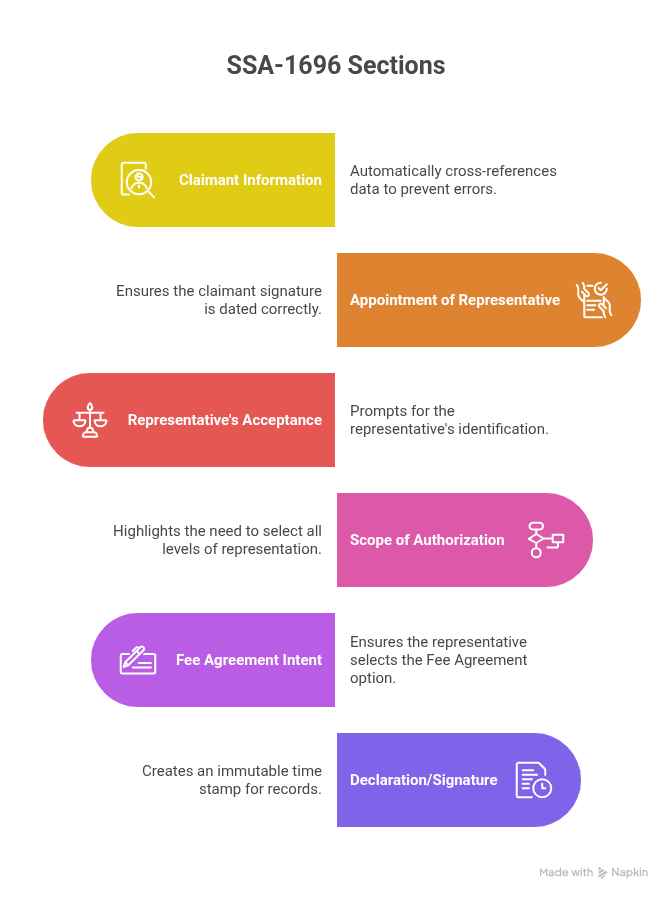
Essential Parts of an SSA-1696 Form for Legal Compliance
For a Disability Representative Appointment Form to be legally compliant and functional, it must meticulously satisfy the following SSA requirements. Legal teams must ensure their templates or drafting processes enforce these fields:
-
Claimant Identifying Information: Full name, current address, Social Security Number, and claim number (if known). This ensures the form is matched to the correct SSA file.
-
Representative Identifying Information: Full name, address, telephone, email, and the Representative ID Number (if non-attorney advocate) or State Bar Number (if attorney).
-
Statement of Appointment: A clear, unambiguous statement signed by the claimant granting the representative authority to act on their behalf.
-
Acceptance of Appointment: A section where the representative (or supervising attorney) formally accepts the appointment, confirming they have the necessary qualifications. This signature must be dated.
-
Scope of Representation: A clear indication of the level of administrative action the representative is authorized to pursue (e.g., initial claim, reconsideration, hearing).
-
Fee Agreement Intent: A mandatory checkbox indicating whether the representative intends to charge a fee and, if so, whether the fee will be based on the SSA-approved Fee Agreement (required to be submitted separately, typically on an SSA-1699, or electronically) or via the Fee Petition process.
-
Date and Signature: A valid, non-expired signature and date from both the claimant and the representative.
How to Complete a Disability Representative Appointment Form (SSA-1696)
For high-volume disability practices, the process of executing the SSA-1696 needs to be a standardized, error-free workflow.
-
Client Intake and Data Capture: During the initial client meeting, all necessary demographic and claim ID data is captured and immediately populated into the Wansom SSA-1696 template.
-
Fee Agreement Alignment: The paralegal uses the Wansom system to confirm the Fee Agreement details (25% cap, max amount) are correct for the current statutory period and that the agreement is ready to be filed simultaneously with the SSA-1696.
-
Claimant Signature and Verification: The claimant reviews, signs, and dates the SSA-1696. The law firm ensures they receive the original or a certified electronic copy.
-
Representative Acceptance: The authorized representative (attorney) signs and dates the Acceptance of Appointment section.
-
Secure Submission: The completed SSA-1696 and the Fee Agreement are filed electronically or mailed to the appropriate SSA office (Field Office, DDS, or OHO).
-
Audit Log and Tracking: The filing date, the SSA office receiving the document, and the claimant’s primary contact information are automatically logged in the Wansom audit trail for future reference, ensuring the firm has verifiable proof of authority.
The objective is to make the submission of the SSA-1696 a single-step, verified process, removing the administrative risk of forms being signed incorrectly, filed separately, or utilizing outdated SSA fee language.
Disability Representative Appointment Form Template Example
The Wansom template for the SSA-1696 is designed to guide the user through the mandatory fields, paying special attention to the often-missed Fee Agreement section.
Easier Disability Representative Forms with Wansom
The successful management of a high-volume disability practice hinges on the perfect execution of administrative tasks like the SSA-1696. Wansom is the AI-powered solution that removes the liability inherent in manual form processing.
Automate Fee Compliance and Prevent Costly Rejections
Wansom's platform understands the dynamic rules governing the SSA fee structure. When drafting the SSA-1696 and the linked Fee Agreement:
-
Version Control: Wansom ensures your firm is always using the most recent, approved version of the SSA forms, preventing rejections due to outdated documents.
-
Cap Validation: The system runs a background check to confirm the stated Fee Agreement percentage (25%) and the dollar maximum (e.g., $7,200) comply with current SSA regulations, flagging immediate errors before filing.
-
Integrated Filing Strategy: The AI workspace prompts paralegals to file the Fee Agreement concurrently with the SSA-1696, eliminating the common administrative error of filing them separately, which often leads to Fee Petition default.
Immutable Communication and Authority Tracking
Once the SSA-1696 is filed, the Wansom system transforms the document's data into actionable compliance records:
-
Centralized Authority Log: Every SSA-1696 and Fee Agreement is stored and tagged with its expiration, scope, and the specific SSA office (e.g., Baltimore, Boston OHO) that received it. This makes it instantly searchable for audits or client inquiries.
-
Substitution of Counsel Management: If a client switches firms, Wansom simplifies the complex process of filing a new SSA-1696 and provides the outgoing firm with a legally sound record of their authorized time spent, facilitating a smoother fee division process.
-
HIPAA Compliant PHI Access: The SSA-1696 is the gateway to PHI access. Wansom's platform securely manages the flow of PHI records obtained via this authority, ensuring all subsequent document handling meets the highest standards of data security (HIPAA and beyond).
Wansom empowers disability law firms to elevate their administrative compliance from a chaotic paper trail to an organized, secure, and automated audit defense mechanism. By minimizing administrative errors on the SSA-1696, firms maximize their ability to focus on substantive legal arguments and secure timely payment.
Conclusion:
The Disability Representative Appointment Form (SSA-1696) is the legal foundation of every successful disability claim. Its correct and timely filing is essential for securing the right to represent the client and, most critically, securing the law firm's rightful contingency fee via the SSA Direct Pay system.
Generic templates and manual processes introduce an unacceptable level of administrative risk—a risk that costs firms thousands of dollars in lost fees and non-billable hours spent on fee petition litigation.
Wansom provides legal teams with the definitive, AI-powered workspace to draft, validate, and manage every SSA-1696 and Fee Agreement with guaranteed compliance. Eliminate administrative error, secure your fee, and solidify your practice’s financial foundation.
Ready to automate the most critical document in your disability practice?
Start customizing and downloading Wansom's AI-powered, compliant Disability Representative Appointment Form template today.
Related to Blog: Fee Petitions vs. Fee Agreements: Which is Right for Your Firm?
Frequently Asked Questions
1. What is the difference between the SSA-1696 and the Fee Agreement (SSA-1699)?
The SSA-1696 is the formal document where the claimant names and appoints a representative, granting them authority to act. The Fee Agreement (SSA-1699, often electronic) is a separate but mandatory document that outlines how the representative will be paid (usually 25% of past-due benefits, up to the statutory cap). The SSA requires both documents to be filed together and approved to enable Direct Payment.
2. Can a non-attorney represent a claimant and use the SSA-1696?
Yes. The SSA permits both licensed attorneys and accredited non-attorney representatives to use the SSA-1696 to gain representation authority. The SSA maintains a program for non-attorney representatives that requires stringent certification and examination to ensure they meet competency standards.
3. How does the SSA-1696 expiration work?
Unlike a Medical Release Form (HIPAA Authorization), the SSA-1696 does not automatically expire once the claim is approved. The appointment of a representative generally remains effective until the SSA has made a final determination on the claim and the time for further appeal has passed, or until the claimant formally revokes the appointment in writing.
4. What happens if the SSA-1696 is rejected or missing?
If the SSA-1696 is rejected or not filed, the SSA will not recognize the representative's authority. This means they will not send correspondence to the firm, will not grant access to the claimant’s electronic file (eFolder), and will immediately reject the Fee Agreement. The representative would then have to rely on the costly and time-consuming Fee Petition process to justify and receive payment.
Leave a Reply